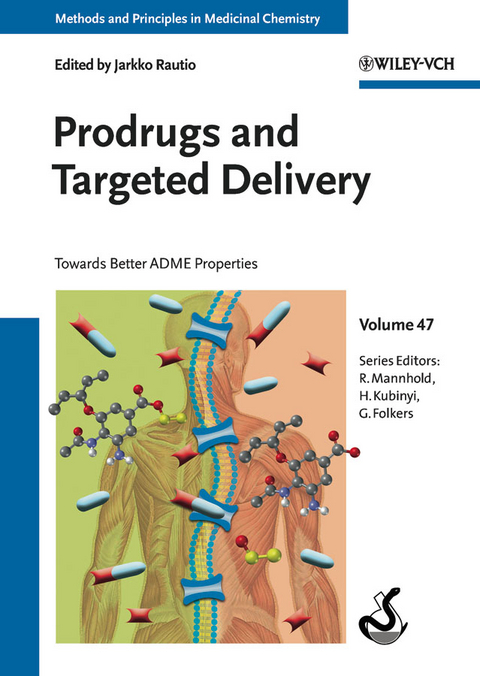
Every company employing medicinal chemists will be interested in this practice-oriented overview of a key strategy in modern drug discovery and development.
Jarkko Rautio is professor of pharmaceutical chemistry and head of the multidisciplinary Pharmaceutical and Medicinal Chemistry (PMC) research group at the School of Pharmacy, University of Eastern Finland (formerly University of Kuopio), where he received his PhD in pharmaceutical chemistry in 2000. He subsequently carried out his postdoctoral studies at the University of Maryland, Baltimore, USA, and was a visiting scientist at GlaxoSmithKline, North Carolina, while also co-founding the American Association of Pharmaceutical Scientists (AAPS) Prodrug Focus Group in 2005. Professor Rautio's research focuses on chemistry-based methods, especially prodrugs, to overcome the liabilities of drugs.
Preface
PART ONE: Prodrug Design and Intellectual Property
PRODRUG STRATEGIES IN DRUG DESIGN
Prodrug Concept
Basics of Prodrug Design
Rationale for Prodrug Design
History of Prodrug Design
Recently Marketed Prodrugs
Concluding Remarks
THE MOLECULAR DESIGN OF PRODRUGS BY FUNCTIONAL GROUP
Introduction
The Prodrug Concept and Basics of Design
Common Functional Group Approaches in Prodrug Design
Conclusions
INTELLECTUAL PROPERTY PRIMER ON PHRAMACEUTICAL PATENTS WITH A SPECIAL EMPHASIS ON PRODRUGS AND METABOLITES
Introduction
Patents and FDA Approval Process
Obtaining a Patent
Conclusion
PART TWO: Prodrugs Addressing ADMET Issues
INCREADING LIPOPHILICITY FOR ORAL DRUG DELIVERY
Introduction
pKa, Degree of Ionization, Partition Coefficient, and Distribution Coefficient
Prodrug Strategies to Enhance Lipid Solubility
Prodrug Examples for Antibiotics
Antiviral Related Prodrugs
Cardiovascular Related Prodrugs
Lipophilic Prodrugs of Benzamidine Drugs
Miscellaneous Examples
Summary and Conclusion
MODULATING SOLUBILITY THROUGH PRODRUGS FOR ORAL AND IV DRUG DELIVERY
Introduction
Basics of Solubility and Oral/IV Drug Delivery
Prodrug Applications for Enhanced Aqueous Solubility
Challenges with Solubilizing Prodrugs of Insoluble Drugs
Additional Applications of Prodrugs for Modulating Solubility
Parallel Exploration of Analogues and Prodrugs in Drug Discovery (Commentary)
Conclusions
PRODRUGS DESIGNED TO TARGET TRANSPORTERS FOR ORAL DRUG DELIVERY
Introduction
Serendipity: An Actively Transported Prodrug
Requirements for Actively Transported Prodrugs
Peptide Transporters: PEPT1 and PEPT2
Monocarboxylate Transporters
Bile Acid Transporters
Conclusions
TOPICAL AND TRANSDERMAL DELIVERY USING PRODRUGS: MECHANISM OF ENHANCEMENT
Introduction
Arrangement of Water in the Stratum Corneum
A New Model for Diffusion Through the Stratum Corneum: The Biphasic Solubility Model
Equations for Quantifying Effects of Solubility on Diffusion Through the Stratum Corneum
Design of Prodrugs for Topical and Transdermal Delivery Based on the Biphasic Solubility Model
Comparison of Human and Mouse Skin Experiments
Summary
OCULAR DELIVERY USING PRODRUGS
Introduction
Criteria for an Ideal Ophthalmic Prodrug
Anatomy and Physiology of the Eye
Barriers to Ocular Drug Delivery
Influx and Efflux Transporters on the Eye
Transporter-Targeted Prodrug Approach
Drug Disposition in Ocular Delivery
Effect of Physiochemical Factors on Drug Disposition in Eye
Prodrug Strategy to Improve Ocular Bioavailability (Nontransporter-Targeted Approach)
Recent Patents and Marketed Ocular Prodrugs
Novel Formulation Approaches for Sustained Delivery of Prodrugs
Conclusion
REDUCING PRESYSTEMIC DRUG METABOLISM
Introduction
Presystemic Metabolic Barriers
Prodrug Approaches to Reduce Presystemic Drug Metabolism
Targeting Colon
Targeting Lymphatic Route
Conclusion
ENZYME-ACTIVATED PRODRUG STRATEGIES FOR SITE-SELECTIVE DRUG DELIVERY
Introduction
General Requirements for Enzyme-Activated Targeted Prodrug Strategy
Examples of Targeted Prodrug Strategies
Summary
PRODRUG APPROACHES FOR CENTRAL NERVOUS SYSTEM DELIVERY
Blood-Brain Barrier in CNS Drug Development
Prodrug Strategies
Prodrug Strategies Based Upon BBB Nutrient Transporters
Prodrug Strategies Based Upon BBB Receptors
CNS Prodrug Summary
DIRECTED ENZYME PRODRUG THERAPIES
Introduction
Theoretical Background of DEPT
Comparison of ADEPT and GDEPT
Enzymes in ADEPT and GDEPT
Design of Prodrugs
Strategies Used for the Improvement of DEPT Systems
Biological Data for ADEPT and GDEPT
Conclusions
PART THREE: Codrugs and Soft Drugs
IMPROVING THE USE OF DRUG COMBINATIONS THROUGH THE CODRUG APPROACH
Codrugs and Codrug Strategy
Ideal Codrug Characteristics
Examples of Marketed Codrugs
Topical Codrug Therapy for the Treatment of Ophthalmic Diseases
Codrugs for Transdermal Delivery
Codrugs of L-DOPA for the Treatment of Parkinson's Disease
Analgesic Codrugs Containing Nonsteroidal Anti-Inflammatory Agents
Analgesic Codrugs of Opioids and Cannabinoi
| Erscheint lt. Verlag | 11.1.2011 |
|---|---|
| Reihe/Serie | Methods & Principles in Medicinal Chemistry |
| Methods and Principles in Medicinal Chemistry | Methods and Principles in Medicinal Chemistry |
| Mitarbeit |
Herausgeber (Serie): Raimund Mannhold, Hugo Kubinyi, Gerd Folkers |
| Sprache | englisch |
| Themenwelt | Medizin / Pharmazie |
| Naturwissenschaften ► Chemie | |
| Schlagworte | action • approach prevalent • Arzneimittelentwicklung • Arzneimittelforschung • become • beneficial • Chemie • Chemistry • clever strategy • Current • Drug • drug design • Drug Discovery & Development • Drug Formulation & Delivery • Drugs • harm otherwise • highly • Integrated • Patentability • Place • Prodrugs • Reference • right • Site • substances • Time • todays • Topical • Toxicology • Toxikologie • Wirkstoff • Wirkstoffformulierung, Wirkstofftransport • Wirkstoffforschung u. -entwicklung |
| ISBN-10 | 3-527-63318-9 / 3527633189 |
| ISBN-13 | 978-3-527-63318-0 / 9783527633180 |
| Informationen gemäß Produktsicherheitsverordnung (GPSR) | |
| Haben Sie eine Frage zum Produkt? |
 EPUB (Adobe DRM)
Kopierschutz: Adobe-DRM
Adobe-DRM ist ein Kopierschutz, der das eBook vor Mißbrauch schützen soll. Dabei wird das eBook bereits beim Download auf Ihre persönliche Adobe-ID autorisiert. Lesen können Sie das eBook dann nur auf den Geräten, welche ebenfalls auf Ihre Adobe-ID registriert sind.
Details zum Adobe-DRM
Dateiformat: EPUB (Electronic Publication)
EPUB ist ein offener Standard für eBooks und eignet sich besonders zur Darstellung von Belletristik und Sachbüchern. Der Fließtext wird dynamisch an die Display- und Schriftgröße angepasst. Auch für mobile Lesegeräte ist EPUB daher gut geeignet.
Systemvoraussetzungen:
PC/Mac: Mit einem PC oder Mac können Sie dieses eBook lesen. Sie benötigen eine
eReader: Dieses eBook kann mit (fast) allen eBook-Readern gelesen werden. Mit dem amazon-Kindle ist es aber nicht kompatibel.
Smartphone/Tablet: Egal ob Apple oder Android, dieses eBook können Sie lesen. Sie benötigen eine
Geräteliste und zusätzliche Hinweise
Buying eBooks from abroad
For tax law reasons we can sell eBooks just within Germany and Switzerland. Regrettably we cannot fulfill eBook-orders from other countries.
aus dem Bereich