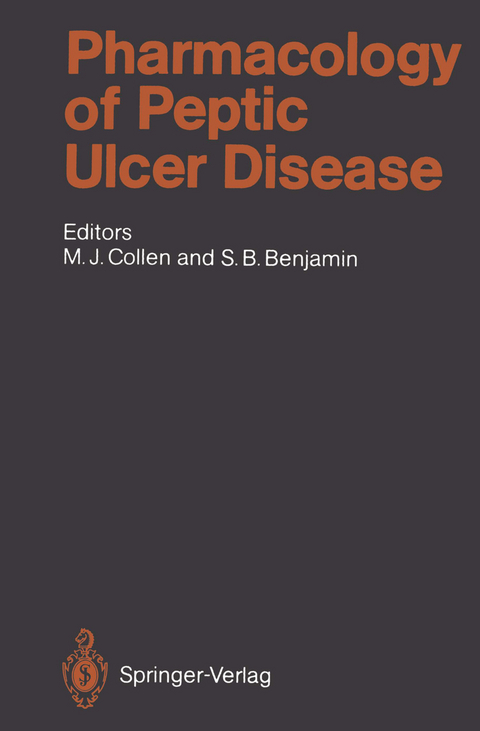
Pharmacology of Peptic Ulcer Disease
Springer Berlin (Verlag)
978-3-642-75860-7 (ISBN)
1 Pharmacology of the Parietal Cell.- A. Introduction.- B. Anatomy of Gastric Mucosa.- C. Secretion by the Stomach.- I. General.- II. Secretion and Absorption by Surface Epithelial Cells.- D. Gastric Barrier.- E. Agents Thought to Affect Gastric Barrier function.- I. Sucralfate.- II. Prostaglandins.- III. Bismuth Compounds.- F. Ion Transport by the Parietal Cell.- I. Apical Surface.- II. Basal Lateral Surface.- III. Stimulation of Acid Secretion.- IV. Mechanism of Parietal Cell Stimulation.- G. Receptor Antagonists.- I. Muscarinic Antagonists.- II. H2 Antagonists.- H. Mechanism of Gastric Proton Pump.- I. Transport by ATPase.- II. Reaction Cycle.- III. Structure of Gastric H+, K+-ATPase.- J. Inhibitors of H+, K+-ATPase.- I. Omeprazole.- 1. Effects on Acid Secretion.- 2. Duration of Action.- 3. Mechanism of Action.- II Reversible H+, K+-ATPase Inhibitors.- III. Clinical Use of Pump Inhibitors.- References.- 2 Epidermal Growth Factor.- A. Introduction.- B. Perspective on Growth Factors.- C. Perspective on Mucosal Disease.- D. EGF Structure.- E. Structure-Activity Relationships.- F. Biological Effects.- G. Gastrointestinal Activity.- I. Developmental Effects of EGF.- II. Gastric Acid Secretion.- III. Trophic Effects.- H. Conclusion.- References.- 3 Gastrin and Other Peptide Hormones.- A. Introduction.- B. The Molecular Heterogeneity of Gastrin.- C. Gastrin Release.- D. Autonomic Control of Gastrin Release.- E. Bombesin-Like Peptides.- F. Somatostatin.- G. Mechanism of Gastrin-Induced Gastric Acid Secretion.- H. Gastrin and Peptic Ulcer Disease.- J. Hypergastrinemic Syndromes.- K. Conclusion.- References.- 4 The Role of Essential Fatty Acids in Gastric and Duodenal Protection and Ulcer Therapy.- A. Cytoprotection and Prostaglandins.- I. Definition of Cytoprotection.- II. Mucosal Sites of Cytoprotection.- 1. Protection of the Mucosal Microvasculature.- 2. Direct Protection of Gastric Mucosal Cells.- III. Metabolism of Natural and Synthetic Prostaglandins.- B. Arachidonic Acid Cascade and Prostaglandin Synthesis by Gastric and Duodenal Mucosa.- I. Arachidonic Acid Cascade.- II. Sources of Arachidonic Acid from Mucosal Pools.- III. Control of Mucosal Prostaglandin Synthesis.- C. Dietary Sources of Arachidonic and Linoleic Acids.- I. Food Sources.- II. Absorption of Dietary Essential Fatty Acids.- III. Distribution of Absorbed Essential Fatty Acids Between Organs.- IV. The Requirement for Detergents for the Intestinal or Gastric Absorption of Essential Fatty Acids.- D. Gastric Mucosal Synthesis of Endogenous Prostanoids from Dietary Essential Fatty Acids.- I. The Requirement for Detergents for Absorption of Dietary Essential Fatty Acids into the Gastric Mucosa.- II. The Requirement for Direct Gastric Mucosal Contact with Solubilized Essential Fatty Acids for Mucosal Protection.- III. Generation of Prostanoids by the Gastric Mucosa from Solubilized Essential Fatty Acids.- E. Gastric Mucosal Protection by Solubilized Essential Fatty Acids.- I. Angiogenic Effect of Essential Fatty Acids.- F. Dietary Intake of Essential Fatty Acids.- I. Animal Studies.- II. Human Intake of Dietary Essential Fatty Acids and Its Relationship to Peptic Ulcer Disease.- G. Potential Therapeutic Advantages of Dietary Essential Fatty Acids Over the Synthetic Prostaglandins.- I. Effect of Short-Term Treatment with Dietary Essential Fatty Acids on the Human Gastric Mucosa.- H. Summary and Conclusion.- References.- 5 Helicobacter pylori.- A. Introduction.- B. Clinical Relevance of Helicobacter pylori.- I. Frequency in the General Population and Association with Chronic Gastritis and Peptic Ulcer Disease.- II. Causation.- 1. Chronic Gastritis.- 2. Peptic Ulcer Disease.- C. Attempts to Eradicate Helicobacter pylori.- I. Natural History.- II. Eradication of Helicobacter pylori Infections.- III. Methods to Confirm Eradication of Helicobacter pylori Infections.- IV. Bismuth Salts.- V. Antimicrobials as Monotherapy.- VI. Drug Combinations.- 1. Triple Drug Combinations.-
| Erscheint lt. Verlag | 13.12.2011 |
|---|---|
| Reihe/Serie | Handbook of Experimental Pharmacology |
| Co-Autor | S.B. Benjamin, G.M.A. Börsch, S.H. Caldwell, E.L. Cattau, M.J. Collen, J. Doppman, D.E. Fleischer, J.D. Gardener, D.Y. Graham, A. Guglietta, D. Hollander, C.W. Howden, R.H. Hunt, R.T. Jensen, D.A. Johnson, J.H. Lewis, P.N. Maton, R.W. McCallum, L.S. Miller, R.V. Nardi, I. Parikh, J.W. Rademaker, A.M. Rosen, G. Sachs, A. Tarnawski, J. Van Dam, B. Wallmark, M.M. Wolfe, P.N. Yakshe |
| Zusatzinfo | XXII, 464 p. |
| Verlagsort | Berlin |
| Sprache | englisch |
| Maße | 155 x 235 mm |
| Gewicht | 737 g |
| Themenwelt | Medizin / Pharmazie ► Medizinische Fachgebiete ► Pharmakologie / Pharmakotherapie |
| Medizin / Pharmazie ► Pharmazie | |
| Schlagworte | Growth factor • pathophysiology • pharmacology • Physiology |
| ISBN-10 | 3-642-75860-6 / 3642758606 |
| ISBN-13 | 978-3-642-75860-7 / 9783642758607 |
| Zustand | Neuware |
| Informationen gemäß Produktsicherheitsverordnung (GPSR) | |
| Haben Sie eine Frage zum Produkt? |
aus dem Bereich