


Statistics Applied to Clinical Trials (eBook)
366 Seiten
Springer Netherland (Verlag)
978-1-4020-4650-6 (ISBN)
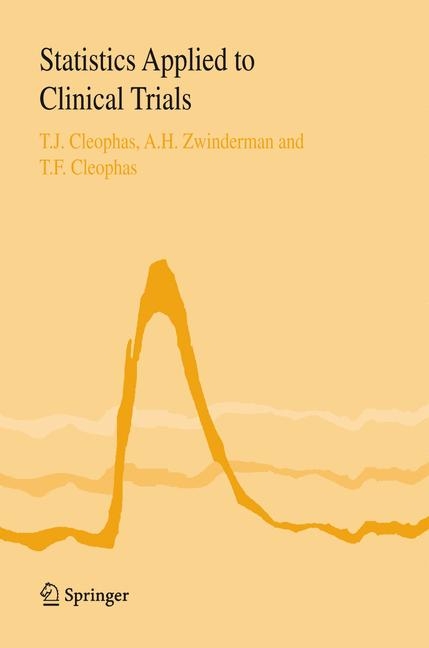
In 1948 the first randomized controlled trial was published by the English Medical Research Council in the British Medical Journal. Until then, observations had been uncontrolled. The intervening decades have seen significant improvement in the accuracy of trials. Today, clinical trial protocols are now routinely scrutinized by ethics committees, institutional and federal review boards, national and international scientific organizations, and monitoring committees charged with conducting interim analyses. The updated Third Edition of Statistics Applied to Clinical Trials explains classical statistical analyses of clinical trials, but equivalence testing, interim analyses, sequential analyses, meta-analyses, and provides a framework of the best statistical methods currently available for such purposes.
In 1948 the first randomized controlled trial was published by the English Medical Research Council in the British Medical Journal. Until then, observations had been uncontrolled. The intervening decades have seen significant improvement in the accuracy of trials. Today, clinical trial protocols are now routinely scrutinized by ethics committees, institutional and federal review boards, national and international scientific organizations, and monitoring committees charged with conducting interim analyses. The updated Third Edition of Statistics Applied to Clinical Trials explains classical statistical analyses of clinical trials, but equivalence testing, interim analyses, sequential analyses, meta-analyses, and provides a framework of the best statistical methods currently available for such purposes.
ForewordChapter 1: Hypotheses, Data, StratificationChapter 2: The Analysis of Efficacy DataChapter 3: The Analysis of Safety DataChapter 4: Log Likelihood Ratio Tests for Safety Data AnalysisChapter 5: Equivalence TestingChapter 6: Statistical Power and Sample SizeChapter 7: Interim AnalysesChapter 8: Clinical Trials Are Often False PositiveChapter 9: Multiple Statistical InferencesChapter 10: The Interpretation of the P-ValuesChapter 11: Research Data Closer to Expectation than Compatible with Random SamplingChapter 12: Statistical Tables for Testing Data Closer to Expectation than Compatible with Random SamplingChapter 13: Principles of Linear RegressionChapter 14: Subgroup Analysis Using Multiple Linear Regression: Confounding, Interaction, SynergismChapter 15: Curvilinear RegressionChapter 16: Logistic and Cox Regression, Markow Models, Regression with Laplace TransformationsChapter 17: Regression Modeling For Improved PrecisionChapter 18: Post-Hoc Analysis in Clinical Trials, A Case For Logistic Regression AnalysisChapter 19: ConfoundingChapter 20: InteractionChapter 21: Meta-Analysis, Basic ApproachChapter 22: Meta-Analysis, Review and Update of MethodologiesChapter 23: Crossover Studies with Continuous VariablesChapter 24: Crossover Studies with Binary ResponsesChapter 25: Cross-Over Trials Should Not Be Used To Test Treatments with Different Chemical ClassChapter 26: Quality-Of-Life Assessments in Clinical TrialsChapter 27: Statistics for the Analysis of Genetic DataChapter 28: Relationship among Statistical DistributionsChapter 29: Testing Clinical Trials for RandomnessChapter 30: Clinical Trials Do Not Use Random Samples AnymoreChapter 31: Clinical Data Where Variability Is More Important than AveragesChapter 32: Testing ReproducibilityChapter 33: Validating Qualitative Diagnostic TestsChapter 34: Uncertainty of Qualitative Diagnostic TestsChapter 35: Meta-Analyses of Qualitative Diagnostic TestsChapter 36: Validating Quantitative Diagnostic TestsChapter 37: Summary of Validation Procedures for Diagnostic TestsChapter 38: Validating Surrogate Endpoints of Clinical TrialsChapter 39: Methods for Repeated Measures AnalysisChapter 40: Advanced Analysis Of Variance, Random Effects and Mixed Effects ModelsChapter 41: Monte Carlo Methods for Data AnalysisChapter 42: Physicians’ Daily Life and the Scientific MethodChapter 43: Superiority-TestingChapter 44: Trend-TestingChapter 45: Odds Ratios and Multiple Regression, Why and How to Use ThemChapter 46: Statistics Is No "Bloodless" AlgebraChapter 47: Bias Due to Conflicts of Interests, Some GuidelinesAppendixIndex
| Erscheint lt. Verlag | 30.4.2016 |
|---|---|
| Zusatzinfo | XV, 366 p. |
| Verlagsort | Dordrecht |
| Sprache | englisch |
| Themenwelt | Mathematik / Informatik ► Mathematik ► Statistik |
| Mathematik / Informatik ► Mathematik ► Wahrscheinlichkeit / Kombinatorik | |
| Medizin / Pharmazie ► Allgemeines / Lexika | |
| Medizin / Pharmazie ► Medizinische Fachgebiete ► Pharmakologie / Pharmakotherapie | |
| Studium ► Querschnittsbereiche ► Epidemiologie / Med. Biometrie | |
| Technik | |
| Schlagworte | Analysis of Variance • clinical research • clinical trial • Clinical Trials • Data Analysis • evidence - based medicine • likelihood • linear regression • Logistic Regression • Pharmaceutical medicine • Regression Analysis • Research • Statistics |
| ISBN-10 | 1-4020-4650-2 / 1402046502 |
| ISBN-13 | 978-1-4020-4650-6 / 9781402046506 |
| Informationen gemäß Produktsicherheitsverordnung (GPSR) | |
| Haben Sie eine Frage zum Produkt? |
 PDF (Wasserzeichen)
Größe: 4,4 MB
DRM: Digitales Wasserzeichen
Dieses eBook enthält ein digitales Wasserzeichen und ist damit für Sie personalisiert. Bei einer missbräuchlichen Weitergabe des eBooks an Dritte ist eine Rückverfolgung an die Quelle möglich.
Dateiformat: PDF (Portable Document Format)
Mit einem festen Seitenlayout eignet sich die PDF besonders für Fachbücher mit Spalten, Tabellen und Abbildungen. Eine PDF kann auf fast allen Geräten angezeigt werden, ist aber für kleine Displays (Smartphone, eReader) nur eingeschränkt geeignet.
Systemvoraussetzungen:
PC/Mac: Mit einem PC oder Mac können Sie dieses eBook lesen. Sie benötigen dafür einen PDF-Viewer - z.B. den Adobe Reader oder Adobe Digital Editions.
eReader: Dieses eBook kann mit (fast) allen eBook-Readern gelesen werden. Mit dem amazon-Kindle ist es aber nicht kompatibel.
Smartphone/Tablet: Egal ob Apple oder Android, dieses eBook können Sie lesen. Sie benötigen dafür einen PDF-Viewer - z.B. die kostenlose Adobe Digital Editions-App.
Buying eBooks from abroad
For tax law reasons we can sell eBooks just within Germany and Switzerland. Regrettably we cannot fulfill eBook-orders from other countries.


