


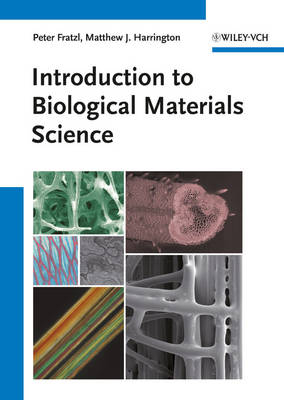
Introduction to Biological Materials Science
Wiley-VCH Verlag GmbH
978-3-527-32940-3 (ISBN)
Peter Fratzl is Director at the Max Planck Institute of Colloids and Interfaces in Potsdam, Germany. He received an engineering degree from the Ecole Polytechnique in Paris, France, and a PhD in Physics from the University of Vienna, Austria. Before moving to Potsdam in 2003, he held professor positions at Universities in Vienna and Leoben in Austria. Peter Fratzl has received several scientific awards, including the Max Planck Research Award 2008 and the Leibniz Prize of the German Science Foundation in 2010. Matthew Harrington is an independent researcher in the Department of Biomaterials at the Max Planck Institute of Colloids and Interfaces in Potsdam, Germany, and recipient of a Humboldt Fellowship for postdoctoral researchers. He received his PhD from the University of California, Santa Barbara, USA, for a work on molecular-level structure-property relationships in the byssal threads of marine mussels.
WHAT IS BIOLOGICAL MATERIALS SCIENCE?
Introduction to the Field
Hierarchy: Understanding Adaptations at Different Length Scales, Bottom-Up Engineering and the Building Blocks
Multifunctionality as an Evolutionary Design Paradigm
ELEMENTARY PHYSICAL INTERACTIONS
Strong and Weak Interactions
Hydrogen Bonding
Hydrophobic/Hydrophilic Forces
Charge-Charge Interactions
Covalent Bonding/Coordination Complexes
MOLECULAR AND PRIMARY STRUCTURES: BUILDING BLOCKS
Synthesis and Processing of Proteins and Sugars, Chitin and Cellulose
Protein Side Groups and their Properties
SECONDARY => QUARTERNARY STRUCTURE
Protein Secondary Structure and Folding: alpha, beta, PPII, coiled coil
Ramachandran Plots
SELF-ASSEMBLY OF BIOLOGICAL MATERIALS
Liquid Crystal
Coacervate
Actin, Collagen Fibrils, Virus, Polymerization Models, Microtubules
MATERIALS PROPERTIES AND BEHAVIOR
Mechanics
Optics
Adhesion
Multifunctionality
TUNING MATERIALS PROPERTIES/
POST-TRANSLATIONAL MODIFICATIONS AND PROCESSING
Crosslinking
Hidden Lengths
Interface Design
Porosity
Nanocomposite Design
Mineralization
BIOMIMETICS
CASE STUDIES
Why Does None not Break more Often?
Why is Cornea Transparent?
How Does a Plant Move?
How Do Mussels Stay Attached to Surfaces on the Wave-Swept Rocky Seashore?
How Does Nature Create Polymers as Hard as Mineral?
How Do Structural Colors Originate?
What Limits Muscle Performance?
How Does a Spider Web Stop an Insect Midflight?
Gecko and Lotus Effect
| Erscheint lt. Verlag | 6.3.2018 |
|---|---|
| Verlagsort | Weinheim |
| Sprache | englisch |
| Maße | 1700 x 2400 mm |
| Themenwelt | Medizin / Pharmazie ► Medizinische Fachgebiete |
| Technik ► Umwelttechnik / Biotechnologie | |
| ISBN-10 | 3-527-32940-4 / 3527329404 |
| ISBN-13 | 978-3-527-32940-3 / 9783527329403 |
| Zustand | Neuware |
| Informationen gemäß Produktsicherheitsverordnung (GPSR) | |
| Haben Sie eine Frage zum Produkt? |
aus dem Bereich


