Zum Hauptinhalt springen
Nicht aus der Schweiz? Besuchen Sie lehmanns.de
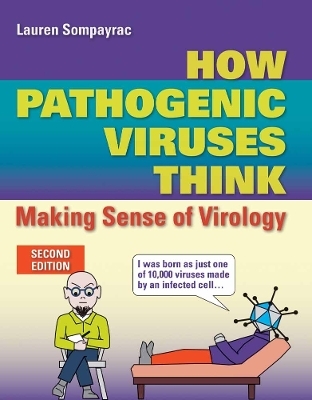
How Pathogenic Viruses Think: Making Sense of Virology - Lauren Sompayrac

How Pathogenic Viruses Think: Making Sense of Virology

Making Sense of Virology
Buch | Softcover
170 Seiten
2012 | Second Edition
Jones and Bartlett Publishers, Inc (Verlag)
978-1-4496-4579-3 (ISBN)
CHF 97,75 inkl. MwSt
  • Titel ist leider vergriffen;
    keine Neuauflage
  • Artikel merken
Over the past decade, the amount of data on viruses has grown dramatically. How can a virology student possibly make sense of all this information? In How Pathogenic Viruses Think, Second Edition, Dr. Sompayrac introduces an "organizing principle" – a paradigm to use to cut through all the details and focus on what's important. He demonstrates the use of this paradigm by "interviewing" twelve medically important viruses. During these interviews, each virus is encouraged to disclose not only what it does, but why it does it. And when a "talking virus" reveals its secrets, they are hard to forget!How Pathogenic Viruses Think covers the essential elements of virus-host interactions with descriptive graphics, helpful mnemonic tactics for retaining the information, and brief reviews of important concepts. It is an ideal book to help medical, science, and nursing students make sense of this complex subject. Example:Interviewer: I always ask the viruses I interview, "How do you attack your hosts, and why have you chosen that route?"Flu Virus: I favor the respiratory route.Interviewer: Okay, but why? For example, why not enter via the digestive tract?Flu Virus: Are you kidding me? Do I look like a dumb virus to you? My Uncle Harold tried the digestive tract once, and got as far as the stomach before the acid in there ate him alive! Not me. I take the easy way in. The respiratory route of infection provides direct access to my favorite target cells – the epithelial cells which line the human airway.

PDr. Lauren Sompayrac was born in Jacksonville, Florida, on September 4, 1941. He attended the Massachusetts Institute of Technology and received a B.S. degree in physics in 1963, and a Ph.D. degree in elementary particle physics in 1969. After two years of postdoctoral research in particle physics, he moved to Copenhagen where he was a Postdoctoral Fellow for two years at the Microbiology Institute. Returning to the United States in 1973, he was a Postdoctoral Fellow in the Department of Pathology at the Harvard Medical School where he studied tumor viruses. In 1976, he moved to the Department of Molecular, Cellular, and Developmental Biology at the University of Colorado to continue his work on tumor viruses, eventually rising to the rank of Research Professor before his retirement in 1998. In retirement, he writes science books, and is the author of How the Immune System Works, published by Blackwell Science in 1999, and How Pathogenic Viruses Work, published by Jones and Bartlett in 2001.

Verlagsort Sudbury
Sprache englisch
Gewicht 425 g
Themenwelt Medizin / Pharmazie Medizinische Fachgebiete Mikrobiologie / Infektologie / Reisemedizin
Studium 2. Studienabschnitt (Klinik) Pathologie
Studium Querschnittsbereiche Infektiologie / Immunologie
ISBN-10 1-4496-4579-8 / 1449645798
ISBN-13 978-1-4496-4579-3 / 9781449645793
Zustand Neuware
Informationen gemäß Produktsicherheitsverordnung (GPSR)
Haben Sie eine Frage zum Produkt?
Mehr entdecken
aus dem Bereich

von Thomas Kirchner; Hans Konrad Müller-Hermelink …

Buch | Softcover (2023)
Urban & Fischer in Elsevier (Verlag)
CHF 58,75

von Gerald Höfler; Hans Kreipe; Holger Moch

Buch | Hardcover (2024)
Urban & Fischer in Elsevier (Verlag)
CHF 145,55
Klinisch-pathologische Übersichtskarten

von Thomas Cerny; Kirill Karlin

Buch | Hardcover (2023)
Springer (Verlag)
CHF 48,95