


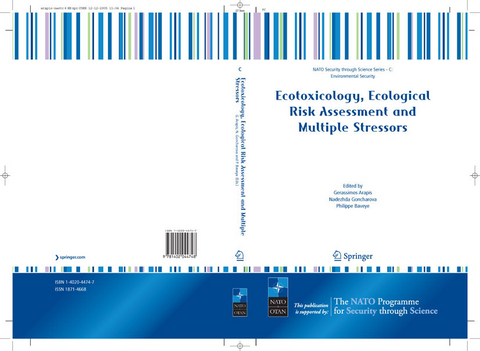
Ecotoxicology, Ecological Risk Assessment and Multiple Stressors (eBook)
XVI, 398 Seiten
Springer Netherlands (Verlag)
978-1-4020-4476-2 (ISBN)
The science of ecotoxicology and the practice of ecological risk assessment are evolving rapidly. Ecotoxicology as a subject area came into prominence in the 1960s after the publication of Rachel Carson's book on the impact of pesticides on the environment. The rise of public and scientific concern for the effects of chemical pollutants on the environment in the 1960s and 1970s led to the development of the discipline of ecotoxicology, a science that takes into account the effects of chemicals in the context of ecology. Until the early 1980s, in spite of public concern and interest among scientists, the assessment of ecological risks associated with natural or synthetic pollutants was not considered a priority issue by most government. However, as the years passed, a better understanding of the importance of ecotoxicology emerged and with it, in some countries, the progressive formalization of an ecological risk assessment process. Ecological risk assessment is a conceptual tool for organizing and analyzing data and information to evaluate the likelihood that one or more stressors are causing or will cause adverse ecological effects. Ecological risk assessment allows risk managers to consider available scientific information when selecting a course of action, in addition to other factors that may affect their decision (e. g. , social, legal, political, or economic). Ecological risk assessment includes three phases (problem formulation, analysis, and risk characterization).
Preface. Contributors. Part I. The Science of Ecotoxicology: Establishing the International Basis for Ecological Risk Assessment. Current Developments in Ecotoxicology and Ecological Risk Assessment; L A.Kapustka.-From Molecules to Ecosystems: Ecotoxicological Approaches and Perspectives; G.D.Arapis.- Protecting the Environment against Ionizing Radiation: The Path Proposed; by 'ICRP', its Origins and Analysis; F. Brechignac.-Eco-epidemiology: a Means to Safeguard Ecosystem Services that Sustain Human Welfare; S.M.Cormier.- Perchlorate: Ecological and Human Health Effects; J. Clarkson et al.- Genetic Ecotoxicology and Risk Assessment: an Overview; N. V. Goncharova.- Part II Ecological Risk Assessment and Multiple Stressors. Scientific Basis for Ecotoxicology, Ecological Risk Assessment and Multiple Stressors: Canadian Experience in Defining Acceptable Risk Levels for Infrastructure; R. N.Hull.-Risk Assessment in Romania: Between Needs and Possibilities of Remediation; C.-H. Barbu et al.-Ecotoxicological Risk Assessment for Plant Protection Products in Europe; M. Foudoulakis.- Assessment of Ecological Risk Caused by the Long-Living Radionuclides in the Environment; V.Kashparov.-Effects of Contaminant Exposure on Plants: Implications for Ecotoxicology and Radiological Protection of the Environment; S.A. Geras’kin et al.-Risk Assessment: Radioactive Contaminated Food Products and Exposure Dose of the Population; N.V. Goncharova and D.A.Bairasheuskaya.-Part III.Methods and Tools in Ecotoxicology and Ecological Risk Assessment.A Habitat Suitability Evaluation Technique and its Application to Environmental Risk Assessment;.A.Grebenkov et al.- The QnD Model/Game System: Integrating Questions and Decisions for Multiple Stressors; G. Kiker and I.Linkov.-The Medaka Fish: an Experimental Model in Environmental Toxicology. Its Use for the Survey of Microalgal Toxins: Phycotoxins and Cyanotoxins; S.Puiseux-Dao and M. Edery.-Cytogenetic Effect of Radioactive or ChemicalContamination on Spring Barley Intercalary Meristems Cells; S. Geras’kin et al.-Water Pollution Indicators of Sustainability in Europe and their Application to Coastal Water Quality Evaluation in Italy; E.Comino.-Application of GIS Technologies in Ecotoxicology: a Radioecological Case Study; N.Grytsyuk et al.- Ambient Ozone Phytodetection with Sensitive Clover (Trifolium Subterraneum L. Cv. Geraldton) in Ukraine;O. Blum and N. Didyk.-Part IV. Ecotoxicology and Toxicity Monitoring. Alterations of Agroecosystems in Greece Through Pesticide Use. The «Phalaris Case»; G. Vassiliou et al.-Contribution to Ecological Safety Through Segmented Integrated Pest Management in Greece; G. Vassiliou.-A Preliminary Study of Toxicity by Bioassay of the Wastes of Pulp and Paper Production Units; N.Venetsaneas and J. Iliopoulou-Georgudaki.-Air Pollution Assessment in Volos Coastal Town, Greece; N. Riga-Karandino et al.-Tropospheric Ozone Measurements in the Thetra Mountains and Its Effects on Plants; B. Godzik and P. Fleischer.- Long-Term Monitoring of Tropospheric Ozone in Kiev, Ukraine: Formation, Temporal Patterns and Potential Adverse Effects; Oleg Blum.- Part V Working Group Summaries Hints on Ecotoxicology and Ethics; M.G.Karandinos.-A Framework for Multi-Criteria Decision-Making With Special Reference to Critical Infrastructure: Policy and Risk Management Working Group Summary and Recommendations R. Hull et al.- Methods and Tools in Ecotoxicology and Ecological Risk Assessment.Working group Summary; L. A. Kapustka et al.-Subject Index
| Erscheint lt. Verlag | 22.5.2006 |
|---|---|
| Sprache | englisch |
| Themenwelt | Medizin / Pharmazie ► Medizinische Fachgebiete ► Arbeits- / Sozial- / Umweltmedizin |
| Naturwissenschaften ► Biologie ► Biochemie | |
| Naturwissenschaften ► Biologie ► Ökologie / Naturschutz | |
| Naturwissenschaften ► Geowissenschaften ► Geografie / Kartografie | |
| Naturwissenschaften ► Physik / Astronomie ► Angewandte Physik | |
| Technik ► Umwelttechnik / Biotechnologie | |
| Schlagworte | agroecosystems • atmospheric pollution • Contamination • ecosystem • Ecosystems • ecotoxicology • Environment • environmental • Environmental risk assessment • human health effects • NATO • Pesticide • Pest management • Pollutants • remediation • Science • security • Sub-Series C • Toxicology • water quality |
| ISBN-10 | 1-4020-4476-3 / 1402044763 |
| ISBN-13 | 978-1-4020-4476-2 / 9781402044762 |
| Informationen gemäß Produktsicherheitsverordnung (GPSR) | |
| Haben Sie eine Frage zum Produkt? |
 PDF (Wasserzeichen)
Größe: 22,2 MB
DRM: Digitales Wasserzeichen
Dieses eBook enthält ein digitales Wasserzeichen und ist damit für Sie personalisiert. Bei einer missbräuchlichen Weitergabe des eBooks an Dritte ist eine Rückverfolgung an die Quelle möglich.
Dateiformat: PDF (Portable Document Format)
Mit einem festen Seitenlayout eignet sich die PDF besonders für Fachbücher mit Spalten, Tabellen und Abbildungen. Eine PDF kann auf fast allen Geräten angezeigt werden, ist aber für kleine Displays (Smartphone, eReader) nur eingeschränkt geeignet.
Systemvoraussetzungen:
PC/Mac: Mit einem PC oder Mac können Sie dieses eBook lesen. Sie benötigen dafür einen PDF-Viewer - z.B. den Adobe Reader oder Adobe Digital Editions.
eReader: Dieses eBook kann mit (fast) allen eBook-Readern gelesen werden. Mit dem amazon-Kindle ist es aber nicht kompatibel.
Smartphone/Tablet: Egal ob Apple oder Android, dieses eBook können Sie lesen. Sie benötigen dafür einen PDF-Viewer - z.B. die kostenlose Adobe Digital Editions-App.
Zusätzliches Feature: Online Lesen
Dieses eBook können Sie zusätzlich zum Download auch online im Webbrowser lesen.
Buying eBooks from abroad
For tax law reasons we can sell eBooks just within Germany and Switzerland. Regrettably we cannot fulfill eBook-orders from other countries.


