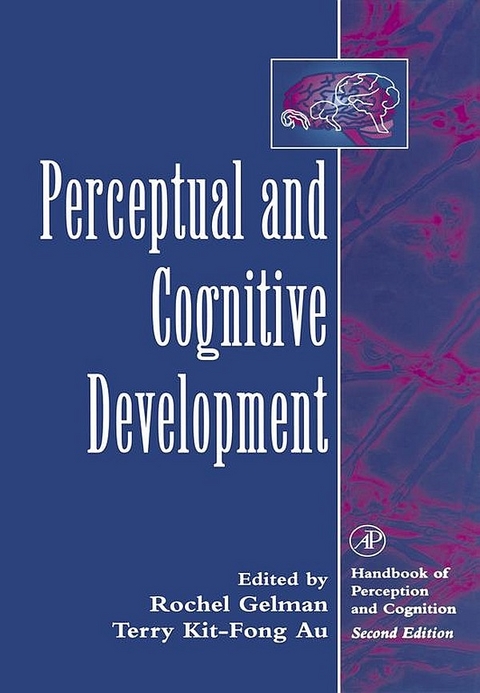
Perceptual and Cognitive Development (eBook)
454 Seiten
Elsevier Science (Verlag)
9780080538624 (ISBN)
Key Features
* Research advances and theoretical reorientations are updated in the Second Edition; the revision focuses more attention on the cognitive and biological sciences and neuroscience
* Illustrates how the developmental approach can yield fundamental contributions to our understanding of perception and cognition as a whole
* Discussions of learning, memory, and attention permeate individual chapters
Perceptual and Cognitive Development illustrates how the developmental approach yields fundamental contributions to our understanding of perception and cognition as a whole. The book discusses how to relate developmental, comparative, and neurological considerations to early learning and development, and it presents fundamental problems in cognition and language, such as the acquisition of a coherent, organized, and shared understanding of concepts and language. Discussions of learning, memory, attention, and problem solving are embedded within specific accounts of the neurological status of developing minds and the nature of knowledge. - Research advances and theoretical reorientations are updated in the Second Edition; the revision focuses more attention on the cognitive and biological sciences and neuroscience- Illustrates how the developmental approach can yield fundamental contributions to our understanding of perception and cognition as a whole- Discussions of learning, memory, and attention permeate individual chapters
Front Cover 1
Perceptual and Cognitive Development 4
Copyright Page 5
Contents 6
Foreword 16
Preface 18
Part 1: Perception and Cognition 20
Chapter 1. The Origins of Object Perception 22
I. Introduction 22
II. Edge Detection 29
III. Edge Classification 31
IV. Boundary Assignment 33
V. Unit Formation 34
VI. Three-Dimensional Form Perception 45
VII. Perception of Size 54
VIII. Tangibility and Substance 55
IX. Conclusions 56
References 62
Chapter 2. Perceptual Classification and Expertise 68
I. Introduction 68
II. Face Recognition 69
III. What Do We Know about the Acquisition of Expertise at Perceptual Classification, Independent of Considerations of Age? 74
IV. The Effect of Orientation on Configural Encoding 77
V. Are Faces Processed Less as Configurations by Children 79
VI. Expertise: The Mystery Factor 82
VII. A Few Concluding Remarks 86
References 87
Chapter 3. Early Cognitive Development: Objects and Space 90
I. Two Views of Cognitive Development 91
II. Developing Knowledge of Objects 92
III. Developing Knowledge of Space 109
IV. Themes and Prospects 125
References 127
Part 2: Cognition and Language 134
Chapter 4. Concepts and Theories 136
I. Introduction 136
II. Concepts 137
II. Theories 144
IV. Concepts and Theories 154
V. Conclusions 159
References 161
Chapter 5. Controversies in Language Acquisition: Word Learning and the Part of Speech 170
I. Introduction 170
II. Evidence Concerning the Role of Syntax in Word Learning 172
III. The Origin of Children’s Knowledge of Syntactic Cues to Word Meaning 189
IV. What Role Do Syntactic Cues Play in Word Learning? 193
V. Conclusion: The Proper Place of Syntactic Cues within a Theory of Early Language Development 196
References 198
Chapter 6. The Development of External Symbol Systems: The Child as a Notator 204
I. Introduction 204
II. Symbolization and Notation 205
III. Constraints on the Development of Drawing 206
IV. Constraints on Written Language and Number Notation 213
V. Constraints on Children’s Use and Understanding of Maps 216
VI. Constraints on Children’s Use of Scale Models 221
VII. Summary and Future Directions 224
References 225
Chapter 7. Origins of Quantitative Competence 232
I. Origins of Quantitative Reasoning 232
II. Does Quantitative Reasoning Depend on a “Number Concept?” 233
III. Measurement and Early Quantitative Knowledge 235
IV. The Nature of Mathematical Development: An Organizing Metaphor 236
V. Infant Numerical Abilities 238
VI. Counting and Early Mathematical Development 242
VII. Symbolic Tools for Mathematical Reasoning 246
VIII. From Counting to Arithmetic 250
IX. Mathematical Reasoning Reprised 254
References 255
Chapter 8. Conversation and Cognition 262
I. Children and Conversation: A Paradox 263
II. Conversation and Theory of Mind 267
III. Conversational Processes in Suggestibility and Children’s Recollections of Events 276
IV. Explaining the Transition 284
V. Concluding Remarks: Toward Resolving More Than One Paradox 290
References 292
Chapter 9. A Theory of Mind Perspective on Social Cognitive Development 302
I. Introduction 302
11. The Development of a Theory of Mind 303
111. The Influence of Theory of Mind Research 316
IV. Final Thoughts and Speculations 332
References 335
Part 3: Models of Development 350
Chapter 10. Developmental Cognitive Neuroscience: A Biological Perspective on Cognitive Change 352
I. Why Take a Cognitive Neuroscience Approach to Development? 352
II. The Development of Species and Face Recognition 356
III. Visual Orienting and Attention 366
IV. Prefrontal Cortex and Working Memory 371
V. Future Directions 378
References 384
Chapter 11. Computational Models of Developmental Mechanisms 392
I. New Tools for the Study of Development 392
II. Types of Change 394
III. The Evolution of a Population of Neural Networks 396
IV. Maturation 411
V. Learning 416
VI. Conclusion 428
References 429
Chapter 12. Activity-Dependent Processes in Perceptual and Cognitive Development 432
I. What Is Knowledge? 433
II. Perceiving and Knowing in the Brain 435
III. Self-Modifying Systems 440
IV. Activity-Dependent Development: Infants and Children 445
V. Conceptual Development 453
VI. Conclusion: The Origins of Knowledge 456
References 457
Index 466
The Origins of Object Perception
Philip J. Kellman
I INTRODUCTION
Two streams of light enter tiny apertures of a child’s eyes. Instantly, she is aware, in rich detail, of the objects that furnish her environment. How is this possible?
To explain object perception, we must connect facts of many different kinds. We need facts about the physical world, such as how light is absorbed and reflected by objects, and geometrical facts about how objects’ projections change as they move or as the observer moves. We must also know about information processing: what properties and relationships in reflected light carry information about objects? How is information extracted, represented and transformed? We also need to know how this information processing is carried out biologically: facts about the functions of retinal receptors, single cortical cells, cortical areas, and so on. For some purposes, accounts at one level or another may be most important. For building a computer model or robot, information processing is the focus, since once understood in humans it may be simulated on the computer. The details of our biology will not be shared by the computer, which has much different circuitry. For treating pathology of the human visual system, on the other hand, physiology is crucial, whereas knowing an algorithm for recovering shape from motion is irrelevant.
Woven through these multiple levels of understanding is a dimension we have not yet mentioned: Development. Available information, processes that extract it, and their biological substrates are not static. Growth and learning, especially during the first year of life, profoundly change perception. Our purpose in this chapter is to examine these changes, focusing on the question: How does object perception develop? We will emphasize perceptual abilities at or near the beginning of human life, and what is known about their transformation as a person grows and learns. Both early capacities and patterns of change have implications for early cognitive and social development.
Our treatment will necessarily be confined in several ways. Although objects are perceived via several perceptual systems, we will emphasize vision, both because it is primary in giving us spatial information at a distance, and because it has been heavily researched. We will also concentrate on how perceivers get knowledge about properties of the environment; accordingly, we will draw sparingly from the large literature characterizing sensory thresholds, selectively noting those facts about sensory limitations that can be clearly linked to perceptual performance. (For a more detailed discussion of the development of visual mechanisms, the interested reader may refer to Banks & Salapatek, 1983; Banks & Kellman, in press). Finally, in focusing on object perception we will often note its relation to other topics, such as space and motion perception, but we will not discuss them in detail. (For a detailed treatment of the development of space and motion perception, see Kellman, 1995.)
A What Is an Object?
Much of perception is object perception. Having said that, it might be useful to say what we mean by an “object.” Here “object” will mean a coherent, bounded volume of matter. A stick, a hat, or a cupcake is an object; a pile of sand, a loud noise, or a noun following a verb is not. Our usage suits the study of perception of physical objects. Even this straightforward and limited definition conceals many complexities. One worth mentioning is what might be called the relativity of objects.
The Relativity of Objects
Take an object to be a coherent physical unit, held together by forces and separable, by an action such as lifting or pushing, from other objects. A chair fits this definition, but what about a hydrogen atom or a spiral nebula? These latter examples are not objects, for us at least. What counts as an object depends on both physics and ecology (Gibson, 1966, 1979). When something is very large relative to the human body (e.g., the earth), we tend to treat it as a surface rather than as an object. When it is very small, we can still think of it as an object, but it is no longer detected by ordinary perception or acted upon by ordinary manipulation. It is interesting to ponder how our scientific understandings of the very small and large may implicitly contain aspects of our perception and representation of objects. However, we will not do so here. Closer to our focus, we may conjecture that the relativity of size may change with growth. To an infant, a table may appear as a terrain feature, like a hill. To an adult who can move the table, it is more objectlike. The point about relativity also involves time. Something that coheres, but only for milliseconds, will not be an object of our experience. Likewise, an apple and pencil are fine examples of objects, but they will not likely remain coherent over centuries. Finally, consider forces. How strongly or weakly matter must cohere to be a unit or to allow separation is relative to the capacities of the organism.
We have hardly done justice to the complexities of defining objects and elaborating their ecological basis, but we have some basis from which to proceed. Physical coherence and boundedness at the levels of scale and across the transformations most relevant for human functioning are the roots of, and motivations for, object perception.
B The Function of Object Perception in Early Development
Before we embark on our excursion into early object perception abilities, a word is in order about the special function of object perception in infancy. Ecologically, it is obvious that perceiving objects allows humans and animals to obtain nutrition, avoid obstacles and predators, recognize con-specifics, return tennis serves, and make cellular telephone calls. It is striking that, early in development, human infants do virtually none of these things. By 5 months, an infant may reach for an object; by 7 months, she may crawl, and by 12 months, walk. These milestones, however, do not equip an infant to feed or protect itself (or even make phone calls). Yet this same infant, from its earliest days, possesses sophisticated object perception abilities. These have blossomed by 3–4 months and are adultlike by one year.
It may be argued that the function of these abilities in infancy is different from their function in adulthood. The young infant is not so much doing things with objects as exploring them. Much of what infants do serves primarily the process of learning about the physical and social worlds (Piaget, 1952, 1954). This difference in the task of infant and adult perception may have implications for the priorities of perceiving (Kellman, 1993). The adult may need split-second reactions to sometimes tentative information. The infant is not capable of rapid response, but must acquire accurate information. Consequences of misperception may be more profound in infancy, and opportunities for error correction more limited. For this reason I have conjectured that infant perception might be risk averse in that it is limited initially to those information sources of highest ecological validity. Of the variety of sources available to adults, we might expect that young perceivers will initially use those with the greatest accuracy in indicating what the world is really like (Kellman, 1993). We will return to this conjecture as we survey early object perception abilities.
C A Taxonomy of Object Perception Abilities
Seeing an object means knowing something about the physical world. Certain chunks of the physical environment cohere: They function as units through various events. By the same token, they are separable from other objects and surfaces. A toothbrush may rest against the inside of a cup, which in turn rests upon a surface. When the toothbrush is lifted, its handle and bristles all move together, but no part of the cup or underlying surface moves with the toothbrush. We do not have to perform the action of lifting the toothbrush to know this outcome; it is easily seen in advance. Predictability about how things will cohere, separate, and function is the remarkable achievement of object perception.1 It is central to most of behavior and thought.
Central but not simple. Seeing objects seems effortless and immediate, but the phenomenology conceals many mysteries. First, the structure of the physical world is not obvious in the array of energy that reaches the eye. Physical linkages and three-dimensional (3-D) arrangements are not given by simple properties of reflected light. Consider a convenient representation, used in computer graphics, of an array of light projecting from a scene. In a digitized image, we note for each location (pixel) numbers indicating luminance and spectral values. Strikingly, the pixel map contains no explicit information whatsoever about objects. Moving from one pixel to another, there is no indication that we move from one object to another in the scene.
This is not to say that the pixel map or the projection to the eyes does not contain information. If the latter did not, we could not see; if the former did not, computer vision would be a hopeless dream. But there is much work to do to make that information explicit. A first step is edge detection. Since objects are often made of different materials, boundaries between objects will often, but not always, produce optical discontinuities in luminance, color, or texture. Discontinuities in depth and in motion also...
| Erscheint lt. Verlag | 17.6.1996 |
|---|---|
| Sprache | englisch |
| Themenwelt | Geisteswissenschaften ► Psychologie ► Allgemeine Psychologie |
| Geisteswissenschaften ► Psychologie ► Biopsychologie / Neurowissenschaften | |
| Geisteswissenschaften ► Psychologie ► Entwicklungspsychologie | |
| Geisteswissenschaften ► Psychologie ► Verhaltenstherapie | |
| Medizin / Pharmazie ► Medizinische Fachgebiete ► Pharmakologie / Pharmakotherapie | |
| Medizin / Pharmazie ► Medizinische Fachgebiete ► Psychiatrie / Psychotherapie | |
| ISBN-13 | 9780080538624 / 9780080538624 |
| Informationen gemäß Produktsicherheitsverordnung (GPSR) | |
| Haben Sie eine Frage zum Produkt? |
 PDF (Adobe DRM)
Kopierschutz: Adobe-DRM
Adobe-DRM ist ein Kopierschutz, der das eBook vor Mißbrauch schützen soll. Dabei wird das eBook bereits beim Download auf Ihre persönliche Adobe-ID autorisiert. Lesen können Sie das eBook dann nur auf den Geräten, welche ebenfalls auf Ihre Adobe-ID registriert sind.
Details zum Adobe-DRM
Dateiformat: PDF (Portable Document Format)
Mit einem festen Seitenlayout eignet sich die PDF besonders für Fachbücher mit Spalten, Tabellen und Abbildungen. Eine PDF kann auf fast allen Geräten angezeigt werden, ist aber für kleine Displays (Smartphone, eReader) nur eingeschränkt geeignet.
Systemvoraussetzungen:
PC/Mac: Mit einem PC oder Mac können Sie dieses eBook lesen. Sie benötigen eine
eReader: Dieses eBook kann mit (fast) allen eBook-Readern gelesen werden. Mit dem amazon-Kindle ist es aber nicht kompatibel.
Smartphone/Tablet: Egal ob Apple oder Android, dieses eBook können Sie lesen. Sie benötigen eine
Geräteliste und zusätzliche Hinweise
Buying eBooks from abroad
For tax law reasons we can sell eBooks just within Germany and Switzerland. Regrettably we cannot fulfill eBook-orders from other countries.
aus dem Bereich