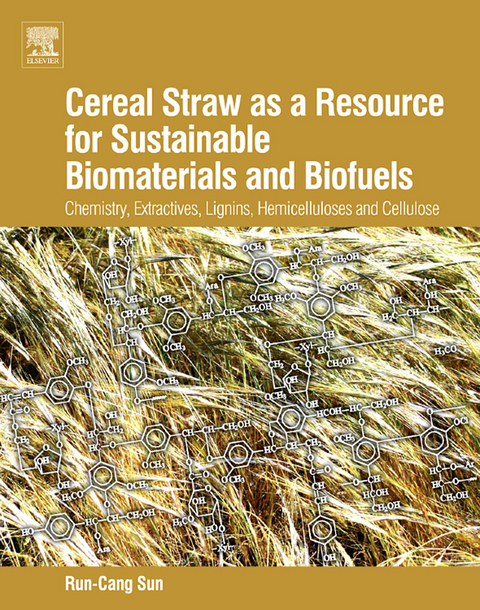
Cereal Straw as a Resource for Sustainable Biomaterials and Biofuels (eBook)
300 Seiten
Elsevier Science (Verlag)
978-0-08-093267-5 (ISBN)
-
,Provides the basics of straw composition and the structure of its cell walls
-
Details the procedures required to fractionate straw components to produce chemical derivatives from straw cellulose, hemicelluloses, and lignins
-
Elucidates new techniques for the production of biodegradable materials for the energy sector, chemical industry, and pulp and paper business
,
Materials from renewable resources are receiving increased attention, as leading industries and manufacturers attempt to replace declining petrochemical-based feedstocks with products derived from natural biomass, such as cereal straws. Cereal straws are expected to play an important role in the shift toward a sustainable economy, and a basic knowledge of the composition and structure of cereal straw is the key to using it wisely. Cereal Straw as a Resource for Sustainable Biomaterials and Biofuels: Chemistry, Extractives, Lignins, Hemicelluloses and Cellulose provides an introduction to straw chemistry. Topics discussed include the structure, ultrastructure, and chemical composition of straw; the structure and isolation of extractives from the straw; the three main components of straw: cellulose, hemicelluloses, and lignins; and chemical modifications of straw for industrial applications. This book will be helpful to scientists interested in the areas of natural resource management, environmental chemistry, plant chemistry, material science, polysaccharide chemistry, and lignin chemistry. It will also be of interest to academic and industrial scientists/researchers interested in novel applications of agricultural residues for industrial and/or recycling technologies. - Provides the basics of straw composition and the structure of its cell walls- Details the procedures required to fractionate straw components to produce chemical derivatives from straw cellulose, hemicelluloses, and lignins- Elucidates new techniques for the production of biodegradable materials for the energy sector, chemical industry, and pulp and paper business
Front Cover 1
Half Title Page 2
Title Page 4
Copyright Page 5
Table of Contents 6
Preface 10
Chapter 1 Introduction 12
References 16
Chapter 2 Structure, Ultrastructure, and Chemical Composition 20
2.1 Anatomical Structure 20
2.2 Ultrastructure 21
2.2.1 Ultrastructure of Wood 21
2.2.2 Ultrastructure of Grass 26
2.3 Distribution of Polysaccharides and Lignin 29
2.3.1 Polysaccharides Distribution 29
2.3.2 Lignin Distribution 32
2.4 Chemical Composition 40
2.4.1 Cellulose 42
2.4.2 Hemicelluloses 45
2.4.3 Lignin 48
2.4.4 Pectic Substances 50
2.4.5 Proteins 51
2.4.6 Cutins, Suberins, Waxes and Other Extracts 51
2.4.7 Ash 54
References 54
Chapter 3 Extractives 60
3.1 Isolation and Purification 61
3.1.1 Procedures for Isolation of Extractives 61
3.1.2 Purification of Extractives 62
3.2 Structural Characterization 63
3.2.1 Chemical Composition of Extractives 63
3.2.2 Spectroscopic and Thermal Characterization 73
References 81
Chapter 4 Hemicelluloses 84
4.1 Introduction 84
4.2 Occurrence, Nature, and Classification 84
4.2.1 Occurrence, Nature, and Classification of Hemicelluloses 85
4.2.2 Occurrence, Nature, and Classification of Straw Hemicelluloses 87
4.3 Isolation, Analysis, and Structure 88
4.3.1 Isolation 88
4.3.2 Structural Analysis of Straw Hemicelluloses 96
4.3.3 Structure 100
4.4 Physicochemical Properties 107
4.4.1 Solubility 107
4.4.2 Mw and Mw Distribution 107
4.4.3 Rheological Behavior 108
4.4.4 Surface Tension 109
4.4.5 Thermal Behavior 110
4.4.6 Biological Activity 111
4.5 Interactions with Cellulose 111
4.5.1 Interaction of Hemicelluloses with Celluloses in Production of Celluloses 112
4.5.2 Interaction of Hemicelluloses with Celluloses in Papermaking Process 114
4.5.3 Effect of Interaction of Hemicelluloses with Celluloses on the Bioethanol Production 115
4.5.4 The Assembly Characteristics of Hemicelluloses on Cellulose 116
4.6 Modification of Hemicelluloses and its Application 116
4.6.1 The Potential Modification of Hemicelluloses 116
4.6.2 Chemical Modification and its Application 117
4.6.3 Straw Hemicelluloses and their Application 128
4.7 Summary 129
References 130
Chapter 5 Cellulose 142
5.1 Occurrence 142
5.2 Isolation 143
5.2.1 Delignification and Alkali Extraction 143
5.2.2 Steam Explosion 145
5.2.3 Alkaline Peroxide Extraction 146
5.2.4 Organic Solvent Extraction 146
5.2.5 Other Isolation Methods 147
5.3 Structure and Crystalline Lattice of Cellulose I 149
5.3.1 Supermolecular Structure 149
5.3.2 Cellulose Lattice I 149
5.3.3 Conversion of Cellulose I to Cellulose II 153
5.4 Physico-Chemical Properties 154
5.4.1 Structural Properties 154
5.4.2 Dissolution of Cellulose 157
5.4.3 Regeneration of Cellulose 162
5.4.4 Hydrolysis of Cellulose 164
5.5 Chemical Modification and its Utilization 165
5.5.1 Acetylation 166
5.5.2 Acylation with Other Linear Anhydrides or Chlorides 168
5.5.3 Esterification with Cyclic Anhydrides 168
5.5.4 Carboxymethylation 169
5.5.5 Other Chemical Modification 172
5.6 Concluding Remarks 173
References 173
Chapter 6 Lignin 180
6.1 Introduction 180
6.2 Monolignols, and Lignification in Grass Cell Walls 181
6.2.1 Biosynthesis of Monolignols 181
6.2.2 Lignin Deposition and Topochemistry 182
6.2.3 Lignification – Polymerization of Monolignols 184
6.3 Isolation and Purification of Lignins 185
6.3.1 Milled Wood Lignin 186
6.3.2 Enzyme Lignin 188
6.3.3 Alkali Lignins 189
6.3.4 Organosolv Lignin 191
6.3.5 Purification of Lignins 193
6.4 Analytical Methods for Lignin Characterization 194
6.4.1 Thioacidolysis 194
6.4.2 DFRC Method 194
6.4.3 Nuclear Magnetic Resonance Spectroscopy 196
6.5 Structural Characteristics of Straw Lignins 198
6.5.1 Ferulates in Grass Lignins 199
6.5.2 p-Coumarates in Grass Lignins 203
6.5.3 Lignin–Carbohydrate Complexes in Grasses 204
6.6 Utilization of Lignins 205
6.6.1 Wood Adhesives Made from Lignins 206
6.6.2 Biochemicals/Biofuel from Lignins 207
6.7 Concluding Remarks 208
References 209
Chapter 7 Chemical Modification of Straw as Novel Materials for Industries 220
7.1 Chemical Modification of Cereal Straws as Natural Sorbents in Oil Spill Cleanup 220
7.1.1 Hazard of Oil Spill 220
7.1.2 Methods for Controlling Oil Spills 220
7.1.3 Classification of Oil Sorbents 220
7.1.4 Principles of Sorbency 221
7.1.5 Influence of Sorptive Capacity 221
7.1.6 Chemical Modification of Cereal Straws as Oil Sorbents 222
7.1.7 Types of Catalysts in Chemical Modification 223
7.1.8 Agro-Based Sorbent Application 224
References 227
Chapter 7.2 Modification of Cereal Straws as Natural Sorbents for Removing Metal Ions from Industrial Waste Water 230
7.2.1 Introduction 230
7.2.2 Mechanism of Metal Biosorption 231
7.2.3 Adsorption Models 231
7.2.4 Methods of Chemical Modification 232
7.2.4.1 The Methods of Direct Chemical Modification 233
7.2.4.2 Chemical Grafting Modification 234
7.2.5 Chemically Modified Straw 238
7.2.5.1 Sugarcane Bagasse 238
7.2.5.2 Rice Straw/Husks/Hulls 241
7.2.5.3 Wheat Straw/Wheat Bran 242
7.2.5.4 Corncobs 242
7.2.5.5 Soybean Straw/Hull 243
7.2.5.6 Other Straw/Hulls 244
7.2.6 Summary 244
References 245
Chapter 7.3 Modification of Straw for Activated Carbon Preparation and Application for the Removal of Dyes from Aqueous Solutions 250
7.3.1 Introduction 250
7.3.2 Technologies Available for Dye Removal 250
7.3.2.1 Biological Treatments 251
7.3.2.2 Chemical Methods 251
7.3.2.3 Physical Methods 251
7.3.3 Dye Removal Using Commercial Activated Carbons 252
7.3.4 Dye Removal Using Agricultural Wastes or Byproducts 253
7.3.5 Production of Acs from Agricultural Byproducts 255
7.3.5.1 Physical Activation 256
7.3.5.2 Chemical Activation 256
7.3.5.3 Dye Removal Using ACs from Agricultural Byproducts 256
7.3.6 Summary 258
References 259
Chapter 7.4 Liquefaction and Gasification of Cereal Straws 264
7.4.1 Hydrothermal Liquefaction 264
7.4.2 Solvolytic Liquefaction 267
7.4.3 Thermal Gasification 270
7.4.4 Hydrothermal Gasification 272
References 274
Chapter 7.5 Biorefinery Straw for Bioethanol 278
7.5.1 Introduction 278
7.5.2 Lignocellulosic Biomass Recalcitrance 279
7.5.3 Biorefinery Straw For Bioethanol Production 281
7.5.3.1 Acid Hydrolysis 281
7.5.3.2 Enzymatic Hydrolysis 283
7.5.4 Summary 293
References 294
Index 300
| Erscheint lt. Verlag | 18.1.2010 |
|---|---|
| Sprache | englisch |
| Themenwelt | Medizin / Pharmazie ► Pflege |
| Medizin / Pharmazie ► Physiotherapie / Ergotherapie ► Orthopädie | |
| Naturwissenschaften ► Biologie ► Biochemie | |
| Naturwissenschaften ► Chemie ► Organische Chemie | |
| Naturwissenschaften ► Chemie ► Technische Chemie | |
| Naturwissenschaften ► Physik / Astronomie | |
| Technik ► Elektrotechnik / Energietechnik | |
| Technik ► Medizintechnik | |
| Technik ► Umwelttechnik / Biotechnologie | |
| Weitere Fachgebiete ► Land- / Forstwirtschaft / Fischerei | |
| ISBN-10 | 0-08-093267-3 / 0080932673 |
| ISBN-13 | 978-0-08-093267-5 / 9780080932675 |
| Informationen gemäß Produktsicherheitsverordnung (GPSR) | |
| Haben Sie eine Frage zum Produkt? |
 EPUB (Adobe DRM)
Kopierschutz: Adobe-DRM
Adobe-DRM ist ein Kopierschutz, der das eBook vor Mißbrauch schützen soll. Dabei wird das eBook bereits beim Download auf Ihre persönliche Adobe-ID autorisiert. Lesen können Sie das eBook dann nur auf den Geräten, welche ebenfalls auf Ihre Adobe-ID registriert sind.
Details zum Adobe-DRM
Dateiformat: EPUB (Electronic Publication)
EPUB ist ein offener Standard für eBooks und eignet sich besonders zur Darstellung von Belletristik und Sachbüchern. Der Fließtext wird dynamisch an die Display- und Schriftgröße angepasst. Auch für mobile Lesegeräte ist EPUB daher gut geeignet.
Systemvoraussetzungen:
PC/Mac: Mit einem PC oder Mac können Sie dieses eBook lesen. Sie benötigen eine
eReader: Dieses eBook kann mit (fast) allen eBook-Readern gelesen werden. Mit dem amazon-Kindle ist es aber nicht kompatibel.
Smartphone/Tablet: Egal ob Apple oder Android, dieses eBook können Sie lesen. Sie benötigen eine
Geräteliste und zusätzliche Hinweise
Buying eBooks from abroad
For tax law reasons we can sell eBooks just within Germany and Switzerland. Regrettably we cannot fulfill eBook-orders from other countries.
aus dem Bereich