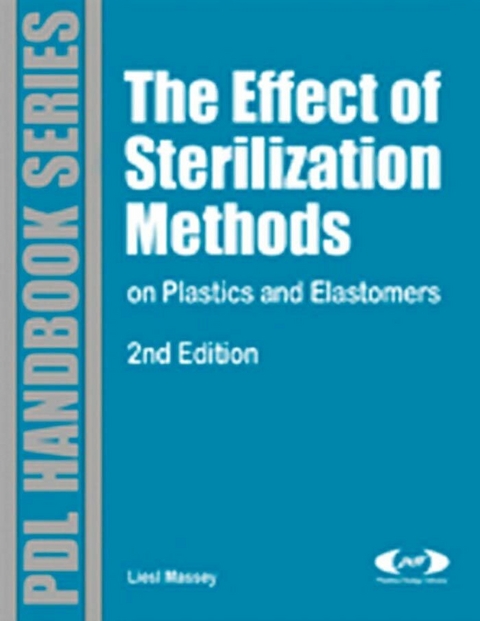
Effect of Sterilization Methods on Plastics and Elastomers (eBook)
413 Seiten
Elsevier Science (Verlag)
978-0-8155-1923-2 (ISBN)
Data is presented on 43 major plastic and elastomer packaging materials, including biodegradable or organic polymers. New to this edition are resin chapters containing textual summary information including: category, general description, applications, resistances to particular sterilization methods, and regulatory status considerations for use in medical devices and medical/food packaging. The resin chapter material supplier trade name product data is presented in graphical and tabular format, with results normalized to SI units, retaining the familiar format of the best selling first edition and allowing easy comparison between materials and test conditions.
This extensively updated second edition was created for medical device, medical packaging, and food packaging design engineers, material product technical support, and research/development personnel. This comprehensive databook contains important characteristics and properties data on the effects of sterilization methods on plastics and elastomers. It provides a ready reference for comparing materials in the same family as well as materials in different families. Data is presented on 43 major plastic and elastomer packaging materials, including biodegradable or organic polymers. New to this edition are resin chapters containing textual summary information including: category; general description; applications; resistances to particular sterilization methods; and regulatory status considerations for use in medical devices and medical/food packaging. The resin chapter material supplier trade name product data is presented in graphical and tabular format, with results normalized to SI units, retaining the familiar format of the best selling first edition and allowing easy comparison between materials and test conditions.
Chapter 2 Acrylonitrile-Butadiene-Styrene (ABS)
Category: Engineering thermoplastic, styrenics.
General Description: Acrylonitrile-butadiene-styrene (ABS) includes a range of resins, each manufactured with usually more than 50% styrene and varying amounts of acrylonitrile and butadiene. ABS is an opaque resin, available in high- and low-gloss versions, that offers good processability and impact resistance.
The Dow Chemical Magnum® 2600 series includes Magnum 2620 (high gloss), Magnum 2630 (high gloss), and Magnum 2642 (low gloss); these are designated for health care applications. Magnum 9020 is one of the highest gloss ABS resins with high impact strength and medium flow.[17]
Bayer Lustran ABS 248 is a high gloss, medium impact ABS. Lustran ABS 743 is a high impact ABS.[18]
BASF Terlux is a transparent, amorphous thermoplastic based on an MABS polymer. Terlux gains its impact strength from a rubber phase made from polybutadiene, embedded submicroscopically into the matrix of styrene, acrylonitrile, and methyl methacrylate. Terlux offers an ideal combination of properties typical of ABS, such as a balanced stiffness/toughness ratio and the high transparency well known in PMMA molding compositions. This special combination of properties makes Terlux unique among transparent thermoplastics.[19]
Sterile Applications: Trays and kits, surgical equipment, surgical staplers, home test kits, roller clamps, and piercing pins. Magnum 9020 is used for injection molding durables.
Gamma Radiation Resistance: The decrease in impact strength of ABS after gamma radiation sterilization is generally attributed to the radiation crosslinking of the butadiene rubber phase of the ABS, which reduces its ductility.[20]
The retention of impact strength of gamma sterilized rubber-modified styrenic polymers is dependent upon the degree of crosslinking that occurs in the butadiene rubber phase. The higher the radiation dosage, the greater the crosslinking, and the lower the ultimate impact strength. At the sterilization exposure level of 10 Mrads, the high-gloss ABS showed losses in impact strength accompanied by a slight increase in tensile strength and a decrease in tensile elongation-at-break. This change is attributed to the crosslinking of the butadiene rubber matrix.[21]
If the rubber content is high enough, crosslinking becomes the dominating factor in determining the physical property characteristics of the polymer upon irradiation. Crosslinked butadiene rubber loses its impact strength, thus, at dosages sufficient to crosslink all the rubber, the enhanced impact properties originally provided by the rubber modifier are lost. The remaining impact strength of the material will be no better than that of the unmodified polymer. Comparing the notched Izod impact strength at 2.5 Mrads and 10 Mrads, one can see the loss in properties with the increase in radiation dosage.[21]
Dow Chemical Magnum 2620: Standard impact tests were conducted on ASTM Type 1 tensile bars to determine retained impact strength after gamma radiation exposure. The samples lost 15% of Izod impact strength after low doses of radiation and, after 10 Mrads of radiation, reductions of 24-30% in Izod impact strength were seen. Dart impact values were reduced minimally after sterilization.[20]
Dow Chemical Magnum 2642: Standard impact and color change tests performed on Magnum 2642 (natural low-gloss ABS) ASTM Type 1 tensile bars after gamma sterilization yielded the following results: Izod impact strength, which measures notch sensitivity, decreased by 15-20% when exposed to 2.5 Mrads. A 30% reduction in Izod impact was seen after 10 Mrads of radiation. Dart impact tests, using a dart to puncture the sample, showed minimal reduction after gamma sterilization.[4]
In separate tests, the dart impact strength decreased 30% (total energy) after exposure to 10 Mrads of gamma radiation.[20]
ABS Magnum 2642 test bars exposed to radiation sterilization experienced discoloration (Graph 2-01). Samples exposed to 25 kGy returned to their original color after 2 weeks, while the 100 kGy samples retained a visible yellowing. Photo-bleaching, exposing the test bars to fluorescent light, yielded less yellowing.™
Graph 2-01. Color change (E) of natural Dow Chemical Magnum 2642 after gamma sterilization.[17]
Dow Chemical Magnum 9020: High-gloss ABS loses impact strength upon exposure to gamma radiation. There is a slight linear increase in tensile strength with the increase in gamma dosage. The optical properties are not affected by the photo-bleaching phenomenon. When tested, samples lost 28% of Izod impact strength after exposure to 2.5 megarads and 55% after exposure to 10.0 megarads. The losses in impact properties and increases in tensile strength are attributed to breakdown and/or crosslinking occurring in the rubber phase. The yellowness index and AE values roughly doubled between exposure to 2.5 and 10.0 megarads. Exposure to 10.0 megarads induces a permanent color change. No difference is seen when comparing the physical properties of the irradiated samples stored in fluorescent light versus those stored in complete darkness. Storage in light does not affect the bleach-back optical properties when exposed to 2.5 and 10.0 megarads.[22]
Lustran ABS 248 injection molded specimens were irradiated at 1.5, 2.5, 3.5 and 5.0 megarads of radiation. The Izod impact values (ASTM D256) showed linear decrease with increasing dose level. At 5.0 megarad, it lost 5-10% of its original impact value. There was no measurable change in tensile modulus, and an increase in tensile stress at yield of 5.0% was noted (ASTM D638). There was no difference in tensile stress at fail between the control and irradiated samples. Tensile elongation at yield exhibited a slight increase. The results of tensile elongation at fail (ASTM D638) were extremely variable. Virtually no change in flexural modulus (ASTM D790) was noted. No obvious trends in flexural modulus (ASTM 790) were observed, with an increasing discoloration as dosages moved toward this level. During experimentation, a “fading” effect was observed. After time, the discoloration of all samples was barely perceptible.[18]
Lustran ABS 743 injection molded test specimens were irradiated at doses of 1.5, 2.5, 3.5 and 5.0 megarads of gamma radiation. The Izod impact (ASTM D256) value showed a linear decrease with increasing dose level. There was no measurable change in tensile modulus (ASTM D638). An increase in tensile stress (ASTM D638) at yield of 5.0% was noted. There was no difference in tensile stress (ASTM D638) at fail between the control and irradiated samples. Tensile elongation at yield exhibited a slight increase. The results of tensile elongation at fail (ASTM D638) were extremely variable. Virtually no change in flexural modulus (ASTM D790) was noted. No obvious trends in flexural modulus (ASTM D790) were observed, with values fluctuationg plus or minus 5.0%. At 2.5 megarad discoloration was minimal. At 10 megarad the sample turned green, with increasing discoloration as dosages moved toward this level. During experimentation, a “fading” effect was observed. After time, the discoloration of all samples was barely perceptible.[18]
GE Plastics Cycolac® MG47 MD and MG94 MD are gamma sterilizable.[23]
Gamma radiation may be used to sterilize Terlux. The doses of gamma radiation usually used for sterilization, 25-35 kGy (2.5-3.5 megarads), have no effect on the mechanical properties of specimens made from Terlux. However, gamma radiation does cause some yellowing, the extent of which depends on the radiation dose used. This effect can be reversed almost completely on storage in light. A grade developed specifically for radiation sterilization with reduced color change is available on request.[19]
Electron Beam Radiation Resistance: E-beam radiation will generally cause a decrease in the impact strength of ABS.
Lustran ABS 248 injection molded specimens were irradiated at 1.5, 2.5, 3.5 and 5.0 megarad of beam radiation. The Izod impact values (ASTM D256) showed linear decrease with increasing dose level. At 5.0 megarad, it lost 5-10% of its original impact value. There was no measurable change in tensile modulus, and an increase in tensile stress at yield of 10 %to 18% was noted (ASTM D638). There was a 5% to 15% difference in tensile stress at fail between the control and irradiated samples. Tensile elongation at yield exhibited a slight increase. The results of tensile elongation at fail (ASTM D638) were extremely variable. Virtually no change in flexural modulus (ASTM D790) was noted. No obvious trends in flexural modulus (ASTM 790) were observed, with values fluctuating plus or minus 5.0%. At 2.5 megarad discoloration was minimal. With increases in dosages uo to 10.0 megarad, the samples turned green, color increased with higher doses. During experimentation, a “fading” effect was observed. After time, the discoloration of all samples was barely perceptible.[18]
Lustran ABS 743 injection molded test specimens were irradiated at doses of 1.5, 2.5, 3.5 and 5.0 megarad of beam radiation. The Izod impact (ASTM D256) value showed a linear decrease with increasing dose level. There was no measurable change in tensile modulus (ASTM...
| Erscheint lt. Verlag | 31.12.2005 |
|---|---|
| Sprache | englisch |
| Themenwelt | Sachbuch/Ratgeber |
| Medizin / Pharmazie | |
| Naturwissenschaften ► Chemie ► Technische Chemie | |
| Technik ► Maschinenbau | |
| Technik ► Medizintechnik | |
| Wirtschaft | |
| ISBN-10 | 0-8155-1923-0 / 0815519230 |
| ISBN-13 | 978-0-8155-1923-2 / 9780815519232 |
| Informationen gemäß Produktsicherheitsverordnung (GPSR) | |
| Haben Sie eine Frage zum Produkt? |
 EPUB (Adobe DRM)
Kopierschutz: Adobe-DRM
Adobe-DRM ist ein Kopierschutz, der das eBook vor Mißbrauch schützen soll. Dabei wird das eBook bereits beim Download auf Ihre persönliche Adobe-ID autorisiert. Lesen können Sie das eBook dann nur auf den Geräten, welche ebenfalls auf Ihre Adobe-ID registriert sind.
Details zum Adobe-DRM
Dateiformat: EPUB (Electronic Publication)
EPUB ist ein offener Standard für eBooks und eignet sich besonders zur Darstellung von Belletristik und Sachbüchern. Der Fließtext wird dynamisch an die Display- und Schriftgröße angepasst. Auch für mobile Lesegeräte ist EPUB daher gut geeignet.
Systemvoraussetzungen:
PC/Mac: Mit einem PC oder Mac können Sie dieses eBook lesen. Sie benötigen eine
eReader: Dieses eBook kann mit (fast) allen eBook-Readern gelesen werden. Mit dem amazon-Kindle ist es aber nicht kompatibel.
Smartphone/Tablet: Egal ob Apple oder Android, dieses eBook können Sie lesen. Sie benötigen eine
Geräteliste und zusätzliche Hinweise
Buying eBooks from abroad
For tax law reasons we can sell eBooks just within Germany and Switzerland. Regrettably we cannot fulfill eBook-orders from other countries.
aus dem Bereich