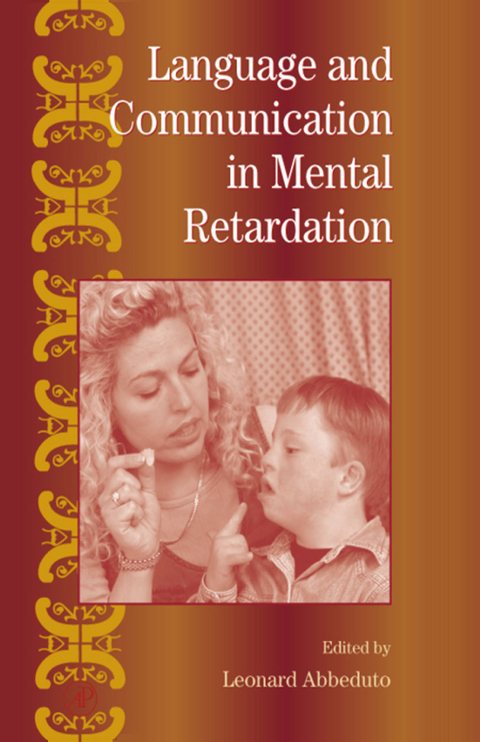
International Review of Research in Mental Retardation (eBook)
324 Seiten
Elsevier Science (Verlag)
9780080544298 (ISBN)
Language and communication problems have long figured prominently in the definition of mental retardation. Volume 27 of the International Review of Research in Mental Retardation focuses exclusively on these language and communication issues. The pace of research on language learning and use in mental retardation has increased in recent years and taken new direction. This revitalization has been fueled by three factors: 1) advances in genetic technologies allowing investigation of the behavioral phenotypes of well-defined syndromes, 2) an increased emphasis on maximizing abilities of individuals with mental retardation to live and succeed in a broader range of contexts and settings, and 3) theoretical debates concerning the mechanisms of language development and the nature of the human mind. Contents in Language and Communication in Mental Retardation include syndromes (e.g., Down syndrome, Williams syndrome), domains of language skill (e.g., reading), and intervention strategies. - Contains the most current research on genetic syndromes, including Williams syndrome, Down syndrome, and fragile X syndrome- Outlines the most current research on language and communication intervention for persons with mental retardation- Authors consider the implications of the research reviewed for both theory and clinical practice- Authors bring state-of-the-art knowledge of cognitive science, developmental science, linguistic, and behavioral genetics to bear on important questions about language and mental retardation- Includes new research on long-studied conditions (e.g., Down syndrome) and disorders that are of only recent interest to child language researchers (e.g., fetal alcohol syndrome)- Includes a consideration of nonverbal, as well as verbal, communication
Cover 1
Contents 6
Contributors 10
Foreword 12
Preface 14
Chapter 1. Language and Communication in Individuals with Down Syndrome 18
I. Introduction 18
II. The Child Talk Model and Language Learning 18
III. The Behavioral Phenotype of Down Syndrome 22
IV. Individual Differences in Syntax Development of Individuals with Down Syndrome 26
V. Effects of Visual Support on Narratives 29
VI. Fast Mapping of Novel Words 31
VII. The Role of Working Memory in Fast Mapping of Vocabulary 34
VIII. Fast Mapping in Event Contexts 35
IX. Fast Mapping Novel Words of Varying Phonological Complexity and Utterance Position 37
X. Fast Mapping of Nouns vs Verbs 41
XI. Fast Mapping Action Verbs in the Context of Same or Differing Objects 43
XII. Summary of Fast-Mapping Findings 44
XIII. Research Implications: Choosing Comparison Groups 44
XIV. Clinical Implications 46
References 47
Chapter 2. Language Abilities of Individuals with Williams Syndrome 52
I. Introduction 52
II. Performance on Standardized Assessments 53
III. Early Language Acquisition 59
IV. Semantic Abilities of School-Age Children and Adults 72
V. Grammatical Ability and its Relation to Cognitive Abilities 80
VI. Summary and Conclusion 89
References 93
Chapter 3. Language and Communication in Fragile X Syndrome 100
I. Introduction 100
II. Research on the Language Characteristics Associated with Fragile X Syndrome 101
III. New Directions in Research on Fragile X Syndrome 121
IV. Conclusion 128
References 130
Chapter 4. On Becoming Socially Competent Communicators: The Challenge for Children with Fetal Alcohol Exposure 138
I. Introduction 138
II. Incidence, Identification and Inclusion 140
III. Behavioral Phenotype 143
IV. Cognition 144
V. Social Interaction 147
VI. Language and Social Communication 150
VII. A Framework for Examining Communicative Behavior in Social Interactions 153
VIII. Conclusion 163
References 163
Chapter 5. Memory, Language Comprehension, and Mental Retardation 168
I. Introduction 168
II. Working Memory 171
III. Semantic Memory 183
IV. Tacit Memory 193
V. Conclusion 197
References 200
Chapter 6. Reading Skills and Cognitive Abilities of Individuals with Mental Retardation 208
I. Introduction 208
II. Typical Reading Development 209
III. Reading Achievement and Mental Retardation: The Emerging Lag 215
IV. Specific Reading Skills and Mental Retardation 218
V. Individual Differences in Reading among Individuals with Mental Retardation 228
VI. Conclusion 236
References 240
Chapter 7. Language Interventions for Children with Mental Retardation 248
I. Introduction 248
II. Interventions for Children with Mental Retardation Associated with Various Diagnoses 250
III. The Role of Children’s Level of Development in Implementing Communication Interventions 257
IV. Intensity of Interventions 258
V. The Role of a Child’s Conversation Partner in Communication Intervention 262
VI. Conclusion 265
References 267
Chapter 8. Augmentative and Alternative Communication for Persons with Mental Retardation 272
I. Introduction 272
II. The Nature of Augmentative and Alternative Communication 273
III. Research on AAC and Persons with Mental Retardation 275
IV. Augmentative Communication for Persons with Mental Retardation: Summary, Implications, and Future Research 289
V. Conclusion 291
References 292
Chapter 9. Atypical Language Development in Individuals with Mental Retardation: Theoretical Implications 298
I. Introduction 298
II. Atypical Language Development in Individuals with Mental Retardation 298
III. Issues in the Cognition–Language Relationship 306
IV. Explaining Intrasyndromic Variation: A Neuro-Genetic Perspective 313
References 319
Index 326
| Erscheint lt. Verlag | 14.11.2003 |
|---|---|
| Mitarbeit |
Herausgeber (Serie): Laraine Masters Glidden |
| Sprache | englisch |
| Themenwelt | Geisteswissenschaften ► Psychologie ► Allgemeine Psychologie |
| Geisteswissenschaften ► Psychologie ► Entwicklungspsychologie | |
| Geisteswissenschaften ► Psychologie ► Klinische Psychologie | |
| Geisteswissenschaften ► Psychologie ► Pädagogische Psychologie | |
| Geisteswissenschaften ► Psychologie ► Verhaltenstherapie | |
| Medizin / Pharmazie ► Medizinische Fachgebiete ► Neurologie | |
| ISBN-13 | 9780080544298 / 9780080544298 |
| Informationen gemäß Produktsicherheitsverordnung (GPSR) | |
| Haben Sie eine Frage zum Produkt? |
 PDF (Adobe DRM)
Kopierschutz: Adobe-DRM
Adobe-DRM ist ein Kopierschutz, der das eBook vor Mißbrauch schützen soll. Dabei wird das eBook bereits beim Download auf Ihre persönliche Adobe-ID autorisiert. Lesen können Sie das eBook dann nur auf den Geräten, welche ebenfalls auf Ihre Adobe-ID registriert sind.
Details zum Adobe-DRM
Dateiformat: PDF (Portable Document Format)
Mit einem festen Seitenlayout eignet sich die PDF besonders für Fachbücher mit Spalten, Tabellen und Abbildungen. Eine PDF kann auf fast allen Geräten angezeigt werden, ist aber für kleine Displays (Smartphone, eReader) nur eingeschränkt geeignet.
Systemvoraussetzungen:
PC/Mac: Mit einem PC oder Mac können Sie dieses eBook lesen. Sie benötigen eine
eReader: Dieses eBook kann mit (fast) allen eBook-Readern gelesen werden. Mit dem amazon-Kindle ist es aber nicht kompatibel.
Smartphone/Tablet: Egal ob Apple oder Android, dieses eBook können Sie lesen. Sie benötigen eine
Geräteliste und zusätzliche Hinweise
Buying eBooks from abroad
For tax law reasons we can sell eBooks just within Germany and Switzerland. Regrettably we cannot fulfill eBook-orders from other countries.
aus dem Bereich