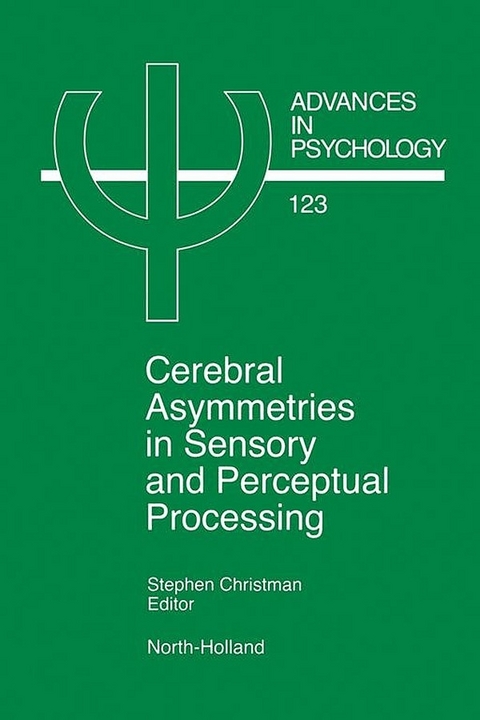
Cerebral Asymmetries in Sensory and Perceptual Processing (eBook)
558 Seiten
Elsevier Science (Verlag)
9780080528823 (ISBN)
The purpose of the book is to provide a comprehensive overview of hemispheric differences in sensory and perceptual processing. The first section of the book deals directly with the intra- and inter-hemispheric processing of spatial and temporal frequencies in the visual modality. The second section addresses the initial interaction between sensory and cognitive mechanisms, dealing with how the left and right cerebral hemispheres differ in their computation and representation of sensory information. The third section covers how attentional mechanisms modulate the nature of perceptual processing in the cerebral hemispheres. Section four consists of a single chapter which reviews evidence suggesting a functional linkage between upper and right visual field processing, on the one hand, and lower and left visual field processing on the other.
Cover 1
Table of Contents 6
Preface 12
Contributors 19
SECTION I: SPATIAL/TEMPORAL FREQUENCY PROCESSING 20
Chapter 1. Hemispheric Asymmetry in the Processing of Spatial Frequency: Experiments Using Gratings and Bandpass Filtering 22
Sinusoidal and Square-wave Stimuli 26
Compound Stimuli 31
Low-pass and Band-pass Filtered Stimuli 38
Conclusions 42
References 45
Chapter 2. Temporal Frequency Processing 50
Hemispheric Asymmetries of Spatio-temporal Interaction: Electrophysiological Evidence 54
Reading Disability and Impairment in Processing Basic Spatio-temporal Information 63
Evidence from Brain-injured Patients 65
Conclusion 68
References 68
Chapter 3. Interhemispheric Transfer of Spatial and Temporal Frequency Information 74
Properties of Interhemispheric Commisures in Mammals 75
Interactions between Sinusoidal Stimuli Presented in the Left or Right Visual Field 80
Discrimination of Spatial Phase in Complex Gratings Presented in the Left or Right Visual Field 86
Interhemispheric Transfer of Information on Chromatic Contrast 92
Discussion 93
References 95
SECTION II: OBJECT AND SPATIAL REPRESENTATIONS 100
Chapter 4. Hemispheric Asymmetry for Components of Spatial Processing 102
The Categorical/Coordinate Distinction 103
The Search for Underlying Mechanisms of Hemispheric Asymmetry for Spatial Processing 107
The Speech/Attention-Shift Hypothesis 108
Are Categorical and Coordinate Spatial Relationships Processed Independently? 110
The Nature of Task-Relevant Visual Information 112
Extensions of the Categorical/Coordinate Distinction 131
Concluding Comments: More on Mechanisms and Future Directions 135
Chapter 5. Computational Analyses and Hemispheric Asymmetries in Visual-Form Recognition 144
Notes 138
References 139
Visual Form Subsystems 145
Behavioral Evidence for Relatively Independent Subsystems 150
Contradictory Internal Processing Strategies 154
Behavioral Evidence for Parts-based Versus Holistic Processing 166
Conclusions and Implications 169
Acknowledgments 172
References 172
SECTION III: VISUAL ATTENTION 178
Chapter. 6. Amplification of Spatial Nonuniformities by Guided Search Mechanisms 180
Visual Search and the Guided Search Model 181
Spatial Nonuniformities in Visual Search 185
General Discussion 203
Conclusions 209
Footnotes 549
Acknowledgements 211
References 212
Chapter 7. Hemispheric Coordination of Spatial Attention 216
Hemispheric Specialization in Visual Search? 217
Hemifield Differences in Unilateral vs. Bilateral Visual Displays 224
Hemifield Competition in Object Identification 234
Discussion 238
What are the Implications for Understanding Spatial Attention? 244
Implications for Understanding Hemispheric Specialization 246
Acknowledgments 248
References 248
Chapter 8. Asymmetries in the Flanker Compatibility Effect 252
Expt. 1: Left-right asymmetries in the FCE: M and W letter arrays 255
Experiment 1B - FCE with H, V letter arrays 262
Experiment 2 - Effects of letter case 264
Experiment 3 - Target-Flanker Spacing 269
General discussion 271
References 277
Expt. 1. Left-right Asymmetries in the FCE. M and W Letter Arrays 255
SECTION IV: EFFECTS OF VISUAL FIELD LOCUS 280
Chapter 9. The Relation Between Left-Right and Upper-Lower Visual Field Asymmetries 282
Simple Reaction Time 285
Resolution/Acuity 286
Local-Global Processing 288
Categorical/Coordinate Processing 289
Stereopsis 291
Motion 293
Visual Search 295
Visual Attention 298
Pattern Recognition 300
Conclusions 302
References 309
SECTION V: AUDITORY PROCESSING 316
Chapter 10. Hemispheric Specialization of Human Auditory Processing. Perception of Speech and Musical Sounds 318
Phonetic Mechanisms in Speech Perception 320
Processing of Melodic Patterns 326
Auditory Imagery 331
Morphometry of Auditory Cortex via Structural MRI 335
References 338
Chapter 11. Perceptual and Cognitive Development: Electrophysiological Correlates 344
Voice Onset Time 347
Place of Articulation 355
Vowel Sounds 360
Electrophysiological Correlates of Infant Memory 361
Electrophysiological Correlates of Early Word Acquisition 375
Acknowledgments 393
References 393
Chapter 12. The Ipsilateral Auditory Pathway. A Psychobiological Perspective 402
Anatomy of the Ascending Auditory System 404
Role of Ipsilateral Pathway in Behavior 424
Evoked Potential Studies 433
Role of Ascending Pathways in Physiology of the Inferior Colliculus 434
Consequences to Cognition 458
Conclusions 460
Footnote 461
Acknowledgment 462
References 462
SECTION VI: TACTUAL PROCESSING 486
Chapter 13. Role of Sensory and Post-sensory Factors in Hemispheric Asymmetries in Tactual Perception 488
Anatomical Bases of Tactual Perception 489
Functional asymmetries for elementary tactile discriminations 490
Tactual Discrimination of Orientations 493
Retention of Sequence of Touches 494
Tactual Discrimination of Dot Patterns 494
Tactual Maze Learning 496
Haptic Discrimination of Spatial Forms 496
Exploratory Strategies for Nonsense Shape Discrimination 497
Haptic Perception in Nonhuman Primates 502
General Discussion 504
References 507
SECTION VII: OLFACTORY PROCESSING 514
Chapter 14. Laterality in Human Nasal Chemoreception 516
Anatomy of the Olfactory and Trugeminal Chemosnsory Systems 518
Olfactory System 520
Trigeminal System 527
The Search for Anatomical Asymmetries in Brain Regions Related to Olfaction 529
The Search for Functional Asymmetry in Human Olfactory Pathways 530
Conclusions 546
Footnotes 549
Acknowledgements 550
References 550
Name Index 562
Subject Index 576
Hemispheric Asymmetry in the Processing of Spatial Frequency: Experiments Using Gratings and Bandpass Filtering.
Stephen D. Christman University of Toledo
When Paul Broca first brought the existence of systematic asymmetries in language representation between the left and right cerebral hemispheres (LH and RH) to the attention of the 19th century medical community, the initial reaction was skepticism and disbelief. This was replaced within ten years by widespread acceptance (Harrington, 1987). Initial doubts centered on the prevailing assumption that bilateral symmetry was "perhaps the most general truth in all the science of animal construction" (Moxson, 1866); interestingly, however, a decade later, hemispheric asymmetry in humans was not only widely accepted, it was taken to be a hallmark of human superiority over other organisms: "Man is, of all the animals, the one whose brain in the normal state is the most asymmetrical… It is this that distinguishes us the most clearly from the animals" (Broca, 1877). While the existence of hemispheric differences has not come into serious question since, an unfortunate legacy of the 19th century viewpoint persisted until recently in the form of three implicit assumptions that guided laterality research conducted between 1880 and 1980: (i) that language and other high level cognitive functions were the only lateralized functions, (ii) that only humans possessed language, and (iii) that, therefore, only humans exhibited significant degrees of hemispheric asymmetry.
The last two decades have seen the dispelling of all three assumptions: Stanley Glick's book Cerebral Lateralization in Nonhuman Species (1985) cleared the way for a large growth in the number of studies of hemispheric asymmetries in nonhumans, and the work of researchers such as the Gardners has at least raised the possibility of rudimentary language acquisition in nonhuman primates (e.g., Gardner, Gardner, & Van Cantfort, 1989). The theme of this chapter (and, indeed, of many chapters in this volume) is that hemispheric asymmetry is not limited to higher-order functions and can be demonstrated in a wide variety of sensory and perceptual functions.
The implications of hemispheric asymmetries in lower-order functions are important elements in the recent shift in theorizing about brain laterality from emphasis on all-inclusive dichotomies (e.g., Bradshaw and Nettleton's [1981] "analytic/holistic" dichotomy) to a growing realization that behavioral asymmetries (e.g., ear and visual field advantages) are determined by a multitude of factors, some involving cerebral lateralization and some not, some involving higherorder functions and others involving lower-order functions. Hellige (1993) provides an overview of this new componential approach to hemispheric asymmetry.
Hemispheric asymmetries in lower-order functions also places the study of hemispheric asymmetry in an evolutionary context. The previous view that asymmetry was confined to higher-order (and especially linguistic) functions implied a sort of evolutionary discontinuity; the current view that asymmetry is present across a wide range of both species and functions places human asymmetry in a richer comparative context, allowing the potential use of animal models in studies of human asymmetry, and helping foster a réévaluation of the neural basis of higher-order asymmetries (c.f., the growing acknowledgment of the importance of non-cortical brain asymmetries).
This chapter focuses on hemispheric differences in processing different ranges of spatial frequency content of visual input. Before discussing the relevant literature, however, it is useful to provide background on the role of spatial frequency in visual processing. The modern era in the visual sciences can be traced back to the seminal work of researchers such as Hubel and Wiesel (1962), who helped refine the use of single-cell recording techniques in the study of the neural basis of visual processing. Models of visual processing initially derived from this work posited the existence of various neuronal cell types selectively responding to specific visual features. For example, Hubel and Wiesel (1962, 1965) proposed three important types of cells in striate cortex: (i) simple cells, which respond best to lines, bar, or edges at particular orientations; (ii) complex cells, which respond best to bars or edges moving in specific directions in particular orientations; and (iii) hypercomplex cells, which respond not only to the orientation and direction of motion of stimuli, but also to specific stimulus sizes, lengths, and widths. More extreme versions of this approach have gone so far as to postulate the existence of "pontifical" or "grandfather" cells: cells that fire only when presented with a visual representation of some specific, complex object such as a face or hand (e.g., Barlow, 1972).
The 1960s saw an alternative approach emerge which more or less replaced the single-cell feature detection framework. Campbell and Robson (1968) first proposed the existence of discrete pathways in the visual system, each sensitive to a limited range of spatial frequency components. These various pathways or channels were hypothesized to carry out a two-dimensional Fourier analysis of the visual scene, in which complex patterns are broken down into simple, sinusoidal components. Spatial frequency components can be described in terms of a number of dimensions. First, they consist of sinusoidal variations in luminance across space, with higher spatial frequencies involving more numerous cycles per unit distance (the spatial frequency of stimuli is typically described in terms of cycles per degree [cpd] of visual angle; high versus low frequency grating stimuli consist of thinner versus wider bars). Phenomenologically, high frequencies carry information about fine details, while low frequencies carry information about more global aspects of the visual scene. Second, they possess a specific orientation that is perpendicular to the axis of luminance variation. Third, they have some specific contrast, defined by the luminance difference between the lightest and darkest portions of the stimulus divided by the sum the luminances of the lightest and darkest portions of the stimulus. Finally, they have a specific phase, referring to the absolute position in space of the light and dark bars relative to some referent. For a more thorough coverage of the spatial frequency approach, the interested reader is directed to DeValois and DeValois (1988); a concise but effective overview is provided in Harris (1980).
Thus, in the spatial frequency approach, the fundamental units of visual analysis are not discrete features, but spatially distributed sinusoidal frequency components. The spatial frequency approach has enjoyed great success, and is now a dominant approach to modeling visual processes. A nice example of the utility of the spatial frequency approach over the feature detection approach can be found in a study by DeValois, DeValois, and Yund (1979), who examined single-cell responses to gratings and checkerboard patterns. Checkerboards afford a dissociation between the predictions of the two approaches. Namely, the orientations of the explicit features (i.e., the edges) of a checkerboard are 0° and 90°, while the orientations of the fundamental spatial frequency components are ± 45°. Their procedure involved first identifying cells that produced optimal responding to a sinusoidal grating of some specific orientation (e.g., 0°). According to the feature detection approach, such a cell should exhibit optimal responding to a checkerboard pattern that contains edges oriented at 0°, while the spatial frequency approach would predict that such a cell would exhibit no response to such a checkerboard. Rather, that cell would respond optimally to a checkerboard whose edges were oriented at 45° but whose fundamental Fourier component is at 0°. Their results confirmed the predictions of the spatial frequency approach: cells tuned to gratings at 0° responded optimally to diagonally oriented checkerboard patterns. Additional evidence was reported concerning similar dissociations involving higher harmonic components and contrast.
The ascending dominance of the spatial frequency approach in models of vision during the 1970s led to the first studies of visual field differences in spatial frequency processing, which will be discussed later (e.g., Blake & Mills, 1979; Rao, Rourke, & Whitman, 1981; Rijsdik, Kroon, & van der Wildt, 1980; Rovamo & Virsu, 1979). However, it was Justine Sergent who first formally proposed a model of cerebral hemispheric asymmetry in spatial frequency processing. She came to this hypothesis not through an interest in sensory psychophysics per se, but rather as an outgrowth of an interest in the cerebral bases for facial processing. In a thorough review of the literature, Sergent and Bindra (1981) proposed that perceptual characteristics of facial stimuli play an important role in determining which hemisphere exhibited superior performance. For example, experiments using faces consisting of line drawings and/or in which different faces differed by a single feature tended to yield LH advantages; photographs of faces and/or facial stimuli which differed on many features, on the other hand, tended to yield RH advantages. This led Sergent to the conclusion that a complete understanding of hemispheric differences in facial processing (and, more generally, in...
| Erscheint lt. Verlag | 11.12.1997 |
|---|---|
| Sprache | englisch |
| Themenwelt | Geisteswissenschaften ► Psychologie ► Allgemeine Psychologie |
| Geisteswissenschaften ► Psychologie ► Biopsychologie / Neurowissenschaften | |
| Geisteswissenschaften ► Psychologie ► Verhaltenstherapie | |
| Medizin / Pharmazie ► Medizinische Fachgebiete ► Neurologie | |
| ISBN-13 | 9780080528823 / 9780080528823 |
| Informationen gemäß Produktsicherheitsverordnung (GPSR) | |
| Haben Sie eine Frage zum Produkt? |
 PDF (Adobe DRM)
Kopierschutz: Adobe-DRM
Adobe-DRM ist ein Kopierschutz, der das eBook vor Mißbrauch schützen soll. Dabei wird das eBook bereits beim Download auf Ihre persönliche Adobe-ID autorisiert. Lesen können Sie das eBook dann nur auf den Geräten, welche ebenfalls auf Ihre Adobe-ID registriert sind.
Details zum Adobe-DRM
Dateiformat: PDF (Portable Document Format)
Mit einem festen Seitenlayout eignet sich die PDF besonders für Fachbücher mit Spalten, Tabellen und Abbildungen. Eine PDF kann auf fast allen Geräten angezeigt werden, ist aber für kleine Displays (Smartphone, eReader) nur eingeschränkt geeignet.
Systemvoraussetzungen:
PC/Mac: Mit einem PC oder Mac können Sie dieses eBook lesen. Sie benötigen eine
eReader: Dieses eBook kann mit (fast) allen eBook-Readern gelesen werden. Mit dem amazon-Kindle ist es aber nicht kompatibel.
Smartphone/Tablet: Egal ob Apple oder Android, dieses eBook können Sie lesen. Sie benötigen eine
Geräteliste und zusätzliche Hinweise
Buying eBooks from abroad
For tax law reasons we can sell eBooks just within Germany and Switzerland. Regrettably we cannot fulfill eBook-orders from other countries.
aus dem Bereich