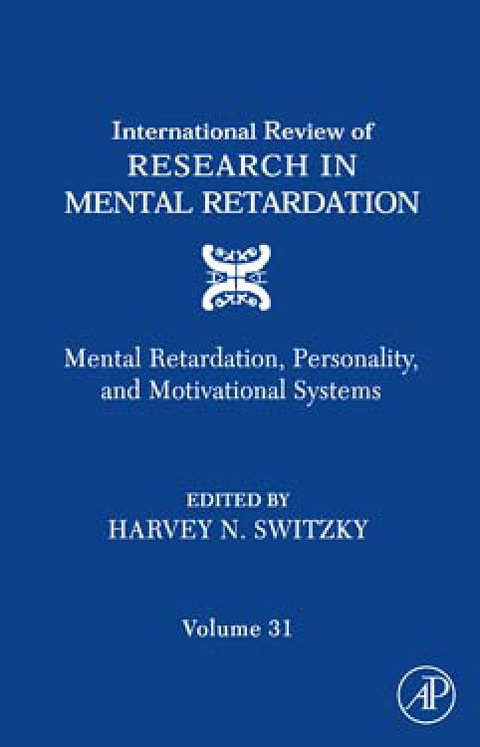
International Review of Research in Mental Retardation (eBook)
360 Seiten
Elsevier Science (Verlag)
9780080463537 (ISBN)
*Explores personality and motivation in persons with mental retardation
*Discusses intrinsic and extrinsic motivation in both mentally retarded and non-retarded children
*A useful reference for researchers and scholars in developmental and cognitive psychology, as well as neuropsychology
Volume 31 of the International Review of Research in Mental Retardation is a thematic exploration of personality and motivation in persons with mental retardation. Looking at a broad spectrum of intellectual disabilities, Mental Retardation, Personality, and Motivational Systems explores motivation as a moderator for performance and individualized effort. Coverage includes discussions of intrinsic and extrinsic motivation in both mentally retarded and non-retarded children, self-determination, interpersonal decision making in adolescents and adults with mental retardation, interpersonal relationships, and the connection between etiological-specific differences and motivation to form "e;behavioral phenotypes."e; A final chapter presents a transactional perspective on human ability, relying on constructs of intelligence, cognitive processes, and motivation, with implications for developmental interventions in the lives of persons with mental retardation. - Explores personality and motivation in persons with mental retardation- Discusses intrinsic and extrinsic motivation in both mentally retarded and non-retarded children- A useful reference for researchers and scholars in developmental and cognitive psychology, as well as neuropsychology
Cover Page 1
Contents 6
Contributors 10
Foreword 12
Preface 14
Chapter 1: The Importance of Cognitive-Motivational Variables in Understanding the Outcome Performance of Persons with Mental Retardation: A Personal View from the Early Twenty-First Century 22
I. Introduction 22
II. Effectance Motivation, Mastery Motivation, and Theories of Intrinsic Motivation 24
A. Contributions of the Yale Group 24
B. Contributions of the Peabody-Vanderbilt Group 25
C. Switzky's Contributions and Research Odyssey 29
III. Implications of cognitive-motivational variables in understanding the outcome performance of persons with mental retardation and intellectual disabilities 41
A. Motivation and the AAMR Model of Mental Retardation 41
IV. Conclusion 45
References 45
Chapter 2: Self-Determination, Causal Agency, and Mental Retardation 52
I. Introduction 52
II. Self-Determination 53
A. Self-Determination and Determinism 53
B. Self-Determination in Psychology 55
C. Self-Determination and Disability 58
III. Models of Self-Determination in the Field of Mental Retardation 60
A. Self-Determination as a Function of Self-Regulation 60
B. A Functional Model of Self-Determination 63
C. Research on Self-Determination and Mental Retardation 77
IV. Future Directions for Research in Self-Determination and Mental Retardation 80
A. Causal Agency Theory 81
References 88
Chapter 3: The Role of Motivation in the Decision Making of Adolescents with Mental Retardation 94
I. Adolescent Risk Behaviors 94
A. Life Task Perspective 95
B. Risk Taking 96
C. Victimization 96
D. Risk Behaviors and Decision Making 98
II. Theoretical Perspectives on Decision Making 99
A. The Role of Motivation in Decision Making 100
B. Adolescent Development and Decision Making 102
III. Decision Making and Mental Retardation 106
A. Decision-Making Effectiveness of Individuals with Mental Retardation 106
B. A Conceptual Framework 108
C. Research Support for Conceptual Framework 111
IV. Decision Making in Adolescents With Mental Retardation 113
A. Situational and Environmental Factors 113
B. Motivational Processes 117
V. New Directions 126
A. Focus on Motivational Processes and their Interrelationships in Decision Making 127
B. Implications for Intervention 128
VI. Conclusion 130
References 131
Chapter 4: Individual Differences in Interpersonal Relationships for Persons with Mental Retardation 138
I. Introduction 138
II. Individual differences in the structure and function of relationships 139
A. Structure of Relationships 139
B. Function of Relationships 140
III. Individual differences in motivation and implications for interpersonal relationships 141
IV. Individual differences in Perceptions of relationships 143
V. Individual differences in social support and social strain 146
A. Social Support Research: Overview 146
B. Social Support and Mental Retardation 147
C. Social Strain Research: An Overview 149
D. Social Strain and Mental Retardation 150
VI. Individual differences in Reciprocity 153
A. Reciprocity: An Overview 153
B. Reciprocity and Mental Retardation 154
VII. Individual differences in community-based relationships 155
A. Locality/Setting and Its Role in Interpersonal Relationships 156
B. Formal Groups and Their Role in Interpersonal Relationships 157
C. Homogeneity and Its Role in Interpersonal Relationships 158
D. The Community Role in Interpersonal Relationships 158
VIII. Summary 159
IX. An Integrated Model of Interpersonal Relationships 160
A. Individual Variables 161
B. Community Variables 163
C. Interpersonal Relationships 165
X. Implications 166
A. The Model Outlined Has Several Research and Clinical Implications 166
B. Individual Level Intervention 167
C. Community-Level Intervention 168
XI. Conclusions 172
References 173
Chapter 5: Understanding Low Achievement and Depression in Children with Learning Disabilities: A Goal Orientation Approach 184
I. Introduction 185
II. Motivation and Learning Disabilities 185
III. Achievement Goals: Traditional and Contemporary Approaches 186
A. Traditional Approaches: Achievement Motive and Motivational Orientation 187
B. Contemporary Approaches: Achievement Goal Theory 188
C. Application of a Goal Orientation Model in Explaining Academic Achievement in Students with LD 193
IV. Depression and Learning Disabilities 195
A. Review of Literature on Depression and Learning Disabilities 195
B. Application of a Goal Orientation Model in Explaining the Depressive Tendencies of Individuals with Learning Disabilities 200
C. Hypotheses of Dykman's (1998) Diathesis-Stress Model 201
D. Empirical Analysis of Dykman's Predictions: A Classroom Study 202
E. On Developing a Hierarchical Goal Orientation Model of Depression Vulnerability: Fear of Failure and Ought-Self Guides 209
F. An Empirical Analysis of the Hierarchical Goal Orientation Model of Depression Vulnerability 211
V. Concluding Remarks 217
References 218
Chapter 6: Motivation and Etiology-Specific Cognitive-Linguistic Profiles 226
I. Introduction 226
II. Motivation and Mental Retardation 228
A. Development of Effectance Motivation 228
B. Effectance Motivation in Mental Retardation 230
C. Domain-Specificity in Motivational Orientation 231
III. Motivation in Different Genetic Syndromes 232
A. Within-Syndrome Variability 233
IV. Motivation and the formation of behavioral phenotypes: Williams syndrome 233
A. Language in Williams Syndrome 234
B. Language Development and Motivation 235
V. Motivation and Improving Developmental Outcomes: Down syndrome 237
A. Verbal and Visuo-Spatial Processing 238
B. Auditory Processing Deficits and Language Development 238
C. Language and Motivation 239
D. Implications for Intervention in Down Syndrome 240
VI. Aptitude X Treatment Interaction 242
VI. Conclusion 244
References 245
Chapter 7: The Role of Motivation and Psychopathology in Understanding the IQ-Adaptive Behavior Discrepancy 252
I. Introduction 252
II. IQ-Adaptive Behavior Discrepancy-Conceptual Model 253
A. Motivation 254
B. Intellectual Functioning 261
C. Adaptive Behavior 262
D. Intellectual Functioning and Adaptive Behavior 263
E. Psychopathology 264
III. Motivation and Psychopathology in Children with Mental Retardation: Pilot Study 266
A. Methodology 267
B. Results 269
IV. Discussion 270
A. Implications for Diagnosis of Mental Retardation and Developmental Disabilities 271
B. Implications for the Classroom 272
C. Implications for Community-Based Supports and Interventions 272
D. Implications for Psychopathology 273
E. Concluding Comments 273
References 274
Chapter 8: Behavior-Analytic Experimental Strategies and Motivational Processes in Persons with Mental Retardation 282
I. Introduction 282
II. Strategies for Analyses of Feedback Properties 284
A. Evaluating Reinforcer Preferences 284
B. Evaluating Reinforcer Function 284
III. Strategies for Analyses of Sensitivity to Feedback 287
A. Background: Behavioral Choice and Competition 287
B. A Research Method for Analyses of Sensitivity 289
C. Analyses of Sensitivity to Changes in Feedback 291
D. Quantitative Analyses of Global Sensitivity to Feedback 294
IV. Strategies for Analyses of Behavioral Persistence 299
A. Behavioral Momentum Theory 299
B. Behavioral Momentum Research in Persons with Mental Retardation 300
C. Potential Applications of Momentum Research 303
V. Summary and Concluding Comments 304
References 306
Chapter 9: A Transactional Perspective on Mental Retardation 310
I. Introduction 310
II. A Little History of Intelligence and Mental Retardation 310
III. Inadequacy of the Iq-based Concept of Mental Retardation 312
IV. Variability in the Behavior of Persons With Mental Retardation 312
V. Learning and Performance Can Be Improved: A Very Small Selection of Examples 313
VI. Effects of Motivational and Environmental Variables 316
VII. Relation of Iq and Adaptive Behavior 317
VIII. Need to Reconceptualize the Nature of Human Ability 318
IX. A Transactional Perspective 318
A. Intelligence 319
B. Cognitive Processes 319
C. Task-Intrinsic Motivation 323
X. Transactional Perspective and Mental Retardation 326
References 329
Index 336
Contents of Previous Volumes 348
| Erscheint lt. Verlag | 11.4.2006 |
|---|---|
| Mitarbeit |
Herausgeber (Serie): Laraine Masters Glidden |
| Sprache | englisch |
| Themenwelt | Geisteswissenschaften ► Psychologie ► Allgemeine Psychologie |
| Geisteswissenschaften ► Psychologie ► Entwicklungspsychologie | |
| Geisteswissenschaften ► Psychologie ► Klinische Psychologie | |
| Geisteswissenschaften ► Psychologie ► Sozialpsychologie | |
| Geisteswissenschaften ► Psychologie ► Verhaltenstherapie | |
| Medizin / Pharmazie ► Medizinische Fachgebiete ► Neurologie | |
| Sozialwissenschaften ► Pädagogik | |
| ISBN-13 | 9780080463537 / 9780080463537 |
| Informationen gemäß Produktsicherheitsverordnung (GPSR) | |
| Haben Sie eine Frage zum Produkt? |
 PDF (Adobe DRM)
Kopierschutz: Adobe-DRM
Adobe-DRM ist ein Kopierschutz, der das eBook vor Mißbrauch schützen soll. Dabei wird das eBook bereits beim Download auf Ihre persönliche Adobe-ID autorisiert. Lesen können Sie das eBook dann nur auf den Geräten, welche ebenfalls auf Ihre Adobe-ID registriert sind.
Details zum Adobe-DRM
Dateiformat: PDF (Portable Document Format)
Mit einem festen Seitenlayout eignet sich die PDF besonders für Fachbücher mit Spalten, Tabellen und Abbildungen. Eine PDF kann auf fast allen Geräten angezeigt werden, ist aber für kleine Displays (Smartphone, eReader) nur eingeschränkt geeignet.
Systemvoraussetzungen:
PC/Mac: Mit einem PC oder Mac können Sie dieses eBook lesen. Sie benötigen eine
eReader: Dieses eBook kann mit (fast) allen eBook-Readern gelesen werden. Mit dem amazon-Kindle ist es aber nicht kompatibel.
Smartphone/Tablet: Egal ob Apple oder Android, dieses eBook können Sie lesen. Sie benötigen eine
Geräteliste und zusätzliche Hinweise
Buying eBooks from abroad
For tax law reasons we can sell eBooks just within Germany and Switzerland. Regrettably we cannot fulfill eBook-orders from other countries.
aus dem Bereich