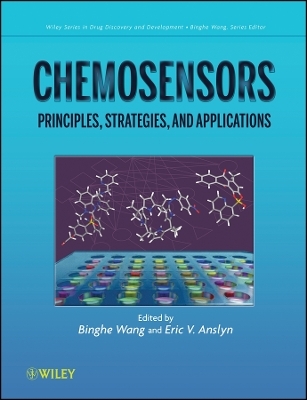
Chemosensors – Principles, Strategies and Applications
John Wiley & Sons Inc (Hersteller)
978-1-118-01958-0 (ISBN)
- Keine Verlagsinformationen verfügbar
- Artikel merken
BINGHE WANG, PhD , is Professor and Chair of the Department of Chemistry at Georgia State University as well as Georgia Research Alliance Eminent Scholar in Drug Discovery. He is Editor-in-Chief of the journal Medicinal Research Reviews, series editor for the Wiley Series in Drug Discovery and Development, and coeditor of Drug Delivery: Principles and Applications and Carbohydrate Recognition: Biological Problems, Methods, and Applications, both from Wiley. ERIC V. ANSLYN, PhD , is the Norman Hackerman Professor of Chemistry at the University of Texas at Austin. His research interests include physical organic chemistry, molecular recognition, sensor design, and sensor arrays.
Contributors. Preface. SECTION 1 FORCES GOVERNING EXCHANGEABLE INTERACTIONS. 1 van der Waals Interactions and the Hydrophobic Effect ( Bruce C. Gibb ). 2 Ionic, Hydrogen Bond, and p -Cation Interactions ( Hector Adam Velazquez and Donald Hamelberg ). 3 Covalent Interactions in Chemosensor Design ( Yunfeng Cheng, Xiaochuan Yang, and Binghe Wang ). 4 Metal Chelation Chemistry ( Dongwhan Lee ). SECTION 2 STRATEGIES TOWARD BUILDING THE DESIRED BINDING MOIETY. 5 Scaffold Design Using Computational Chemistry ( Dale Drueckhammer ). 6 Combinatorial Search of Sensors ( Marc Vendrell, Suihan Feng, and Young-Tae Chang ). 7 Molecular Imprinting and Sensor Development ( Yagang Zhang and Ken D. Shimizu ). 8 Dendrimer-Based Sensors ( Lin Pu ). 9 Nanoparticles and Sensors ( Yi-Cheun Yeh, Sarit S. Agasti, Krishnendu Saha, and Vincent M. Rotello ). 10 Aptamer Selection, Phage Display, and Sensor Development ( Hui Wang, Yan Chen, and Weihong Tan ). 11 Sensor Development Using Existing Scaffolds ( Hiroyasu Yamaguchi, Tomoki Ogoshi, and Akira Harada ). SECTION 3 DETECTION METHODS IN CHEMOSENSING. 12 Fluorescent Detection Principles and Strategies ( Raman Parkesh, Emma B. Veale, and Thorfinnur Gunnlaugsson ). 13 New Fluorophore Design ( Michael D. Heagy ). 14 Colorimetric Sensor Design ( Kevin L. Bicker, Sheryl L. Wiskur, and John J. Lavigne ). 15 Electrochemical Detection ( Simon R. Bayly, George Z. Chen, and Paul D. Beer ). 16 Surface Plasmon Resonance and Quartz Crystal Microbalance Methods for Detection of Molecular Interactions ( Yang Liu, Archana Jaiswal, Mark A. Poggi, and W. David Wilson ). 17 Array-Based Sensors ( Pavel Anzenbacher and Manuel A. Palacios ). SECTION 4 CHEMOSENSORS: CASE STUDIES. 18 Design of Cation-Selective Synthetic Fluorescent Indicators ( Christoph J. Fahrni ). 19 Anion Sensors ( Philip A. Gale and Claudia Caltagirone ). 20 Chemosensors: Case Studies of Indicators for Organic Molecules ( Oleksandr Rusin, Jorge O. Escobedo, and Robert M. Strongin ). 21 Molecular Recognition Elements for Toxin and Pathogen Detection ( Daniel M. Lewallen, Duane M. Hatch, and Suri S. Iyer ). 22 Chemical Sensing and Detection in Forensic Science ( Simon W. Lewis ). Index.
| Erscheint lt. Verlag | 19.7.2011 |
|---|---|
| Verlagsort | New York |
| Sprache | englisch |
| Maße | 150 x 250 mm |
| Gewicht | 666 g |
| Themenwelt | Medizin / Pharmazie |
| Naturwissenschaften ► Chemie ► Organische Chemie | |
| ISBN-10 | 1-118-01958-X / 111801958X |
| ISBN-13 | 978-1-118-01958-0 / 9781118019580 |
| Zustand | Neuware |
| Informationen gemäß Produktsicherheitsverordnung (GPSR) | |
| Haben Sie eine Frage zum Produkt? |
aus dem Bereich