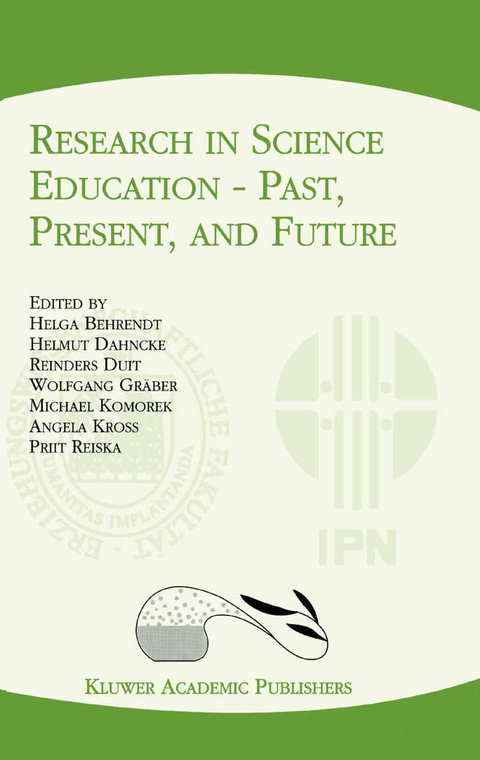
Research in Science Education — Past, Present, and Future
Springer (Verlag)
978-90-481-5631-3 (ISBN)
Views and Visions of Science Education Research.- Science Education Researchers and Research in Transition: Issues and Policies.- Research in Science Education in Europe: Retrospect and Prospect.- Science Content as Problematic - Issues for Research.- Science Education Versus Science in the Academy: Questions - Discussion - Perspectives.- Scientific Literacy — Conceptions and Assessment.- The Assessment of Scientific Literacy in the OECD/PISA Project.- Scientific Literacy: From Theory to Practice.- Making Formative Use of a National Summative Assessment Regime.- A Comparison of STS-teaching and Traditional Physics Lessons - On the Correlation of Physics Knowledge and Taking Action.- Students’ Conceptions.- On the Quantum Thinking of Physics Undergraduates.- Experiences with a Modern Course in Quantum Physics.- Learning Process Studies in the Field of Fractals.- Students’ Understandings of their Internal Structure as Revealed by Drawings.- Personal Context and Continuity of Human Thought; Recurrent Themes in a Longitudinal Study of Pupils’ Understanding of Scientific Phenomena.- Entities of the World and Causality in Children’s Thinking.- Using Media Reports of Science Research in Pupils’ Evaluation of Evidence.- Pupils’ Perceptions of Science Education at Primary and Secondary School.- Teachers’ Conceptions.- Teacher Professionalism and Change: Developing a Professional Self Through Reflective Assessment.- Formative Assessment Using Concept Cartoons: Initial Teacher Training in the UK.- Teaching Chemical Equilibrium in Australian and German Senior High Schools.- The Ideas of Spanish Primary Teachers on how to Develop an Understanding of Processes in Science and their Support in Textbooks.- Pre-service Elementary Teachers Constructing the Nature andLanguage of Science.- Combining Knowledge of Physics and Chemistry in Teaching: The Behaviour of a Narrow Jet of Water in the Presence of Charged Insulators.- Intuitive Rules: A Theory and its Implications to Mathematics and Science Teacher Education.- Conceptual Change — Teaching and Learning Processes.- Conceptual Change Research and the Teaching of Science.- Rhetoric and Science Education.- Development of Complexity through Dealing with Physical Qualities: One Type of Conceptual Change?.- On the Micro-structure of Analogical Reasoning: The Case of Understanding Chaotic Systems.- Role-playing, Conceptual Change, and the Learning Process: A Case Study of 7th Grade Pupils.- Concept Mapping as a Tool for Research in Science Education.- The Need for and the Role of Metacognition in Teaching and Learning the Particle Model.- Evolving Mental Models of Electric Circuits.- Two Models for a Physical Situation: the Case of Optics. Students’ Difficulties, Teachers’ Viewpoints and Guidelines for a ?Didactic Structure?.- The Influence of a Historically Oriented Course on the Content Knowledge of Students in Optics.- Using Everyday and Scientific Conceptions for Developing Guidelines of Teaching Microbiology.- Teaching and Learning the Concept of the Model in Secondary Schools.- Conceptual Change and Student Diversity: The Case of Volcanism at Primary School.- The Development of Prospective Teachers’ Concerns about Teaching Chemistry Topics at a Macro-micro-symbolic Interface.- How to Enhance Students’ Motivation and Ability to Communicate in Science Class-discourse.- How do Boys and Girls use Language in Physics Classes?.- Instructional Media and Lab Work.- Improving the Use of Instructional Illustrations in Learning Chemistry.- Computing in Stereochemistry - 2D or3D Representations?.- Learning Physics with Multimedia- and Experimental-supported Workshop Instruction.- Generating Hypotheses in Scientific Enquiry.- Using Laboratory Work for Purposeful Learning about the Practice of Science.- University Students During Practical Work: Can We Make the Learning Process Intelligible?.- Learning About Investigations - The Teacher’s Role.- Point and Set Paradigms in Students’ Handling of Experimental Measurements.- Beyond the Laboratory-learning Physics Using Real-life Contexts.
| Zusatzinfo | VIII, 344 p. |
|---|---|
| Verlagsort | Dordrecht |
| Sprache | englisch |
| Maße | 155 x 235 mm |
| Themenwelt | Schulbuch / Wörterbuch |
| Geisteswissenschaften ► Psychologie ► Pädagogische Psychologie | |
| Medizin / Pharmazie ► Medizinische Fachgebiete ► Psychiatrie / Psychotherapie | |
| Naturwissenschaften ► Chemie | |
| Sozialwissenschaften ► Pädagogik ► Erwachsenenbildung | |
| Sozialwissenschaften ► Pädagogik ► Schulpädagogik / Grundschule | |
| ISBN-10 | 90-481-5631-9 / 9048156319 |
| ISBN-13 | 978-90-481-5631-3 / 9789048156313 |
| Zustand | Neuware |
| Informationen gemäß Produktsicherheitsverordnung (GPSR) | |
| Haben Sie eine Frage zum Produkt? |
aus dem Bereich