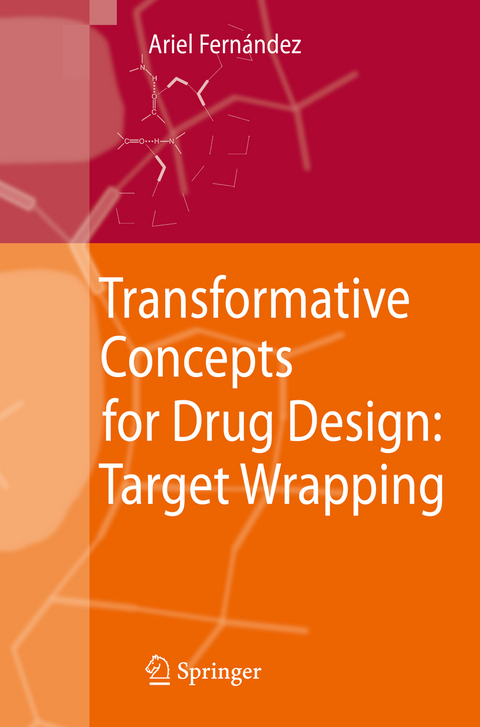
Transformative Concepts for Drug Design: Target Wrapping
Springer Berlin (Verlag)
978-3-642-11791-6 (ISBN)
Protein Cooperativity and Wrapping: Two Themes in the Transformative Platform of Molecular Targeted Therapy.- Wrapping Defects and the Architecture of Soluble Proteins.- Folding Cooperativity and the Wrapping of Intermediate States of Soluble Natural Proteins.- Wrapping Deficiencies and De-wetting Patterns in Soluble Proteins: A Blueprint for Drug Design.- Under-Wrapped Proteins in the Order-Disorder Twilight: Unraveling the Molecular Etiology of Aberrant Aggregation.- Evolution of Protein Wrapping and Implications for the Drug Designer.- Wrapping as a Selectivity Filter for Molecular Targeted Therapy: Preliminary Evidence.- Re-engineering an Anticancer Drug to Make It Safer: Modifying Imatinib to Curb Its Side Effects.- Wrapping Patterns as Universal Markers for Specificity in the Therapeutic Interference with Signaling Pathways.- Fulfilling a Therapeutic Imperative in Cancer Treatment: Control of Multi-target Drug Impact.- Inducing Folding By Crating the Target.- Wrapper Drugs as Therapeutic Editors of Side Effects.- Wrapper Drugs for Personalized Medicine.- Last Frontier and Back to the Drawing Board: Protein-Water Interfacial Tension in Drug Design.
From a News Release of the Rice University, Houston, Texas: "Drug Design: New book introduces fresh approach. Rice professor says drug industry can improve drug safety, lower costs. The pharmaceutical industry can reduce costs, bring new drugs to market more quickly and decrease the dangerous side effects of new medications if it pays closer attention to the latest research regarding the subtle differences between closely related protein targets. A new book, "Transformative Concepts for Drug Design: Target Wrapping" (Springer) by Rice University bioengineering professor Ariel Fernandez, suggests new methods the industry can use to improve its bottom line today. ... Fernandez said it takes about a decade and costs about $1 billion to bring a new drug to market, and the lead time and costs for drug development are increasing."
From a News Release of the Rice University, Houston, Texas:
"Drug Design: New book introduces fresh approach. Rice professor says drug industry can improve drug safety, lower costs.
The pharmaceutical industry can reduce costs, bring new drugs to market more quickly and decrease the dangerous side effects of new medications if it pays closer attention to the latest research regarding the subtle differences between closely related protein targets.
A new book, "Transformative Concepts for Drug Design: Target Wrapping" (Springer) by Rice University bioengineering professor Ariel Fernandez, suggests new methods the industry can use to improve its bottom line today. ...
Fernandez said it takes about a decade and costs about $1 billion to bring a new drug to market, and the lead time and costs for drug development are increasing."
| Erscheint lt. Verlag | 11.5.2010 |
|---|---|
| Zusatzinfo | X, 230 p. |
| Verlagsort | Berlin |
| Sprache | englisch |
| Maße | 155 x 235 mm |
| Gewicht | 1 g |
| Themenwelt | Medizin / Pharmazie ► Physiotherapie / Ergotherapie ► Orthopädie |
| Technik | |
| Schlagworte | Base • Biophysics • Cancer Treatment • Chemistry • clinical trial • drug design • drug discovery • Kinases • medicinal chemistry • Medicine • molecular biophysics • Molecular Cancer Therapy • Protein • Protein Structure • targeted therapy • target wrapping • Textbook • Translation |
| ISBN-10 | 3-642-11791-0 / 3642117910 |
| ISBN-13 | 978-3-642-11791-6 / 9783642117916 |
| Zustand | Neuware |
| Informationen gemäß Produktsicherheitsverordnung (GPSR) | |
| Haben Sie eine Frage zum Produkt? |
aus dem Bereich