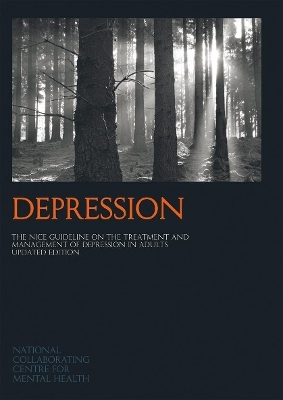
Depression
RCPsych Publications
978-1-904671-85-5 (ISBN)
- Keine Verlagsinformationen verfügbar
- Artikel merken
Depression affects 6% of adults each year and is the leading
cause of suicide. Its symptoms can be disabling and its effects pervasive,
impacting on not only the individual patient but also on their families and the
wider society. This book is an invaluable resource enabling healthcare
professionals to recognise, assess and offer effective treatments for this
common mental health problem, which can become a chronic disorder if
inadequately treated.
This updated guideline includes new sections on: current
practice; service user and carer experiences; emphasis on low-intensity
psychosocial interventions and an increased range of effective psychological
interventions; and the management of subthreshold depressive symptoms.
This guideline is an update of the previous guidance from
NICE (full guideline published 2004) on depression.
NICE Mental Health Guidelines
These guidelines
from NICE set out clear recommendations, based on the best available evidence,
for health care professionals on how to work with and implement physical,
psychological and service-level interventions for people with various mental
health conditions.
The book contains the full guidelines that cannot be
obtained in print anywhere else. It brings together all of the evidence that led
to the recommendations made, detailed explanations of the methodology behind
their preparation, plus an overview of the condition covering detection,
diagnosis and assessment, and the full range of treatment and care
approaches.
The accompanying free CD-ROM contains all the data used as
evidence, including:
Included and excluded studies.
Profile tables that summarise both the quality of the evidence and the
results of the evidence synthesis.
All meta-analytical data, presented as forest plots.
Detailed information about how to use and interpret forest plots.
The National Collaborating Centre for Mental Health (NCCMH) was established in 2001 by the UK-based National Institute for Health and Clinical Excellence (NICE) to develop guidance on the appropriate treatment and care of people with mental health problems and then write the clinical guidelines. The NCCMH is a partnership between the Royal College of Psychiatrists and the British Psychological Society.
Contents
1
Preface
1.1
National guideline
1.2
The national depression
guideline
2
Depression
2.1
The disorder
2.2
Aetiology
2.3
Economic costs of
depression
2.4
Treatment and management in the National
Health Service
3
Methods used to develop this
guideline
3.1
Overview
3.2
The scope
3.3
The Guideline Development
Group
3.4
Clinical questions
3.5
Systematic clinical literature
review
3.6
Health economics methods
3.7
Methods for reviewing experience of
care
3.8
Stakeholder contributions
3.9
Validation of the guideline
4
Experience of
care
4.1
Introduction
4.2
Personal accounts – people with
depression
4.3
Personal accounts – carers
4.4
Qualitative analysis
4.5
Review of the qualitative
literature
4.6
From evidence to
recommendations
4.7
Recommendations
5
Case identification and
service delivery
5.1
Introduction
5.2
The identification of depression in
primary care and community settings
5.3
Service delivery systems in the treatment
and management of depression
5.4
Stepped care
5.5
Collaborative care
5.6
Medication management
5.7
Crisis resolution and home treatment
teams
5.8
Acute day hospital care
5.9
Non-acute day hospital care
5.10
Non-statutory support
5.11
Research recommendation
6
Introduction to psychological
and psychosocial interventions
6.1
Introduction
6.2
Recommending psychological and
psychosocial treatments
6.3
How do psychological and psychosocial
interventions become evidence based?
6.4
Contextual factors that impact on
clinical practice
6.5
Databases searched and
inclusion/exclusion criteria
6.6
Studies considered
7
Low-intensity psychosocial
interventions
7.1
Computerised cognitive behavioural
therapy
7.2
Guided self-help
7.3
Physical activity
programmes
7.4
From evidence to recommendations-
low-intensity psychosocial interventions
7.5
Recommendations
8
High-intensity psychological
interventions
8.1
Cognitive and behavioural
therapies
8.2
Behavioural activation
8.3
Problem solving
8.4
Couples therapy
8.5
Interpersonal therapy
8.6
Counselling
8.7
Short-term psychodynamic
psychotherapy
8.8
Rational emotive behavioural
therapy
8.9
Economic modelling
8.10
From evidence to
recommendations
8.11
Recommendations
8.12
Research recommendations
9
Introduction to
pharmacological and physical interventions
9.1
Introduction
9.2
Dose and duration of antidepressant
treatment: evidence from clinical practice
9.3
Limitations of the literature: problems
with randomised controlled trials in pharmacology
9.4
Studies considered for review –
additional inclusion criteria
9.5
Issues and topics covered by this
review
9.6
Placebo-controlled randomised controlled
trials of antidepressants
9.7
Selective serotonin reuptake inhibitors
versus placebo
9.8
Tricyclic antidepressants versus
placebo
9.9
From evidence to
recommendations
9.10
Recommendation
10
Pharmacological
interventions
10.1
Introduction
10.2
Use of individual drugs in the treatment
of depression
10.3
Tricyclic antidepressants
10.4
Selective serotonin reuptake
inhibitors
10.5
Escitalopram
10.6
The THREAD study
10.7
Monoamine oxidase
inhibitors
10.8
Third-generation
antidepressants
10.9
St John’s wort
10.10
Health economics evidence
10.11
Network meta-analysis of newer
antidepressants
10.12
Economic model for the cost-effectiveness
of pharmacological interventions for people with depression
10.13
From evidence to
recommendations
10.14
Clinical practice
recommendations
10.15
When to change antidepressant treatment
when symptoms of depression are not improving
11
Factors influencing choice of
antidepressants
11.1
Introduction
11.2
The pharmacological management of
depression in older adults
11.3
The effect of sex on antidepressant
choice
11.4
The pharmacological management of
depression with psychotic symptoms
11.5
The pharmacological management of
atypical depression
11.6
The physical and pharmacological
management of depression with a seasonal pattern
11.7
Dosage issues for tricyclic
antidepressants
11.8
Antidepressant discontinuation
symptoms
11.9
The cardiotoxicity of
antidepressants
11.10
Depression, antidepressants and
suicide
12
The pharmacological and
physical management of depression that has not adequately responded to
treatment, and relapse prevention
12.1
Introduction
12.2
Approach to the reviews
12.3
Pharmacological `next-step’ treatment for
depression that has not adequately responded to treatment
12.4
Electroconvulsive therapy
12.5
Other non-pharmacological physical
treatments
12.6
The pharmacological management of relapse
prevention
13
The management of
subthreshold depressive symptoms
13.1
Introduction
13.2
Pharmacological interventions for
subthreshold depressive symptoms and persistent subthreshold depressive symptoms
(dysthymia)
13.3
Psychological and other strategies for
the treatment of persistent subthreshold depressive symptoms
(dysthymia)
13.4
From evidence to
recommendations
13.5
Recommendations
13.6
Research recommendations
14
Summary of
recommendations
14.1
Care of all people with
depression
14.2
Stepped care
14.3
Step 1: recognition, assessment and
initial management
14.4
Step 2: recognised depression -
persistent subthreshold depressive symptoms or mild to moderate
depression
14.5
Step 3: persistent subthreshold
depressive symptoms or mild to moderate depression with inadequate response to
initial interventions, and moderate and severe depression
14.6
Treatment choice based on depression
subtypes and personal characteristics
14.7
Enhanced care for
depression
14.8
Sequencing treatments after initial
inadequate response
14.9
Continuation and relapse
prevention
14.1
Step 4: complex and severe
depression
14.1
Research recommendations
15
Appendices
16
References
17
Abbreviations
| Erscheint lt. Verlag | 1.8.2010 |
|---|---|
| Reihe/Serie | NICE Guidelines |
| Verlagsort | London |
| Sprache | englisch |
| Maße | 170 x 240 mm |
| Gewicht | 1180 g |
| Themenwelt | Medizin / Pharmazie ► Gesundheitswesen |
| Medizin / Pharmazie ► Medizinische Fachgebiete ► Psychiatrie / Psychotherapie | |
| ISBN-10 | 1-904671-85-3 / 1904671853 |
| ISBN-13 | 978-1-904671-85-5 / 9781904671855 |
| Zustand | Neuware |
| Informationen gemäß Produktsicherheitsverordnung (GPSR) | |
| Haben Sie eine Frage zum Produkt? |
aus dem Bereich