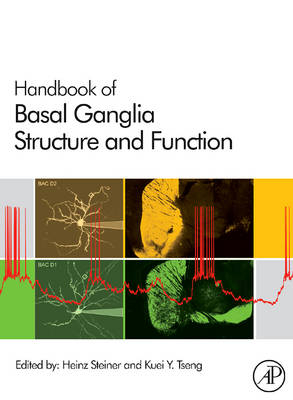
Handbook of Basal Ganglia Structure and Function
Academic Press Inc (Verlag)
978-0-12-374767-9 (ISBN)
- Titel erscheint in neuer Auflage
- Artikel merken
The Basal Ganglia comprise a group of forebrain nuclei that are interconnected with the cerebral cortex, thalamus and brainstem. Basal ganglia circuits are involved in various functions, including motor control and learning, sensorimotor integration, reward and cognition. The importance of these nuclei for normal brain function and behavior is emphasized by the numerous and diverse disorders associated with basal ganglia dysfunction, including Parkinson’s disease, Tourette’s syndrome, Huntington’s disease, obsessive-compulsive disorder, dystonia, and psychostimulant addiction.
The Handbook of Basal Ganglia provides a comprehensive overview of the structural and functional organization of the basal ganglia, with special emphasis on the progress achieved over the last 10-15 years. Organized in six parts, the volume describes the general anatomical organization and provides a review of the evolution of the basal ganglia, followed by detailed accounts of recent advances in anatomy, cellular/molecular, and cellular/physiological mechanisms, and our understanding of the behavioral and clinical aspects of basal ganglia function and dysfunction.
Heinz Steiner is Professor and Chair of the Department of Cellular and Molecular Pharmacology at the Chicago Medical School/Rosalind Franklin University of Medicine and Science in Chicago, Illinois. Dr. Steiner is an expert on the functional organization of the basal ganglia and related brain systems. His research focuses, in particular, on the role of the neurotransmitter dopamine in the regulation of basal ganglia–cortical interactions; his recent investigations examine how chronic enhancement of dopamine actions produce changes in gene regulation, and how these molecular alterations affect basal ganglia function and behavior. He has been the North America Regional Editor for the journal Basal Ganglia since 2011. Kuei Y. Tseng is Associate Professor in the Department of Cellular and Molecular Pharmacology at the Chicago Medical School/Rosalind Franklin University of Medicine and Science in Chicago, Illinois. Dr. Tseng’s research focuses on the neural bases of Parkinson’s disease, particularly the effects of dopamine loss within the cortico–basal ganglia circuitry and the mechanisms underlying information processing in the brains of individuals affected by Parkinson’s disease. He is the editor of two books on the cortex.
Part A: The Basal Ganglia System and its Evolution
Chapter 1. The Neuroanatomical Organization of the Basal Ganglia
Charles R. Gerfen
Chapter 2. The Conservative Evolution of the Vertebrate Basal Ganglia
A. Reiner
Chapter 3. Cell Types in the Different Nuclei of the Basal Ganglia
Dorothy E. Oorschot
Chapter 4. Neurotransmitter Receptors in the Basal Ganglia
Piers C. Emson, Henry Waldvogel and Richard Faull
Part B: Anatomy and Physiology of the Striatum
Chapter 5. The Striatal Skeleton: Medium Spiny Projection Neurons and their Lateral Connections
Dietmar Plenz and Jeffery R. Wickens
Chapter 6. D1 and D2 Dopamine Receptor Modulation of Striatal Glutamatergic Signaling in Striatal Medium Spiny Neurons
D. James Surmeier, Michelle Day, Tracy Gertler, Savio Chan and Weixing Shen
Chapter 7. The Cholinergic Interneurons of the Striatum: Intrinsic Properties Underlie Multiple Discharge Patterns
Joshua A. Goldberg and Charles J. Wilson
Chapter 8. GABAergic Interneurons of the Neostriatum
James M. Tepper
Chapter 9. Endocannabinoid Signaling in the Striatum
David M. Lovinger, Margaret I. Davis and Rui M. Costa
Chapter 10. Nitric Oxide Signaling in the Striatum
Anthony R. West
Chapter 11. Adenosine-Dopamine Receptor Interaction
Micaela Morelli, Simola Nicola, Popoli Patrizia and Carta Anna R.
Chapter 12. Regulation of Corticostriatal Synaptic Plasticity in Physiological and Pathological Conditions
Massimiliano Di Filippo and Paolo Calabresi
Part C: Anatomy and Physiology of Globus Pallidus, Subthalamic Nucleus and Substantia Nigra
Chapter 13. Organization of the Globus Pallidus
Hitoshi Kita
Chapter 14. Projections from Pallidum to Striatum
Pieter Voorn
Chapter 15. The Subthalamic Nucleus: From in vitro to in vivo Mechanisms
Stephane Charpier, Corinne Beurrier and Jeanne T. Paz
Chapter 16. Neurophysiology of Substantia Nigra Dopaminergic Neurons: Modulation by GABAergic Afferents
James M. Tepper
Chapter 17. Regulation of Extracellular Dopamine: Release and Reuptake
David Sulzer, Hui Zhang, Marianne Benoit-Marand, and Francois Gonon
Part D: Network Integration
Chapter 18. Organization of Corticostriatal Projection Neuron Types
Anton Reiner
Chapter 19. Gating of Cortical Input to the Striatum
Jeffery R. Wickens and Gordon W. Arbuthnott
Chapter 20. Organization of Prefrontal-Striatal Connections
Henk J. Groenewegen and Harry B.M. Uylings
Chapter 21. Gating of Limbic Input to the Ventral Striatum
Patricio O’Donnell
Chapter 22. Anatomical and Functional Organization of the Thalamostriatal Systems
Yoland Smith, Adriana Galvan, Dinesh Raju and Thomas Wichmann
Chapter 23. Subcortical Connections of the Basal Ganglia
David I.G. Wilson, Philip Winn and Peter Redgrave
Chapter 24. Integrative Networks across Basal Ganglia Circuits
Suzanne N. Haber
Chapter 25. Synchronous Activity in Basal Ganglia-Cortical Circuits
J.R. Walters and D.A. Bergstrom
Part E: Molecular Signaling in the Basal Ganglia
Chapter 26. Second Messenger Cascades
Stephanie E. Bronson and Christine Konradi
Chapter 27. Neurotransmitter Regulation of Basal Ganglia Gene Expression
Kristen A. Keefe and Kristen A. Horner
Chapter 28. D1-Dopamine Receptor Supersensitivity in the Striatum
Charles R. Gerfen
Chapter 29. Psychostimulant-Induced Gene Regulation in Cortico-Striatal Circuits
Heinz Steiner
Chapter 30. Chromatin Remodeling: Role in Neuropathologies of the Basal Ganglia
Jocelyne Caboche, Emmanuel Roze, Karen Brami-Cherrier and Sandrine Betuing
Part F: Basal Ganglia Function and Dysfunction
Chapter 31. Phasic Dopamine Signaling and Basal Ganglia Function
Peter Redgrave, Veronique Coizet and John Reynolds
Chapter 32. Basal Ganglia-Mediated Motor Learning
M.G. Packard
Chapter 33. Drug Addiction: The Neural and Psychological Basis of a Compulsive Incentive Habit
David Belin and Barry J. Everitt
Chapter 34. Environmental Contributions to Parkinson’s disease: Cross Talk between Environmental Factors and Gene Defects
Gloria E. Meredith and Susan Totterdell
Chapter 35. Alterations in Corticostriatal Synaptic Function in Huntington’s and Parkinson’s Diseases
Carlos Cepeda, Nigel S. Bamford, Véronique M. André and Michael S. Levine
Chapter 36. Molecular Mechanisms of L-DOPA-Induced Dyskinesia
M. Angela Cenci
Chapter 37. Compensatory Mechanisms in Experimental and Human Parkinsonism: Potential for New Therapies
Erwan Bezard, Grégory Porras, Javier Blesa and José A. Obeso
Chapter 38. Pathological Synchrony of Basal Ganglia-Cortical Networks in the Systemic MPTP Primate Model of Parkinson's Disease
Hagai Bergman, Adam Zaidel, Boris Rosin, Maya Slovik, Michal Rivlin-Etzion, Shay Moshel and Zvi Israel
Chapter 39. Deep-Brain Stimulation for Neurologic and Psychiatric Disorders
Mahlon R. DeLong and Thomas Wichmann
| Erscheint lt. Verlag | 17.3.2010 |
|---|---|
| Reihe/Serie | Handbook of Behavioral Neuroscience |
| Verlagsort | San Diego |
| Sprache | englisch |
| Maße | 216 x 276 mm |
| Gewicht | 2190 g |
| Themenwelt | Medizin / Pharmazie ► Medizinische Fachgebiete ► Neurologie |
| ISBN-10 | 0-12-374767-8 / 0123747678 |
| ISBN-13 | 978-0-12-374767-9 / 9780123747679 |
| Zustand | Neuware |
| Informationen gemäß Produktsicherheitsverordnung (GPSR) | |
| Haben Sie eine Frage zum Produkt? |
aus dem Bereich