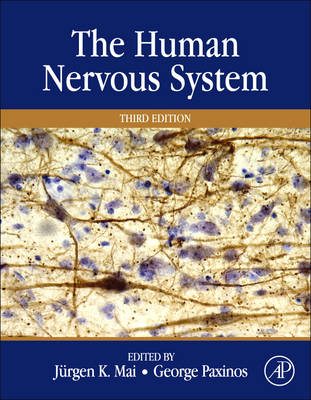
The Human Nervous System
Academic Press Inc (Verlag)
978-0-12-374236-0 (ISBN)
- Titel erscheint in neuer Auflage
- Artikel merken

The previous two editions of the Human Nervous System have been the standard reference for the anatomy of the central and peripheral nervous system of the human. The work has attracted nearly 2,000 citations, demonstrating that it has a major influence in the field of neuroscience. The 3e is a complete and updated revision, with new chapters covering genes and anatomy, gene expression studies, and glia cells. The book continues to be an excellent companion to the Atlas of the Human Brain, and a common nomenclature throughout the book is enforced. Physiological data, functional concepts, and correlates to the neuroanatomy of the major model systems (rat and mouse) as well as brain function round out the new edition.
Professor Mai studied medicine in Freiburg, Germany, Vienna and UT Southwestern Medical School, Dallas, U.S.A. Student and Medical practices in Freiburg (Clinic for Neurosurgery), Berlin and Düsseldorf. Dissertation ("summa cum laude") and habilitation were awarded by the University of Düsseldorf: After a period as GP in private practice (Titisee-Neustadt) he became scientific assistant and senior assistant at the C. and O. Vogt-Institute for Brain Research, University of Düsseldorf (1972 - 1983) and Professor of Neuroanatomy at the Institute of Neuroanatomy, H.-Heine-University of Düsseldorf. He served as director of the Department of the Institute of Anatomy 1 until retirement in 2011. His main research interests are (i) the structural and molecular anatomy of the mammalian brain and (ii) expression patterns and regulation of terminal carbohydrates in development, cell activation and disease (III) operation planning in stereotactic neurosurgery. He works on a "Digital Brain Atlas for Planning and Interindividual Registration of Targets in Deep Brain Stimulation" and on a "Spatial Information Management Resource for the Human Brain". J. K. Mai has edited the catalogue of human brain sections from the Vogt collection; he is author and editor of several books, e.g. the awarded "Atlas of the Human Brain" (Academic Press/Elsevier, San Diego), "The Human Nervous System" (Academic Press/Elsevier, San Diego, Amsterdam, 3rd ed. 2012), Human Brain in Standard MNI Space: A Comprehensive Pocket Atlas (Academic Press/Elsevier, San Diego, 2017; with M. Majtanik), Funktionelle Anatomie für Zahnmediziner (Quintessenz, Berlin, 2nd. ed. 2008; Sensi Divini (ital., engl., ger, russ. eds). J. K. Mai is founder and CEO of MR-X-Brain GmbH. George Paxinos has written 62 books on the brain of humans, monkeys, rodents and birds. His first atlas, The Rat Brain in Stereotaxic Coordinates, is the most cited neuroscience publication. His Atlas of the Human Brain received The Award for Excellence in Publishing in Medical Science (Assoc American Publishers, 1997) and The British Medical Association Illustrated Book Award (2016). His eco-fiction book A River Divided (georgepaxinos.com.au) considers the question of whether the brain in the Goldilocks Zone - the right “size for survival.
I: Evolution and Development
Brain evolution, Nervous system, Fetal Development of the central nervous system, Development of the peripheral nervous system
II: PERIPHERAL NERVOUS SYSTEM AND SPINAL CORD
Peripheral motor system, Peripheral autonomic pathways, Spinal cord: cyto and chemo architecture, Spinal cord: connection
III: BRAINSTEM AND CEREBELLUM
Organization of human brain stem nuclei, Reticular formation: eye movements gaze and blinks, Periaqueductal gray, Raphe nuclei, Locus coeruleus, Substantia nigra, ventral tegmental area and retrobrul field, The brainstem cholinergic system, Cerebellum and precerebellar nuclei
IV: DIENCEPHALON, BASAL GANGLIA, BASAL FOREBRAIN AND AMYGDALA
Hypothalamus, Hypophysis, Circumventricular organs, Thalamus, The basal ganglia
Basal forebrain, Amygdala
V: CORTEX
Architecture of the human cerebral cortex, Hippocampal formation, Cingulate gyrus,
The frontal cortex/ lobes, Motor cortex, Posterior parietal cortex, Temporal cortex, Lower Brain Stem Regulation of Visceral, Cardiovascular and Respiratory Function
VI: SYSTEMS
Somatosensory system, Trigeminal sensory system, Pain system, Gustatory system, Olfaction, Vestibular system, Auditory system, Visual system, Emotional system, Cerebral vascular system
| Verlagsort | San Diego |
|---|---|
| Sprache | englisch |
| Maße | 210 x 279 mm |
| Gewicht | 3080 g |
| Themenwelt | Geisteswissenschaften ► Psychologie ► Biopsychologie / Neurowissenschaften |
| Medizin / Pharmazie ► Medizinische Fachgebiete ► Neurologie | |
| Studium ► 1. Studienabschnitt (Vorklinik) ► Anatomie / Neuroanatomie | |
| Studium ► 1. Studienabschnitt (Vorklinik) ► Physiologie | |
| ISBN-10 | 0-12-374236-6 / 0123742366 |
| ISBN-13 | 978-0-12-374236-0 / 9780123742360 |
| Zustand | Neuware |
| Informationen gemäß Produktsicherheitsverordnung (GPSR) | |
| Haben Sie eine Frage zum Produkt? |
aus dem Bereich