


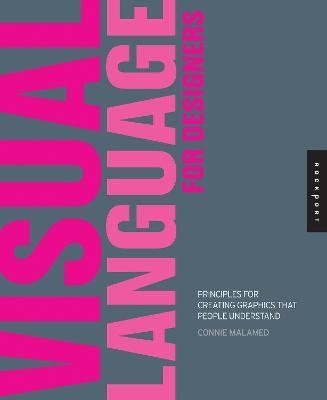
Visual Language for Designers
Principles for Creating Graphics that People Understand
Seiten
2009
Rockport Publishers Inc. (Verlag)
978-1-59253-515-6 (ISBN)
Rockport Publishers Inc. (Verlag)
978-1-59253-515-6 (ISBN)
- Titel ist leider vergriffen;
keine Neuauflage - Artikel merken
Intends to promote user-centric graphics by exploring simple design principles that are based on the way viewers understand and learn from visual information. This book encourages graphic designers to communicate more effectively and accurately with images.
Normal0MicrosoftInternetExplorer4Within every picture is a hidden language that conveys a message, whether it is intended or not. This language is based on the ways people perceive and process visual information. By understanding visual language as the interface between a graphic and a viewer, designers and illustrators can learn to inform with accuracy and power.
In a time of unprecedented competition for audience attention and with an increasing demand for complex graphics, Visual Language for Designers explains how to achieve quick and effective communications. It presents ways to design for the strengths of our innate mental capacities and to compensate for our cognitive limitations.
Includes:
—How to organize graphics for quick perception
—How to direct the eyes to essential information
—How to use visual shorthand for efficient communication
—How to make abstract ideas concrete
—How to best express visual complexity
—How to charge a graphic with energy and emotion
Normal0MicrosoftInternetExplorer4Within every picture is a hidden language that conveys a message, whether it is intended or not. This language is based on the ways people perceive and process visual information. By understanding visual language as the interface between a graphic and a viewer, designers and illustrators can learn to inform with accuracy and power.
In a time of unprecedented competition for audience attention and with an increasing demand for complex graphics, Visual Language for Designers explains how to achieve quick and effective communications. It presents ways to design for the strengths of our innate mental capacities and to compensate for our cognitive limitations.
Includes:
—How to organize graphics for quick perception
—How to direct the eyes to essential information
—How to use visual shorthand for efficient communication
—How to make abstract ideas concrete
—How to best express visual complexity
—How to charge a graphic with energy and emotion
Connie Malamed has a background in art and cognitive psychology, with a B.S. in Art Education and an M.A. in Instructional Design and Technology. She is a consultant based in the Washington, D.C. area in the fields of e-learning, visual communication, media design, and information design. http://www.malamedconsulting.com
| Erscheint lt. Verlag | 1.6.2009 |
|---|---|
| Zusatzinfo | 300 |
| Sprache | englisch |
| Maße | 235 x 286 mm |
| Gewicht | 1361 g |
| Themenwelt | Kunst / Musik / Theater ► Design / Innenarchitektur / Mode |
| Mathematik / Informatik ► Informatik ► Grafik / Design | |
| ISBN-10 | 1-59253-515-1 / 1592535151 |
| ISBN-13 | 978-1-59253-515-6 / 9781592535156 |
| Zustand | Neuware |
| Informationen gemäß Produktsicherheitsverordnung (GPSR) | |
| Haben Sie eine Frage zum Produkt? |
Mehr entdecken
aus dem Bereich



aus dem Bereich
Die Kreativmaschine. Next Edition
Buch | Softcover (2024)
Verlag Hermann Schmidt
CHF 55,95
Schritt für Schritt zu Vektorkunst, Illustration und Screendesign
Buch | Hardcover (2023)
Rheinwerk (Verlag)
CHF 55,85


