


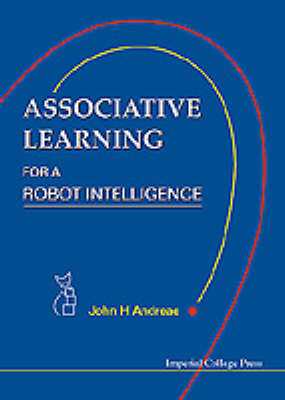
Associative Learning For A Robot Intelligence
Seiten
1998
Imperial College Press (Verlag)
978-1-86094-132-0 (ISBN)
Imperial College Press (Verlag)
978-1-86094-132-0 (ISBN)
- Titel z.Zt. nicht lieferbar
- Versandkostenfrei
- Auch auf Rechnung
- Artikel merken
A study of associative learning for a robot intelligence. It proposes that within an appropriate organization, associative learning can be embodied in a robot to realize a human-like intelligence, which sets its own goals, exhibits unique unformalizable behaviour and has no hidden homunculi.
The explanation of brain functioning in terms of the association of ideas has been popular since the 17th century. Recently, however, the process of association has been dismissed as computationally inadequate by prominent cognitive scientists. In this book, a sharper definition of the term “association” is used to revive the process by showing that associative learning can indeed be computationally powerful. Within an appropriate organization, associative learning can be embodied in a robot to realize a human-like intelligence, which sets its own goals, exhibits unique unformalizable behaviour and has no hidden homunculi.Some believe that artificial intelligence is undergoing a paradigm shift. There are undoubtedly several competing ideas and ideals. Neural networks and dynamic systems are offered as alternatives to the information processing and digital computer models of the brain. One is asked to decide between symbolic and subsymbolic, between algorithmic and nonalgorithmic, and between information processing and interactive systems. Even in the short distance travelled in this book, associative learning is seen to embrace both sides of these dichotomies.
The explanation of brain functioning in terms of the association of ideas has been popular since the 17th century. Recently, however, the process of association has been dismissed as computationally inadequate by prominent cognitive scientists. In this book, a sharper definition of the term “association” is used to revive the process by showing that associative learning can indeed be computationally powerful. Within an appropriate organization, associative learning can be embodied in a robot to realize a human-like intelligence, which sets its own goals, exhibits unique unformalizable behaviour and has no hidden homunculi.Some believe that artificial intelligence is undergoing a paradigm shift. There are undoubtedly several competing ideas and ideals. Neural networks and dynamic systems are offered as alternatives to the information processing and digital computer models of the brain. One is asked to decide between symbolic and subsymbolic, between algorithmic and nonalgorithmic, and between information processing and interactive systems. Even in the short distance travelled in this book, associative learning is seen to embrace both sides of these dichotomies.
Associative learning; the BunPie microworld; designing templates; numbers in the head; universal Turing machine; communicating intentions; consciousness before language; an hierarchical task; stress and disapproval; painted vision; co-operation; turn-taking; climbing a tree or building a rocket.
| Verlagsort | London |
|---|---|
| Sprache | englisch |
| Themenwelt | Informatik ► Theorie / Studium ► Künstliche Intelligenz / Robotik |
| ISBN-10 | 1-86094-132-X / 186094132X |
| ISBN-13 | 978-1-86094-132-0 / 9781860941320 |
| Zustand | Neuware |
| Informationen gemäß Produktsicherheitsverordnung (GPSR) | |
| Haben Sie eine Frage zum Produkt? |
Mehr entdecken
aus dem Bereich


aus dem Bereich
Eine praxisorientierte Einführung
Buch | Softcover (2025)
Springer Vieweg (Verlag)
CHF 53,15
Künstliche Intelligenz, Macht und das größte Dilemma des 21. …
Buch | Softcover (2025)
C.H.Beck (Verlag)
CHF 25,20
Buch | Softcover (2025)
Reclam, Philipp (Verlag)
CHF 11,20


