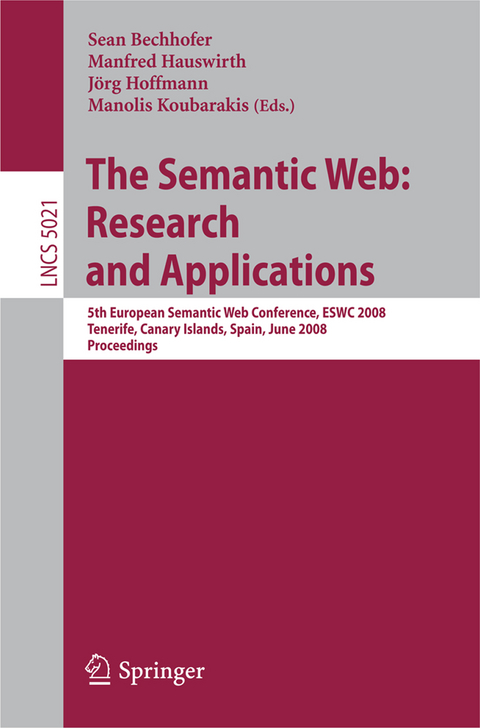
The Semantic Web: Research and Applications
Dr. Jörg Hoffmann ist Professor für Elektrische Meßtechnik, Prozeß- und Analysenmeßtechnik in Osnabrück, Herausgeber zum "Handbuch der Messtechnik" und "Taschenbuch der Messtechnik.
Invited Talks.- From Capturing Semantics to Semantic Search: A Virtuous Cycle.- Foundations of RDF Databases.- Garlik: Semantic Technology for the Consumer.- Agents.- Semantic Web Technology for Agent Communication Protocols.- xOperator - Interconnecting the Semantic Web and Instant Messaging Networks.- Application Ontologies.- An Ontology for Software Models and Its Practical Implications for Semantic Web Reasoning.- A Core Ontology for Business Process Analysis.- Applications.- Assisting Pictogram Selection with Semantic Interpretation.- KonneXSALT: First Steps Towards a Semantic Claim Federation Infrastructure.- Building a National Semantic Web Ontology and Ontology Service Infrastructure -The FinnONTO Approach.- Creating and Using Geospatial Ontology Time Series in a Semantic Cultural Heritage Portal.- Semantic Email as a Communication Medium for the Social Semantic Desktop.- IVEA: An Information Visualization Tool for Personalized Exploratory Document Collection Analysis.- Building a Semantic Web Image Repository for Biological Research Images.- Formal Languages.- Mapping Validation by Probabilistic Reasoning.- Safe and Economic Re-Use of Ontologies: A Logic-Based Methodology and Tool Support.- dRDF: Entailment for Domain-Restricted RDF.- Finite Model Reasoning in DL-Lite.- Module Extraction and Incremental Classification: A Pragmatic Approach for Ontologies.- Forgetting Concepts in DL-Lite.- Foundational Issues.- An Entity Name System (ENS) for the Semantic Web.- A Functional Semantic Web Architecture.- Learning.- Query Answering and Ontology Population: An Inductive Approach.- Instance Based Clustering of Semantic Web Resources.- Conceptual Clustering and Its Application to Concept Drift and Novelty Detection.- Ontologies and Natural Language.- Enrichingan Ontology with Multilingual Information.- Rabbit: Developing a Control Natural Language for Authoring Ontologies.- A Natural Language Query Interface to Structured Information.- Distinguishing between Instances and Classes in the Wikipedia Taxonomy.- Ontology Alignment.- Two Variations on Ontology Alignment Evaluation: Methodological Issues.- Putting Ontology Alignment in Context: Usage Scenarios, Deployment and Evaluation in a Library Case.- CSR: Discovering Subsumption Relations for the Alignment of Ontologies.- Query Processing.- XSPARQL: Traveling between the XML and RDF Worlds - and Avoiding the XSLT Pilgrimage.- Streaming SPARQL - Extending SPARQL to Process Data Streams.- The Creation and Evaluation of iSPARQL Strategies for Matchmaking.- Adding Data Mining Support to SPARQL Via Statistical Relational Learning Methods.- A Semantic Web Middleware for Virtual Data Integration on the Web.- Graph Summaries for Subgraph Frequency Estimation.- Querying Distributed RDF Data Sources with SPARQL.- Improving Interoperability Using Query Interpretation in Semantic Vector Spaces.- Search.- Hybrid Search: Effectively Combining Keywords and Semantic Searches.- Combining Fact and Document Retrieval with Spreading Activation for Semantic Desktop Search.- Q2Semantic: A Lightweight Keyword Interface to Semantic Search.- Semantic Web Services.- Conceptual Situation Spaces for Semantic Situation-Driven Processes.- Combining SAWSDL, OWL-DL and UDDI for Semantically Enhanced Web Service Discovery.- Web Service Composition with User Preferences.- Enhancing Workflow with a Semantic Description of Scientific Intent.- WSMO Choreography: From Abstract State Machines to Concurrent Transaction Logic.- WSMO-Lite Annotations for Web Services.- Storage and Retrieval of Semantic Web Data.-Semantic Sitemaps: Efficient and Flexible Access to Datasets on the Semantic Web.- On Storage Policies for Semantic Web Repositories That Support Versioning.- User Interface and Personalization.- Semantic Reasoning: A Path to New Possibilities of Personalization.- An User Interface Adaptation Architecture for Rich Internet Applications.- OntoGame: Weaving the Semantic Web by Online Games.- Demo Papers.-
| Erscheint lt. Verlag | 20.5.2008 |
|---|---|
| Reihe/Serie | Information Systems and Applications, incl. Internet/Web, and HCI | Lecture Notes in Computer Science |
| Zusatzinfo | XIX, 900 p. |
| Verlagsort | Berlin |
| Sprache | englisch |
| Maße | 155 x 235 mm |
| Gewicht | 1383 g |
| Themenwelt | Mathematik / Informatik ► Informatik ► Theorie / Studium |
| Mathematik / Informatik ► Informatik ► Web / Internet | |
| Informatik ► Weitere Themen ► Hardware | |
| Schlagworte | Agents • Alignment • automated reasoning • classification • conceptual modeling • crawling • Data Semantics • Description Logics • E-Learning • formal language • Hardcover, Softcover / Informatik, EDV/Internet • HCI • HC/Informatik, EDV/Internet • Information Visualization • knowledge management • learning • Metadata • natural language interfaces • Ontologies • Ontology • ontology engineering • OWL • Processing • Querying • Searching • semantic annotation • semantic interoperability • semantic search • semantic web • semantic Web browsing • semantic web languages • Semantic Web Mining • semantic web reasoning • semantic web security • semantic web services • taxonomies • Web Services • Wiki • XML |
| ISBN-13 | 9783540682332 / 9783540682332 |
| Zustand | Neuware |
| Informationen gemäß Produktsicherheitsverordnung (GPSR) | |
| Haben Sie eine Frage zum Produkt? |
aus dem Bereich