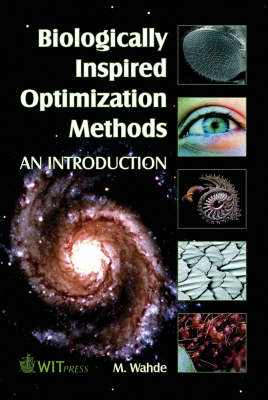
Biologically Inspired Optimization Methods
WIT Press (Verlag)
978-1-84564-148-1 (ISBN)
- Keine Verlagsinformationen verfügbar
- Artikel merken
The advent of rapid, reliable and cheap computing power over the last decades has transformed many, if not most, fields of science and engineering. The multidisciplinary field of optimization is no exception. First of all, with fast computers, researchers and engineers can apply classical optimization methods to problems of larger and larger size. In addition, however, researchers have developed a host of new optimization algorithms that operate in a rather different way than the classical ones, and that allow practitioners to attack optimization problems where the classical methods are either not applicable or simply too costly (in terms of time and other resources) to apply. This book is intended as a course book for introductory courses in stochastic optimization algorithms (in this book, the terms optimization method and optimization algorithm will be used interchangeably), and it has grown from a set of lectures notes used in courses, taught by the author, at the international master programme Complex Adaptive Systems at Chalmers University of Technology in Goteborg, Sweden.Thus, a suitable audience for this book are third and fourth-year engineering students, with a background in engineering mathematics (analysis, algebra, and probability theory) as well as some knowledge of computer programming.
Mattias Wahde is a researcher and teacher Adaptive Systems research group Vehicle Safety Division of the Applied Mechanics Department at the Chalmers University of Technology in Goteborg, Sweden, where research focuses on the development of control systems for autonomous robots capable of carrying out a variety of tasks, often tedious or dangerous, that are currently carried out by people. The research is based on biologically inspired computation methods, especially evolutionary algorithms.
1: Introduction The importance of optimization; Inspiration from biological phenomena; Optimization of a simple behaviour for an autonomous robot 2: Classical optimization Introduction; Taxonomy of optimization problems; Continuous optimization; Algorithms for continuous optimization; Limitations of classical optimization; Exercise 3: Evolutionary algorithms Biological background; Genetic algorithms; Linear genetic programming; Interactive evolutionary computation; Biological vs. artificial evolution; Applications; Exercises 4: Ant colony optimization Biological background; Ant algorithms; Applications; Exercises 5: Particle swarm optimization Biological background; Algorithm; Properties of PSO; Discrete versions; Applications; Exercises 6: Performance comparison Unconstrained function optimization; Constrained function optimization; Optimization of feedforward neural networks; The travelling salesman problem A : Neural networks Biological background; Artificial neural networks; Applications B: Analysis of optimization algorithms Classical optimization; Genetic algorithms; Ant colony optimization; Particle swarm optimization C: Data analysis Hypothesis evaluation; Experiment design D: Benchmark functions The Goldstein-Price function; The Rosenbrock function; The Sine square function; The Colville function; A multidimensional benchmark function
| Erscheint lt. Verlag | 20.8.2008 |
|---|---|
| Zusatzinfo | Illustrations |
| Verlagsort | Southampton |
| Sprache | englisch |
| Maße | 155 x 230 mm |
| Themenwelt | Mathematik / Informatik ► Mathematik ► Angewandte Mathematik |
| Mathematik / Informatik ► Mathematik ► Finanz- / Wirtschaftsmathematik | |
| ISBN-10 | 1-84564-148-5 / 1845641485 |
| ISBN-13 | 978-1-84564-148-1 / 9781845641481 |
| Zustand | Neuware |
| Informationen gemäß Produktsicherheitsverordnung (GPSR) | |
| Haben Sie eine Frage zum Produkt? |
aus dem Bereich