


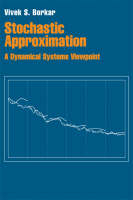
Stochastic Approximation
A Dynamical Systems Viewpoint
Seiten
2008
Cambridge University Press (Verlag)
978-0-521-51592-4 (ISBN)
Cambridge University Press (Verlag)
978-0-521-51592-4 (ISBN)
Simple, compact toolkit for designing and analyzing algorithms, with concrete examples from control and communications engineering, artificial intelligence, economic modelling.
This simple, compact toolkit for designing and analyzing stochastic approximation algorithms requires only basic literacy in probability and differential equations. Yet these algorithms have powerful applications in control and communications engineering, artificial intelligence and economic modelling. The dynamical systems viewpoint treats an algorithm as a noisy discretization of a limiting differential equation and argues that, under reasonable hypotheses, it tracks the asymptotic behaviour of the differential equation with probability one. The differential equation, which can usually be obtained by inspection, is easier to analyze. Novel topics include finite-time behaviour, multiple timescales and asynchronous implementation. There is a useful taxonomy of applications, with concrete examples from engineering and economics. Notably it covers variants of stochastic gradient-based optimization schemes, fixed-point solvers, which are commonplace in learning algorithms for approximate dynamic programming, and some models of collective behaviour. Three appendices give background on differential equations and probability.
This simple, compact toolkit for designing and analyzing stochastic approximation algorithms requires only basic literacy in probability and differential equations. Yet these algorithms have powerful applications in control and communications engineering, artificial intelligence and economic modelling. The dynamical systems viewpoint treats an algorithm as a noisy discretization of a limiting differential equation and argues that, under reasonable hypotheses, it tracks the asymptotic behaviour of the differential equation with probability one. The differential equation, which can usually be obtained by inspection, is easier to analyze. Novel topics include finite-time behaviour, multiple timescales and asynchronous implementation. There is a useful taxonomy of applications, with concrete examples from engineering and economics. Notably it covers variants of stochastic gradient-based optimization schemes, fixed-point solvers, which are commonplace in learning algorithms for approximate dynamic programming, and some models of collective behaviour. Three appendices give background on differential equations and probability.
Vivek S. Borkar is dean of the School of Technology and Computer Science at the Tata Institute of Fundamental Research. A distinguished researcher in stochastic and adaptive control, he distils his deep knowledge and broad experience in this motivating book.
Preface; 1. Introduction; 2. Basic convergence analysis; 3. Stability criteria; 4. Lock-in probability; 5. Stochastic recursive inclusions; 6. Multiple timescales; 7. Asynchronous schemes; 8. A limit theorem for fluctuations; 9. Constant stepsize algorithms; 10. Applications; 11. Appendices; References; Index.
| Erscheint lt. Verlag | 1.9.2008 |
|---|---|
| Zusatzinfo | Worked examples or Exercises |
| Verlagsort | Cambridge |
| Sprache | englisch |
| Maße | 157 x 233 mm |
| Gewicht | 380 g |
| Themenwelt | Mathematik / Informatik ► Mathematik ► Wahrscheinlichkeit / Kombinatorik |
| ISBN-10 | 0-521-51592-0 / 0521515920 |
| ISBN-13 | 978-0-521-51592-4 / 9780521515924 |
| Zustand | Neuware |
| Informationen gemäß Produktsicherheitsverordnung (GPSR) | |
| Haben Sie eine Frage zum Produkt? |
Mehr entdecken
aus dem Bereich

aus dem Bereich
Stochastik: von Abweichungen bis Zufall
Buch | Softcover (2025)
De Gruyter (Verlag)
CHF 48,90
Buch | Hardcover (2023)
Wiley-VCH (Verlag)
CHF 138,60


