


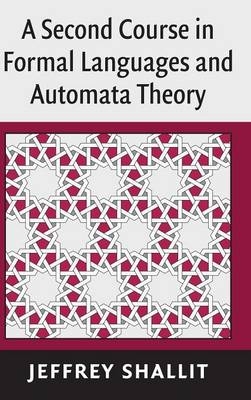
A Second Course in Formal Languages and Automata Theory
Seiten
2008
Cambridge University Press (Verlag)
978-0-521-86572-2 (ISBN)
Cambridge University Press (Verlag)
978-0-521-86572-2 (ISBN)
This graduate textbook covers topics in the theory of computation not usually covered in a first course. It explains combinatorics on words, regular languages, context-free languages, parsing and recognition, Turing machines, and other language classes, repetitions in words, state complexity, the interchange lemma, 2DPDAs, and more.
Written for graduate students and advanced undergraduates in computer science, A Second Course in Formal Languages and Automata Theory treats topics in the theory of computation not usually covered in a first course. After a review of basic concepts, the book covers combinatorics on words, regular languages, context-free languages, parsing and recognition, Turing machines, and other language classes. Many topics often absent from other textbooks, such as repetitions in words, state complexity, the interchange lemma, 2DPDAs, and the incompressibility method, are covered here. The author places particular emphasis on the resources needed to represent certain languages. The book also includes a diverse collection of more than 200 exercises, suggestions for term projects, and research problems that remain open.
Written for graduate students and advanced undergraduates in computer science, A Second Course in Formal Languages and Automata Theory treats topics in the theory of computation not usually covered in a first course. After a review of basic concepts, the book covers combinatorics on words, regular languages, context-free languages, parsing and recognition, Turing machines, and other language classes. Many topics often absent from other textbooks, such as repetitions in words, state complexity, the interchange lemma, 2DPDAs, and the incompressibility method, are covered here. The author places particular emphasis on the resources needed to represent certain languages. The book also includes a diverse collection of more than 200 exercises, suggestions for term projects, and research problems that remain open.
Jeffrey Shallit is Professor of the David R. Cheriton School of Computer Science at the University of Waterloo. He is the author of Algorithmic Number Theory (co-authored with Eric Bach) and Automatic Sequences: Theory, Applications, Generalizations (co-authored with Jean-Paul Allouche). He has published approximately 90 articles on number theory, algebra, automata theory, complexity theory, and the history of mathematics and computing.
1. Review of formal languages and automata theory; 2. Combinatorics on words; 3. Finite automata and regular languages; 4. Context-free grammars and languages; 5. Parsing and recognition; 6. Turing machines; 7. Other language classes.
| Erscheint lt. Verlag | 8.9.2008 |
|---|---|
| Zusatzinfo | Worked examples or Exercises; 12 Tables, unspecified |
| Verlagsort | Cambridge |
| Sprache | englisch |
| Maße | 157 x 229 mm |
| Gewicht | 480 g |
| Themenwelt | Mathematik / Informatik ► Informatik ► Theorie / Studium |
| ISBN-10 | 0-521-86572-7 / 0521865727 |
| ISBN-13 | 978-0-521-86572-2 / 9780521865722 |
| Zustand | Neuware |
| Informationen gemäß Produktsicherheitsverordnung (GPSR) | |
| Haben Sie eine Frage zum Produkt? |
Mehr entdecken
aus dem Bereich

aus dem Bereich
was jeder über Informatik wissen sollte
Buch | Softcover (2024)
Springer Vieweg (Verlag)
CHF 53,15
Grundlagen – Anwendungen – Perspektiven
Buch | Softcover (2022)
Springer Vieweg (Verlag)
CHF 53,15
Teil 2 der gestreckten Abschlussprüfung Fachinformatiker/-in …
Buch | Softcover (2025)
Europa-Lehrmittel (Verlag)
CHF 37,90


