


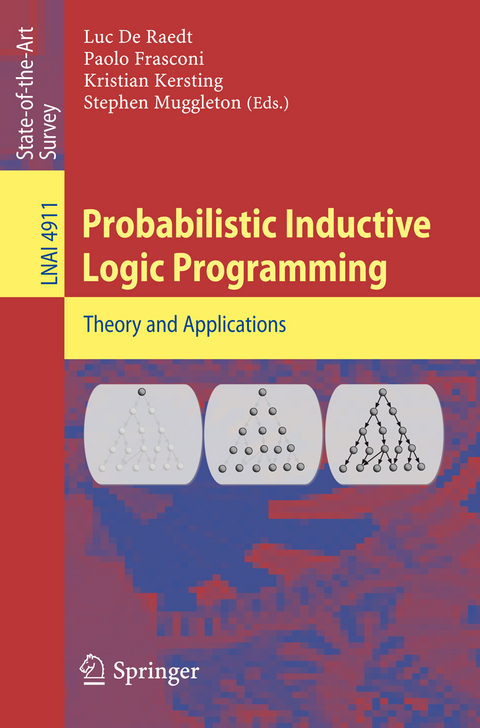
Probabilistic Inductive Logic Programming
Seiten
This book provides an introduction to probabilistic inductive logic programming. It places emphasis on the methods based on logic programming principles and covers formalisms and systems, implementations and applications, as well as theory.
One of the key open questions within arti?cial intelligence is how to combine probability and logic with learning. This question is getting an increased - tentioninseveraldisciplinessuchasknowledgerepresentation,reasoningabout uncertainty, data mining, and machine learning simulateously, resulting in the newlyemergingsub?eldknownasstatisticalrelationallearningandprobabil- ticinductivelogicprogramming.Amajordriving forceisthe explosivegrowth in the amount of heterogeneous data that is being collected in the business and scienti?c world. Example domains include bioinformatics, chemoinform- ics, transportation systems, communication networks, social network analysis, linkanalysis,robotics,amongothers.Thestructuresencounteredcanbeass- pleassequencesandtrees(suchasthosearisinginproteinsecondarystructure predictionandnaturallanguageparsing)orascomplexascitationgraphs,the WorldWideWeb,andrelationaldatabases. This book providesan introduction to this ?eld with an emphasison those methods based on logic programming principles. The book is also the main resultofthesuccessfulEuropeanISTFETprojectno.FP6-508861onAppli- tionofProbabilisticInductiveLogicProgramming(APRILII,2004-2007).This projectwascoordinatedbytheAlbertLudwigsUniversityofFreiburg(Germany, Luc De Raedt) and the partners were Imperial College London (UK, Stephen MuggletonandMichaelSternberg),theHelsinkiInstituteofInformationTe- nology(Finland,HeikkiMannila),theUniversit` adegliStudidiFlorence(Italy, PaoloFrasconi),andtheInstitutNationaldeRechercheenInformatiqueet- tomatiqueRocquencourt(France,FrancoisFages).Itwasconcernedwiththeory, implementationsandapplicationsofprobabilisticinductivelogicprogramming. Thisstructureisalsore?ectedinthebook. The book starts with an introductory chapter to Probabilistic Inductive LogicProgramming byDeRaedtandKersting.Inasecondpart,itprovidesa detailedoverviewofthemostimportantprobabilisticlogiclearningformalisms and systems. We are very pleased and proud that the scientists behind the key probabilistic inductive logic programming systems (also those developed outside the APRIL project) have kindly contributed a chapter providing an overviewoftheircontributions.Thisincludes:relationalsequencelearningte- niques (Kersting et al.), using kernels with logical representations (Frasconi andPasserini),MarkovLogic(Domingosetal.), the PRISMsystem (Satoand Kameya),CLP(BN)(SantosCostaetal.),BayesianLogicPrograms(Kersting andDeRaedt),andtheIndependentChoiceLogic(Poole).Thethirdpartthen provides a detailed account of some show-caseapplications of probabilistic - ductive logic programming, more speci?cally: in protein fold discovery (Chen et al.), haplotyping (Landwehr and Mielik ainen) and systems biology (Fages andSoliman). The ?nal parttouchesupon sometheoreticalinvestigationsand VI Preface includes chaptersonbehavioralcomparisonof probabilisticlogicprogramming representations(MuggletonandChen)andamodel-theoreticexpressivityan- ysis(Jaeger).
One of the key open questions within arti?cial intelligence is how to combine probability and logic with learning. This question is getting an increased - tentioninseveraldisciplinessuchasknowledgerepresentation,reasoningabout uncertainty, data mining, and machine learning simulateously, resulting in the newlyemergingsub?eldknownasstatisticalrelationallearningandprobabil- ticinductivelogicprogramming.Amajordriving forceisthe explosivegrowth in the amount of heterogeneous data that is being collected in the business and scienti?c world. Example domains include bioinformatics, chemoinform- ics, transportation systems, communication networks, social network analysis, linkanalysis,robotics,amongothers.Thestructuresencounteredcanbeass- pleassequencesandtrees(suchasthosearisinginproteinsecondarystructure predictionandnaturallanguageparsing)orascomplexascitationgraphs,the WorldWideWeb,andrelationaldatabases. This book providesan introduction to this ?eld with an emphasison those methods based on logic programming principles. The book is also the main resultofthesuccessfulEuropeanISTFETprojectno.FP6-508861onAppli- tionofProbabilisticInductiveLogicProgramming(APRILII,2004-2007).This projectwascoordinatedbytheAlbertLudwigsUniversityofFreiburg(Germany, Luc De Raedt) and the partners were Imperial College London (UK, Stephen MuggletonandMichaelSternberg),theHelsinkiInstituteofInformationTe- nology(Finland,HeikkiMannila),theUniversit` adegliStudidiFlorence(Italy, PaoloFrasconi),andtheInstitutNationaldeRechercheenInformatiqueet- tomatiqueRocquencourt(France,FrancoisFages).Itwasconcernedwiththeory, implementationsandapplicationsofprobabilisticinductivelogicprogramming. Thisstructureisalsore?ectedinthebook. The book starts with an introductory chapter to Probabilistic Inductive LogicProgramming byDeRaedtandKersting.Inasecondpart,itprovidesa detailedoverviewofthemostimportantprobabilisticlogiclearningformalisms and systems. We are very pleased and proud that the scientists behind the key probabilistic inductive logic programming systems (also those developed outside the APRIL project) have kindly contributed a chapter providing an overviewoftheircontributions.Thisincludes:relationalsequencelearningte- niques (Kersting et al.), using kernels with logical representations (Frasconi andPasserini),MarkovLogic(Domingosetal.), the PRISMsystem (Satoand Kameya),CLP(BN)(SantosCostaetal.),BayesianLogicPrograms(Kersting andDeRaedt),andtheIndependentChoiceLogic(Poole).Thethirdpartthen provides a detailed account of some show-caseapplications of probabilistic - ductive logic programming, more speci?cally: in protein fold discovery (Chen et al.), haplotyping (Landwehr and Mielik ainen) and systems biology (Fages andSoliman). The ?nal parttouchesupon sometheoreticalinvestigationsand VI Preface includes chaptersonbehavioralcomparisonof probabilisticlogicprogramming representations(MuggletonandChen)andamodel-theoreticexpressivityan- ysis(Jaeger).
Probabilistic Inductive Logic Programming.- Formalisms and Systems.- Relational Sequence Learning.- Learning with Kernels and Logical Representations.- Markov Logic.- New Advances in Logic-Based Probabilistic Modeling by PRISM.- CLP( ): Constraint Logic Programming for Probabilistic Knowledge.- Basic Principles of Learning Bayesian Logic Programs.- The Independent Choice Logic and Beyond.- Applications.- Protein Fold Discovery Using Stochastic Logic Programs.- Probabilistic Logic Learning from Haplotype Data.- Model Revision from Temporal Logic Properties in Computational Systems Biology.- Theory.- A Behavioral Comparison of Some Probabilistic Logic Models.- Model-Theoretic Expressivity Analysis.
| Erscheint lt. Verlag | 14.3.2008 |
|---|---|
| Reihe/Serie | Lecture Notes in Artificial Intelligence | Lecture Notes in Computer Science |
| Zusatzinfo | VIII, 341 p. |
| Verlagsort | Berlin |
| Sprache | englisch |
| Maße | 155 x 235 mm |
| Gewicht | 530 g |
| Themenwelt | Informatik ► Theorie / Studium ► Künstliche Intelligenz / Robotik |
| Schlagworte | Algorithm analysis and problem complexity • Algorithmic Learning • Bayesian networks • Classifier SYstems • Clustering • Computational Biology • Constraint Logic Programming • Data Mining • decision-tree learning • generalisation operators • genetic programming • Hardcover, Softcover / Informatik, EDV/Informatik • HC/Informatik, EDV/Informatik • Higher-Order Logic • inductive logic programmi • Inductive Logic Programming • Induktive Logik • inference • information extraction • Kernel • Knowledge • Knowledge Discovery • learning • Learning theory • Logic • Logic Programming • machine learning • Markov logic • pattern dicovery • Performance • probabilistic modeling • Programmierung • programming • relational learning • relational sequence learning • Statistical Learning • Support Vector Machines • Wahrscheinlichkeit |
| ISBN-13 | 9783540786511 / 9783540786511 |
| Zustand | Neuware |
| Informationen gemäß Produktsicherheitsverordnung (GPSR) | |
| Haben Sie eine Frage zum Produkt? |
Mehr entdecken
aus dem Bereich


aus dem Bereich
Eine praxisorientierte Einführung
Buch | Softcover (2025)
Springer Vieweg (Verlag)
CHF 53,15
Künstliche Intelligenz, Macht und das größte Dilemma des 21. …
Buch | Softcover (2025)
C.H.Beck (Verlag)
CHF 25,20
Buch | Softcover (2025)
Reclam, Philipp (Verlag)
CHF 11,20


