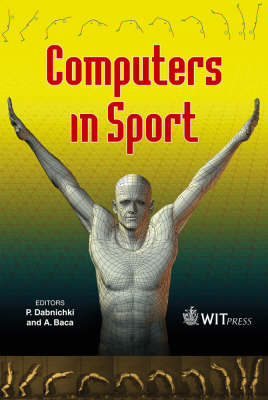
Computers in Sport
WIT Press (Verlag)
978-1-84564-064-4 (ISBN)
- Keine Verlagsinformationen verfügbar
- Artikel merken
The concepts and the possibilities provided by information and communication technologies have influenced and changed practically all aspects of our daily life. Sport and leisure activities are no exception at all from this observation. The present book offers snapshots of situations where Information Technology (IT; i.e., computer hardware and software) has been really helpful in supporting sporting activities, or has the potential to do so. This is due to the ever increasing processing power, and to IT's capability of modelling and solving problems which are of great help for a variety of sports disciplines. The present book offers a wealth of information, including the following subject areas: Coaching and training; biomedical modelling and motion analysis; Development of new sport games; Sports and robotics; New management The area of sports (and in particular the support of sports through IT) is a particularly delicate one. Many ethical issues need to be addressed (e.g., in biomechanics), and computers can comparably easily be misused. Experience indicates that some (athletes or managers) will stop short at nothing if they can profit from it.The present book is a very important step in order to improve the visibility of "computers and sport" as a discipline which is of highest relevance for the future - both scientifically and economically.
Dr Peter Dabnichki is visiting professor in the University of Vienna where he teaches biomechanics and informatics. He is a member of the board of directors of the International Association of Computer Science in Sport and serves on the editorial board of the journal Structural Durability & Health Monitoring. He is also editorial board member of the book series "Computational and Experimental Methods in Structures" with responsibility for selecting contributions from world leading experts in the biomedical area. He has been involved in the support of Olympic teams and provided biomechanics support for British athletes at the Olympic games in Salt Lake City. His research interests are focused around applications of smart technologies in the areas of medicine, sport and biomechanics such as Intelligent systems in medicine and sport, Pervasive computing in medicine and sport , Modelling in biomechanics, Biology inspired design, and Sport Engineering. A large part of his research is devoted to the biomechanics of human locomotion, specifically in sport activities such as swimming, running and throwing. He provided science support for the British bobsleigh and skeleton national teams in their preparation for the Winter Olympic games in Salt Lake City. He is strongly involved in technological developments for high performance sport in conjunction with the UK Sport Institute and is an acting member of the Winter Sports Innovation group of the BOA. He holds a research grant from the UK Sport Institute and industrial sponsorship for the design of a pervasive computer system for cross-sport application. The leading Olympic athletes for technique improvement have used the system. He also obtained a grant by the British Olympic Association, British Bob Skeleton Association and British Bobsleigh Association Grant for provision of Sport Science support for skeleton and bobsleigh teams Professor Arnold Baca is head of the Section of Biomechanics, Kinesiology and Applied Computer Science of the Department of Sport Science at the University of Vienna, Austria, a department he joined in 1998. He received the Engineering Diploma in Computer Science in 1984 (summa cum laude) and the Ph.D. (Thesis: "Variance-reducing techniques for simulation methods in system reliability analysis" in 1986 (summa cum laude) from the Technical University Vienna. In 1998 he received the Habilitation in "Applied Computer Science in Biomechanics and Kinesiology" from the University of Vienna. Since 1998 Prof. Baca has been Associate Professor at the Section of Biomechanics, Kinesiology and Applied Computer Science (Department of Sport Science) at the University of Vienna. He is Editor in Chief of the e-Journal "International Journal of Computer Science in Sport" and reviewer of several national and foreign scientific journals, such as Journal of Biomechanics, Medicine and Science in Sports and Exercise, European Journal of Applied Physiology and IEEE Transactions on Reliability. In 1999, he organised the 2nd International Symposium on Computer Science in Sport in Vienna, Austria. Current research activity: Computer Science Applied to Biomechanics Feedback Systems in Sports Multimedia and Information Systems in Sports Biomechanics of Rowing Game Analysis in Table Tennis
Multimedia/Presentation/Virtual Reality: Virtual reality Introduction; Overview of VR and sport; Components of participant activity in VR and transferability; The process of creating virtual environments; VR environments designed for sports; Implications of VR developments on sport performance; References Feedback systems Introduction; General aspects; Systems and applications; Conclusions; References Long-distance sports Introduction; Trends; Approach; Long-distance sports; Breakout for Two; Airhockey over a distance; Application; Conceptual position; What computing and sports can learn from long-distance sports?; Related work; Future work; Are we going to play long-distance sports soon?; Conclusion; Acknowledgements; References Modelling/Simulation: Coaching and computer science Introduction; Coaching; Computer science and coaching: history and state-of-the-art; Computer science and coaching: perspectives; References Modelling Introduction; Modelling and simulation in sport; Adaptation models; Analysis and simulation of processes; Conclusion and outlook; References Approaching a formal soccer theory from behaviour specifications in robotic soccer Robotics and soccer; Theoretical background; Formalizing soccer strategies; Discussion; References Biomechanics: Biomechanical modelling in sports - selected applications Introduction; MBS in sports biomechanics; Finite element models in sports biomechanics; Short outlook; Acknowledgements; References Motion analysis in water sports Introduction; Technology in swimming research; Technology in kayaking research; Summary; References Data Acquisition/Analysis/Data Bases/IT/Pervasive Computing Sensors and Ubiquitous Computing Technologies in Sports: Introduction; Trends and implications of utilizing sensors in sports; Technological challenges in introducing sensors in sports; Case study on force sensors in martial art competitions; Summary; References Information technology at the Olympic Games Introduction; Olympic Games Information Technology milestones; Software applications supporting Olympic Games; Games management applications; Requirements definitions; Systems architecture; Security; Software and testing; Hardware; Installation; Future challenges; References Education: Multimedia in sport - between illusion and realism Introduction; Types of multimedia learning systems; Learning with multimedia - thesis and antithesis; Learning with multimedia - a synthesis; Learning with multimedia - what science tells us; Learning with multimedia - a look into the future; Multimedia as a research tool - (still) unused potentials; Conclusions; References
| Erscheint lt. Verlag | 25.4.2008 |
|---|---|
| Zusatzinfo | Illustrations |
| Verlagsort | Southampton |
| Sprache | englisch |
| Maße | 155 x 230 mm |
| Themenwelt | Sachbuch/Ratgeber ► Sport |
| Mathematik / Informatik ► Informatik ► Theorie / Studium | |
| Wirtschaft | |
| ISBN-10 | 1-84564-064-0 / 1845640640 |
| ISBN-13 | 978-1-84564-064-4 / 9781845640644 |
| Zustand | Neuware |
| Informationen gemäß Produktsicherheitsverordnung (GPSR) | |
| Haben Sie eine Frage zum Produkt? |
aus dem Bereich