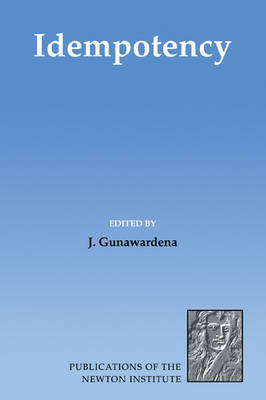
Idempotency
Cambridge University Press (Verlag)
978-0-521-05538-3 (ISBN)
Certain nonlinear optimization problems arising in such disparate areas as the theory of computation, pure and applied probability and mathematical physics, can be solved by linear methods, provided one replaces the usual number system with one in which addition satisfies the idempotent law. This systematic study of the subject has emerged, triggered in part by a workshop organized by Hewlett-Packard's Basic Research Institute in the Mathematical Sciences (BRIMS), which brought together many leading researchers in the area. This volume is a record of that workshop, but it also includes other invited contributions, a broad Introduction to Idempotency, written specially for the book, and a bibliography of the subject. In sum, the articles cover both practical and more theoretical considerations, making it essential reading for all workers in the area.
Foreword; Preface; List of participants; 1. An introduction to idempotency Jeremy Gunawardena; 2. Tropical semirings Jean-Eric Pin; 3. Some automata-theoretic aspects of min-max-plus semirings Daniel Krob; 4. The finite power property for rational sets of a free group Flavio d'Alessandro and Jacques Sakarovitch; 5. The topological approach to the limitedness problem on distance automata Hing Leung; 6. Types and dynamics in partially additive categories Gianfranco Mascari and Marco Pedicini; 7. Task resource models and (max,+) automata Stéphane Gaubert and Jean Mairesse; 8. Algebraic system analysis of timed Petri nets Guy Cohen, Stéphane Gaubert and Jean-Pierre Quadrat; 9. Ergodic theorems for stochastic operators and discrete event networks François Baccelli and Jean Mairesse; 10. Computational issues in recursive stochastic systems Bruno Gaujal and Alain Jean-Marie; 11. Periodic points of nonexpansive maps Roger D. Nussbaum; 12. A system-theoretic approach for discrete-event control of manufacturing systems Ayla Gürel, Octavian C. Pastravanu and Frank L. Lewis; 13. Idempotent structures in the supervisory control of discrete event systems Darren D. Cofer and Vijay K. Garg; 14. Maxpolynomials and discrete-event dynamic systems Raymond A. Cunninghame-Green; 15. The Stochastic HJB equation and WKB method Vassili N. Kolokoltsov; 16. The Lagrange problem from the point of view of idempotent analysis Serguei Samborskii; 17. A new differential equation for the dynamics of the Pareto sets Vassili N. Kolokoltsov and Victor P. Maslov; 18. Duality between probability and optimization Marianne Akian, Jean-Pierre Quadrat and Michel Viot; 19. Maslov optimization theory: topological aspects Pierre Del Moral; 20. Random particle methods in (max,+) optimization problems Pierre Del Moral and Gérard Salut; 21. The geometry of finite dimensional pseudomodules Edouard Wagneur; 22. A general linear max-plus solution technique Elizabeth A. Walkup and Gaetano Borriello; 23. Axiomatics of thermodynamics and idempotent analysis Victor P. Maslov; 24. The correspondence principle for idempotent calculus and some computer applications Grigori L. Litvinov and Victor P. Maslov.
| Erscheint lt. Verlag | 21.1.2008 |
|---|---|
| Reihe/Serie | Publications of the Newton Institute |
| Vorwort | John M. Taylor, Michael Atiyah |
| Zusatzinfo | 25 Line drawings, unspecified |
| Verlagsort | Cambridge |
| Sprache | englisch |
| Maße | 151 x 228 mm |
| Gewicht | 684 g |
| Themenwelt | Mathematik / Informatik ► Mathematik ► Angewandte Mathematik |
| ISBN-10 | 0-521-05538-5 / 0521055385 |
| ISBN-13 | 978-0-521-05538-3 / 9780521055383 |
| Zustand | Neuware |
| Informationen gemäß Produktsicherheitsverordnung (GPSR) | |
| Haben Sie eine Frage zum Produkt? |
aus dem Bereich