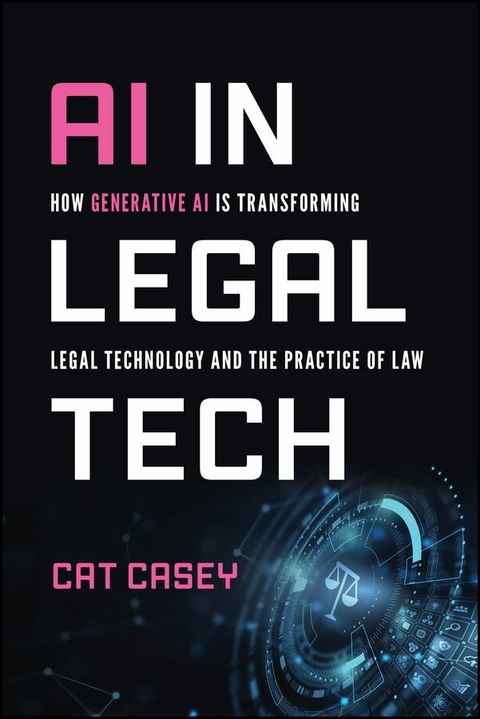
AI in Legal Tech (eBook)
269 Seiten
Wiley (Verlag)
978-1-394-30473-8 (ISBN)
Explore the potential and risks of generative AI in the legal industry
In AI in Legal Tech: How Generative AI Is Transforming Legal Technology and the Practice of Law, legal-tech pioneer and guru Catherine Casey-aka, TechnoCat-delivers a startlingly insightful and up-to-date discussion of the risks and opportunities presented by generative AI in the legal sector. The author walks you through generative AI's impact on the practice of law, legal ethics, and legal careers, offering guidance and clarity on a rapidly evolving technology.
Balancing engaging narrative with expert analysis, AI in Legal Tech is written specifically for non-technical legal professionals and students doing their best to navigate the intersection of technology and law. You'll find:
- Explanations of how AI is shaping new legal careers and what you can do to find success in your own
- A 'Legal Tech Survival Kit,' complete with a comprehensive Legal AI glossary and must-try tools for tech-savvy lawyers
- Insights from the 'front lines' of legal AI and the people designing the technologies shaping tomorrow's legal industry
Perfect for practicing lawyers, law students, and law practice managers, AI in Legal Tech will also prove invaluable to legal technologists, paralegals, and anyone else interested in the application of the latest tech to the legal field.
CAT CASEY is the defining voice at the intersection of AI and legal technology. A twenty-year veteran of the field and CEO of The Technocat LLC, she's led technology and innovation at multiple legal tech Unicorns, the Big Four, and AmLaw 10 firms. Known for her sharp insight, deep technical fluency, and signature irreverence, Cat has helped shape how the legal profession navigates the age of intelligent machines.
Chapter TWO
AI for the Uninitiated: A Crash Course
No PhD Required: Breaking Down AI for the Legal Mind
The path of legal education does not begin your first day as a 1L in law school. My journey dates to a swing set on a Southern California playground. Mid-swing, I had an epiphany: I was good at both math and writing. Choosing math and science would probably lead me toward becoming a doctor, while focusing on English would pave the way to law. My decision was clear; if I made a mistake as a doctor, someone might die, but as a lawyer, I could always appeal!
From that day on, I leaned increasingly toward liberal arts, and math and science took a back seat. After choosing my journey into legal, I favored language, debate, and philosophy over calculus and other hard sciences.
As a result, when I found myself facing statistics, lambda calculus, and data science, it was a bit daunting. No one goes to law school to study relational databases, and yet, when it comes to areas of legal like eDiscovery and contract analytics, that is exactly what you find yourself doing!
When it comes to artificial intelligence and the law, many legal professionals feel a bit like Andy Dwyer from Parks and Recreation; fully aware of their cluelessness but hesitant to ask questions, fearing that doing so will make it painfully obvious to everyone else. Or, worse yet, they embody the Dunning-Kruger Effect, the cognitive bias where if you don’t know something, you also don’t have the ability to recognize that you don’t know it.
Well, my legal compatriots, fear not. You don’t need to learn to code or how to create an algorithm to understand the risk and opportunity posed by the AI revolution. What you do need to learn are the lingo, the players, and the legal issues that arise when working with AI in legal.
The Birth of Artificial Intelligence
While click-bait headlines portray AI as a shiny new toy, it’s less a “New Kid on the Block” and more like a seasoned “Rolling Stone.” Like the septuagenarian rockers, AI has been around for decades, and while it might not always be what lawyers want, it is what modern lawyers need.
Based on the latest Hollywood blockbusters or a casual perusal of the evening news, artificial intelligence has been categorized as everything from super sentient robot overlords to little more than smart toasters.
John McCarthy, often referred to as the father of artificial intelligence, is credited with naming and defining artificial intelligence in 1956. If John McCarthy is the father of AI, then Dartmouth College is its birthplace. It was at a Dartmouth Summer Research Project on artificial intelligence in the summer of 1956 that McCarthy defined artificial intelligence as “the science and engineering of making intelligent machines.”1 Put more simply, he envisioned a future where computers could think like humans.
What Exactly Is Artificial Intelligence?
While the underlying concept of the “science and engineering of making intelligent machines” was first discussed nearly 70 years ago, the father of AI did not just believe in the possibility of smart computers; he believed that “every aspect of learning or any other feature of intelligence can in principle be so precisely described that a machine can be made to simulate it.”2 Quite literally, he saw a future where machines could and would do anything a human can do.
Many science fiction horror movies are based on this conception of AI—born of nightmares about sentient machines that operate without human input, like the Terminator. But the reality of AI today is far from the autonomous AI robot overlord of dystopian nightmares. Since its inception in 1956, AI’s purpose has evolved. Instead of replacing humans, AI now focuses on augmenting human intelligence and empowering data-driven decision-making.
The goal is no longer to replace human decision-making or cognition with AI. Instead, it aims for something more akin to J.A.R.V.I.S. in Tony Stark’s Iron Man suit—a powerful technology working alongside humans to enhance decisions by providing faster, more accurate insights. Much like Iron Man’s suit, these tools act at the behest of and in concert with humans and not in their stead.
While the specter of robolawyer overlords displacing legal practitioners is an apocalyptic nightmare some might have, this fantasy is best left for sci-fi. There is quite a bit of “fear, uncertainty, and doubt” (FUD) floating around the legal industry. Legal professionals are grappling with questions about how AI will reshape traditional roles and responsibilities, leaving many professionals uncertain about their legal futures. People are uncertain about how artificial intelligence will be integrated into the practice of law without putting everyone out of work. The legal profession is also grappling with ethical concerns like AI bias, which could impact fairness in case outcomes and confidentiality, as sensitive client data is processed by AI tools. Lawyers must navigate these challenges carefully to integrate AI responsibly.
While fears of AI replacing lawyers make for great Hollywood blockbusters, the reality is far less dramatic: AI is becoming an indispensable tool for legal professionals, augmenting their skills and expanding their capabilities.
Over the last seven decades, data scientists and non-techies alike have realized that John McCarthy’s definition missed the mark. It did not account for the fact that it is hard to digitally replicate things like human intuition, creativity, and emotional intelligence—facets of human cognition that machines are far from duplicating. As a result, the desire to replace human cognition fell out of favor, replaced with something known as augmented intelligence, or human-centered artificial intelligence.
Today, AI is designed to complement human expertise, enhancing decision-making, speeding up routine processes, and enabling lawyers, for example, to focus on higher-value strategic work. AI hasn’t supplanted human intelligence or our unique consciousness; it has instead become a powerful tool that extends our capabilities. As AI continues to evolve and astonish, McCarthy’s initial idea of replacement has been recalibrated to one of partnership and enhancement.
Artificial Intelligence Reimagined
Since the idea of machines capable of learning first emerged, industries like banking, medicine, and retail have embraced AI-powered applications at warp speed. Fraud detection, personalized shopping experiences, and even precision medicine have all undergone AI-powered transformations. Meanwhile, the technology itself has evolved dramatically, from the lofty dream of replacing human cognition to a more realistic and valuable goal: augmenting and amplifying the humans who use it.
Traditionally, the legal industry has taken a cautious, measured approach to adopting AI—more tortoise than hare in this technological race. Legal has fallen behind by sticking to tried-and-true technologies while industries like finance sprint ahead with cutting-edge AI innovations. Think of legal AI as the classic, well-tailored suit—practical, reliable, and unlikely to stir up controversy. But everything changed when ChatGPT burst onto the scene in November 2022, sparking a seismic shift in how the legal field views AI.
Thankfully, we’re still a long way from a dystopian reality where robots take over the courtroom. Critical reasoning, creative problem-solving, and strategic judgment, the bread and butter of legal practice, are still best handled by humans. Over decades of trial (and lots of error), computer scientists have realized something important: humans and AI aren’t competitors; they’re collaborators. Machines thrive at handling lower-value, repetitive tasks, like processing mountains of data or automating document reviews. But when it comes to the complex mental gymnastics of interpreting that data or making high-stakes decisions, the “living legal brain” is still the undisputed champion.
AI’s modern definition focuses on its ability to “correctly interpret external data, learn from it, and apply those learnings to achieve specific goals through flexible adaptation.”3 Or, in plain terms: Can it learn from data or human input and deliver actionable insights? This evolution in AI’s role has given rise to what’s known as augmented intelligence. Instead of creating machines to replicate humans, we’re building systems that amplify our strengths.
Here’s the big takeaway: humans outperform AI in critical areas like creativity, empathy, and judgment. Instead of replacing people, modern AI acts as a force multiplier for human expertise. Think of AI as your ultimate legal ally; AI makes you faster, sharper, and more effective. This is the shift: from robots that act like people to tools designed to enhance people.
Even with today’s cutting-edge generative AI tools, like GPT-4, the human brain still reigns supreme. Sure, AI can process data at breakneck speed, draft impressive first-pass documents, and even offer insights—but it lacks the nuance, intuition, and emotional intelligence needed for true legal strategy. AI might run the fastest leg of the relay, but lawyers are still the ones anchoring the team and crossing the finish line.
Your Organic Computer
With the constant flood of headlines about AI...
| Erscheint lt. Verlag | 23.12.2025 |
|---|---|
| Sprache | englisch |
| Themenwelt | Mathematik / Informatik ► Informatik |
| Schlagworte | ai ediscovery • ai ethics and law • eDiscovery • ethical legal tech • generative ai and legal tech • Generative ai in law • generative ai litigation • Law and Technology • legal AI • legal ai ethics • legal ai tech • legal ethics and ai • Legal Technology |
| ISBN-10 | 1-394-30473-0 / 1394304730 |
| ISBN-13 | 978-1-394-30473-8 / 9781394304738 |
| Informationen gemäß Produktsicherheitsverordnung (GPSR) | |
| Haben Sie eine Frage zum Produkt? |
 EPUB (Adobe DRM)
Kopierschutz: Adobe-DRM
Adobe-DRM ist ein Kopierschutz, der das eBook vor Mißbrauch schützen soll. Dabei wird das eBook bereits beim Download auf Ihre persönliche Adobe-ID autorisiert. Lesen können Sie das eBook dann nur auf den Geräten, welche ebenfalls auf Ihre Adobe-ID registriert sind.
Details zum Adobe-DRM
Dateiformat: EPUB (Electronic Publication)
EPUB ist ein offener Standard für eBooks und eignet sich besonders zur Darstellung von Belletristik und Sachbüchern. Der Fließtext wird dynamisch an die Display- und Schriftgröße angepasst. Auch für mobile Lesegeräte ist EPUB daher gut geeignet.
Systemvoraussetzungen:
PC/Mac: Mit einem PC oder Mac können Sie dieses eBook lesen. Sie benötigen eine
eReader: Dieses eBook kann mit (fast) allen eBook-Readern gelesen werden. Mit dem amazon-Kindle ist es aber nicht kompatibel.
Smartphone/Tablet: Egal ob Apple oder Android, dieses eBook können Sie lesen. Sie benötigen eine
Geräteliste und zusätzliche Hinweise
Buying eBooks from abroad
For tax law reasons we can sell eBooks just within Germany and Switzerland. Regrettably we cannot fulfill eBook-orders from other countries.
aus dem Bereich