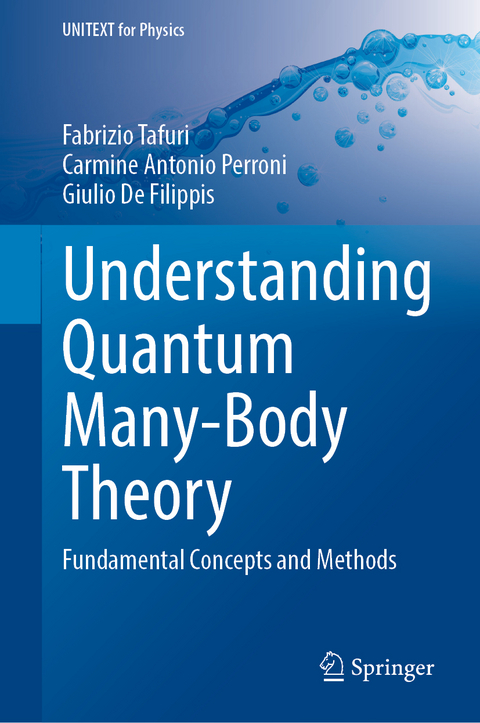
Understanding Quantum Many-Body Theory
Springer International Publishing (Verlag)
978-3-032-17848-0 (ISBN)
- Noch nicht erschienen - erscheint am 14.07.2026
- Versandkostenfrei
- Auch auf Rechnung
- Artikel merken
This textbook offers a rigorous, self-contained introduction to quantum many-body theory, developed from lecture notes at the University of Naples Federico II. Worked examples, solved exercises, and detailed derivations are woven throughout, guiding readers in the formulation and analysis of advanced theoretical and numerical models. Where possible, exact solutions are included to clarify the structure of many-body techniques and deepen understanding of their applications. The result is both a reliable theoretical reference and a practical resource for strengthening conceptual and computational skills.
The textbook is aimed primarily at advanced undergraduates and first-year master s students in physics who are beginning the study of interacting quantum systems, at both zero and finite temperature. A concise review of quantum mechanics covering key concepts and formalism opens the book. Core topics include second quantization, phonons, electron phonon interaction, the Hartree Fock method for fermionic systems, Bogoliubov theory for bosonic systems, many-body Green s functions, Feynman diagrams, linear-response theory, Bose Einstein condensation, and quantization of the electromagnetic field. The volume concludes with two concise toolkit chapters on elements of group theory for physicists and symmetries, serving as supplementary algebraic background.
Fabrizio Tafuri earned his Master s degree in Physics from the University of Naples "Federico II" in 2021 with a thesis on statistical mechanics applied to biological systems. He has authored six publications in classical and quantum statistical mechanics. Currently on his second research fellowship, he focuses on many-body quantum field theory. His broader research interests include equilibrium and non-equilibrium statistical physics, studied through analytical and numerical methods.
Carmine Antonio Perroni received his Ph.D. in Physics from the University of Naples "Federico II" in 2002. He is Associate Professor of Theoretical Physics of Matter in the Department of Physics "E. Pancini" at the same university. Since 2007, he has taught courses including General Physics for students in Pharmacy and Information Engineering, Quantum Many-Body Theory for physics master s students, and Elements of Physics of Matter for physics undergraduates. His research focuses on the electronic, magnetic, and superconducting properties of strongly correlated bulk materials, heterostructures, and nanostructures. More recently, he has investigated quantum systems coupled to external baths and leads, employing both analytical methods and equilibrium and non-equilibrium Green s functions. He is the author of about 100 papers published in peer-reviewed journals.
Giulio De Filippis received his degree in Physics, cum laude, from the University of Naples "Federico II" in 1985, and a Ph.D. in General and Applied Physics from the University of Salerno in 1998. Since 2015, he has been Associate Professor of Theoretical Physics of Matter at the University of Naples "Federico II." He has authored over 100 publications in leading international journals. Since 2002, he has taught courses such as General Physics for students in Chemistry and Pharmaceutical Technologies and Quantum Many-Body Theory for physics master s students. His research interests include high-temperature superconductivity in cuprates, ultrafast quasiparticle dynamics in strongly correlated electron systems, charge transport in organic semiconductors, many-body open quantum systems, quantum information theory, topological insulators, and quantum thermodynamics.
Part one foundations of quantum many body theory.- Quantum mechanics review.- Second quantization for non relativistic identical particles.- Part two a quantum many body model of a solid.- Step one of the solid model bloch electrons.- Step two of the solid model phonons.- Step three of the solid model electron phonon interaction.- Part three developments of quantum many body theory.- Many body greens functions.- Feynmans perturbative theory of the thermal Greens function.- Finite temperature hartree fock method for fermionic systems.- Phonon propagator.- Linear response theory.- Part four further bosonic quantum fields.- Bose einstein condensation of non interacting bosons.- Bogoljubovs theory for interacting boson systems.- Quantization of the electromagnetic field phonons.- Part five toolkit of group theory and symmetries in physics.- Group theory.- Symmetries.- Part six appendices.
| Erscheint lt. Verlag | 14.7.2026 |
|---|---|
| Reihe/Serie | UNITEXT for Physics |
| Zusatzinfo | Approx. 500 p. 60 illus. |
| Verlagsort | Cham |
| Sprache | englisch |
| Maße | 155 x 235 mm |
| Themenwelt | Mathematik / Informatik ► Mathematik |
| Naturwissenschaften ► Chemie ► Physikalische Chemie | |
| Naturwissenschaften ► Physik / Astronomie ► Atom- / Kern- / Molekularphysik | |
| Naturwissenschaften ► Physik / Astronomie ► Quantenphysik | |
| Schlagworte | Acoustic and optical phonon branches • Canonical quantization of lattice vibrations (phonons) • Electron-phonon Hamiltonian derivation • Electron–phonon Hamiltonian derivation • Feynman diagrammatics foundations • Many-body field operator formalism • Many-body Green's functions derivation • Many-body Green’s functions derivation • Matsubara formalism at finite temperature • Microscopic linear-response theory derivation • One- and two-body operators in Fock space • Rigorous proof of Bloch's theorem • Rigorous proof of Bloch’s theorem |
| ISBN-10 | 3-032-17848-7 / 3032178487 |
| ISBN-13 | 978-3-032-17848-0 / 9783032178480 |
| Zustand | Neuware |
| Informationen gemäß Produktsicherheitsverordnung (GPSR) | |
| Haben Sie eine Frage zum Produkt? |
aus dem Bereich