


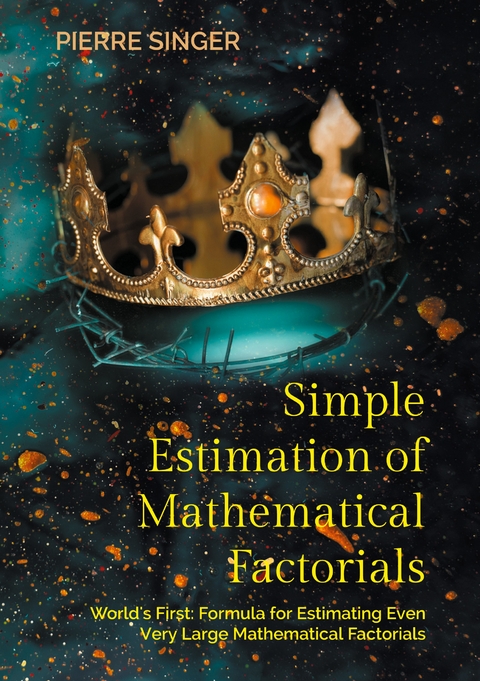
Simple Estimation of Mathematical Factorials
World's First: Formula for Estimating Even Very Large Mathematical Factorials
Seiten
2025
BoD – Books on Demand (Verlag)
978-3-7693-7746-0 (ISBN)
BoD – Books on Demand (Verlag)
978-3-7693-7746-0 (ISBN)
The year 2026 is a historic year. From that year onward, the formula developed by the British mathematician James Stirling, used for approximately 250 years to estimate mathematical factorials, will become largely obsolete. Stirling's formula proves to be worthless, especially for factorials with an exponent greater than 3 in the base 10. According to Stirling's formula, one would first have to divide the number n, from which the factorial is to be determined, by Euler's number e, and then calculate the exponent n of the result. However, modern calculators can generally calculate factorials up to the range of numbers with an exponent of 3 in the base 10. Beyond that, they typically fail, just as Stirling's formula fails when calculating the intermediate result, as described above. In other words, Stirling's formula cannot be used precisely where it would be needed as an approximation. And where it's needed, it tends to deliver rather imprecise results, where-as calculators provide precise results by calculating the exact factorial. With the formula described in this book, estimating factorials at least on the order of the exponent up to a number with 101 digits, i.e., a number with an exponent of 100 in the base 10, is easily possible. Theoretically, there's no limit to the number's height it's simply a matter of diligence. The author has carried this out up to an exponent of 100 in the base 10, and the results can be found in a 10-page table in this book. Of course, it would be interesting to determine even higher exponents. But that will be the subject of a future book. In this book, the author explains the formula as simply and clearly as possible, even for people without any prior math-ematical knowledge. The great advantage of this formula is that, unlike Stirling's formula, it doesn't require constants like pi or Euler's number. These are the simplest multiplications and additions, the kind even a schoolchild can manage.
The author, Pierre Singer, was born in Baden an der Limmat in 1981. After completing apprenticeships as an industrial clerk and insurance consultant, he turned his hobbies in history, chemistry, and general science into his profession. This book is his first work, originally published in Spanish and after translated to English and German.
| Erscheint lt. Verlag | 23.12.2025 |
|---|---|
| Sprache | englisch |
| Maße | 148 x 210 mm |
| Gewicht | 68 g |
| Themenwelt | Mathematik / Informatik ► Mathematik |
| Schlagworte | Approximation • factorial • Factorials • Mathematics • Stirling formula |
| ISBN-10 | 3-7693-7746-X / 376937746X |
| ISBN-13 | 978-3-7693-7746-0 / 9783769377460 |
| Zustand | Neuware |
| Informationen gemäß Produktsicherheitsverordnung (GPSR) | |
| Haben Sie eine Frage zum Produkt? |
Mehr entdecken
aus dem Bereich

aus dem Bereich
Von Logik und Mengenlehre bis Zahlen, Algebra, Graphen und …
Buch | Softcover (2024)
De Gruyter Oldenbourg (Verlag)
CHF 104,90
Grundlagen für das Bachelor-Studium
Buch | Hardcover (2023)
Hanser (Verlag)
CHF 55,95
Analysis und Lineare Algebra mit Querverbindungen
Buch | Hardcover (2022)
Springer Spektrum (Verlag)
CHF 97,95


