


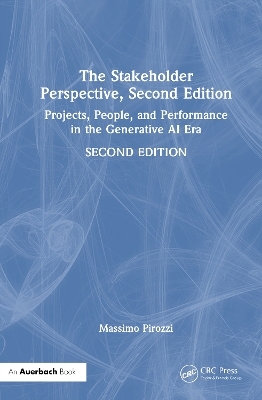
The Stakeholder Perspective, Second Edition
Auerbach (Verlag)
978-1-041-14837-1 (ISBN)
- Noch nicht erschienen (ca. Juli 2026)
- Versandkostenfrei
- Auch auf Rechnung
- Artikel merken
The Stakeholder Perspective, Second Edition is both a continuation and a renewal. It preserves the spirit of the first edition—humanistic, systemic, stakeholder-centered—while taking it into the domain of data and intelligent systems. It recognizes that the biggest challenge in managing projects and stakeholders today is figuring out how to blend human skills with technology in smart systems so that people and machines work together to create and share value by balancing efficiency with purpose, understanding data analysis, and using AI responsibly and ethically. Nevertheless, the augmented capacity for managing relations effectively, interpreting and giving real meaning, and properly taking care of stakeholders’ increased requirements and expectations remains, as ever, absolutely human.
Aligned with the PMBOK® Guide, Eighth Edition, the book focuses on the determinant role of the stakeholders in the process of value generation, perception, and delivery. Taking the view that managing stakeholders is a “project in the project,” it explores how AI has entered the stakeholder domain, not just as a technical tool but as a functional agent that influences communication patterns, decision-making, and, ultimately, value creation. This second edition introduces AI stakeholders, which are non-sentient entities capable of shaping choices, mediating interactions, and amplifying narratives. These systems behave like stakeholders even though they are not human: they can advise, filter, prioritize, negotiate, or even contest information. They can support or disrupt strategic alignment, and they can take on such different roles as influencers, mediators, proxies, or collaborators.
The book presents a coherent vision of Stakeholder Management 4.0 as an intelligent, human-centered model in which data, technology, and consciousness form an integrated ecosystem. Rather than diminishing human relevance, using AI in stakeholder relations underscores the importance of humans because emotional intelligence, critical thinking, and ethical leadership are the defining competencies of project professionals today.
Massimo Pirozzi, MSc, is a project, program, and portfolio manager; a generative artificial intelligence leader and specialist; and a lecturer, educator, and researcher specialized in stakeholder management, project complexity, and the integration of artificial intelligence into project environments. Based in Rome, he holds a master’s degree (cum laude) in electronic engineering from Sapienza University of Rome; he is certified as a professional project manager, as a generative AI leader, as an information security management systems lead auditor, and as an international mediator; and he has more than forty years of professional experience in teaching and in managing complex projects, programs, and portfolios across defense, security, healthcare, transportation, ICT, education, cultural heritage, and citizen services. A senior instructor and master teacher in project management, he is widely recognized for his contributions to the advancement of project management practices and professional standards, and he has received several international awards. He holds more than 70 international certifications spanning project and program management, artificial intelligence, emotional intelligence, effective communication, learning design, and others.
1. Stakeholders, Who are They? 2. The Recent Central Role of Stakeholders in Project Management 3. Stakeholder Identification Integrating Multiple Classification and Behavioral Models 4. Effective Stakeholder Analysis: A Systemic Approach 5. Key Stakeholders Management: Principles of Effective Direct Communication 6. Stakeholder Network Management: Informative and Interactive Communication 7. Basic Personal and Interpersonal Skills: Personal Mastery, Leadership, Teaming 8. Ethics in Stakeholder Relations 9. Stakeholder Relations and Delivered Value: An Indissoluble Link 10. Satisfying Stakeholder Requirements and Expectations: The Critical Success Factor 11. Facing Successfully Different Levels of Project Complexity 12. Targeting Both Project and Business Value Generation by Using KPIs 13. Relationship Management Project: A Structured Path to Effectiveness 14. New Stakeholder-Centered Trends: Project Management X.0 15. Stakeholders in the AI Era – Who Are They? 16. AI-Powered Stakeholder Identification and Analysis 17. AI-Augmented Stakeholder Engagement and Communication 18. Stakeholder Perspective 4.0: Human Excellence in a Hybrid World
| Erscheint lt. Verlag | 31.7.2026 |
|---|---|
| Zusatzinfo | 27 Line drawings, color; 1 Halftones, color; 28 Illustrations, color |
| Verlagsort | London |
| Sprache | englisch |
| Maße | 156 x 234 mm |
| Themenwelt | Mathematik / Informatik ► Informatik ► Netzwerke |
| Wirtschaft ► Betriebswirtschaft / Management ► Logistik / Produktion | |
| Wirtschaft ► Betriebswirtschaft / Management ► Projektmanagement | |
| ISBN-10 | 1-041-14837-2 / 1041148372 |
| ISBN-13 | 978-1-041-14837-1 / 9781041148371 |
| Zustand | Neuware |
| Informationen gemäß Produktsicherheitsverordnung (GPSR) | |
| Haben Sie eine Frage zum Produkt? |
aus dem Bereich


