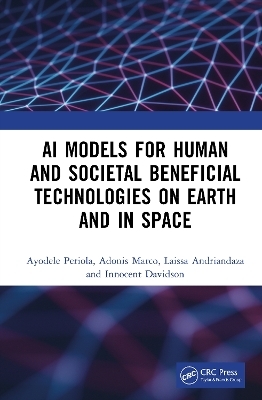
AI Models for Human and Societal Beneficial Technologies on Earth and in Space
CRC Press (Verlag)
978-1-041-15216-3 (ISBN)
- Noch nicht erschienen (ca. Mai 2026)
- Versandkostenfrei
- Auch auf Rechnung
- Artikel merken
Transition from terrestrial to non-terrestrial computing platforms, emphasizing environmental benefits.
The role of Future Chatbot Cascades in shaping long-term artificial intelligence objectives.
Designing space applications for resource-constrained regions, with a special focus on Africa.
Development of small rocket-based architectures and paradigms for future launch systems.
Ground coverage analysis for selected African cities to support space-based connectivity.
This book is intended for graduate students and researchers in artificial intelligence, machine learning, aerospace engineering, and space technology.
Ayodele Periola, (Senior Member, IEEE) received the B. Eng (Hons) degree in Electrical and Electronic Engineering from the Federal University of Technology, Akure, Nigeria in 2009, MSc degree in Mobile and Satellite Communications from the University of South Wales, Wales, UK in 2012, and Ph.D. Degree in electrical engineering from the University of Cape Town, in 2017, specializing in wireless radio networks. He was a post-doctoral research fellow in the Department of Electrical and Electronic Engineering Technology at the University of Johannesburg, South Africa from 2019 to 2022 Currently, he is a Senior Lecturer in the Department of Electrical, Electronic, and Computer Engineering, Deputy Program Coordinator with the French South African Institute of Technology (F’SATI), and African Space Innovation Centre (ASIC), at the Cape Peninsula University of Technology (CPUT), Bellville, South Africa. His research interests include the design of environmentally friendly and energy efficient computing and communication systems and platforms in non-terrestrial data centers in space, stratosphere, and underwater environments, AI applications in future intelligent communication networks and systems. He’s working on the use of data driven systems to improve the design and functionality of renewable energy systems (RES), incorporating AI-based solutions at different interfaces between entities comprising the grid. Furthermore, he has research interests in the design of space systems for constrained contexts, design of applications that leverage on the uniqueness of the space environment ; and has interests in the design of novel technologies that enhance human living and ensure positive environmental outcomes. He is a member of the African Astronomical Society. Dr Periola is a Y2-rated researcher from the National Research Foundation (NRF), South Africa. Marco Adonis holds a Doctorate degree in Electrical Engineering from the Cape Peninsula University of Technology, South Africa. He is an Associate Professor and the Head of Department in Electrical, Electronic and Computer Engineering. His research interests focus on the design and development of sustainable energy technologies for microgrid applications in Sub-Saharan Africa. Distributed generation solutions in Sub-Saharan Africa are paramount to address the energy challenges of the region. The development of smart microgrids has the potential of transforming the energy landscape in the region allowing the empowerment of communities to participate in modern energy futures that will contribute to economic growth and improve energy access. Furthermore, Prof Adonis’s broad research interests span renewable energy technology applications; microgrids; smart grids; distributed generation; engineering education and critical posthumanism. Innocent Ewean Davidson, (Senior Member, IEEE) received the B.Sc. (Eng.) (Hons) and MSc (Eng.) degrees in Electrical Engineering from the University of Ilorin, in 1984 and 1987, respectively, Ph.D. degree in electrical engineering from the University of Cape Town, in 1998; and the PG Diploma degree in Business Management, from the University of KwaZulu-Natal, in 2004. He also received Associate Certificate in Sustainable Energy Management (SEMAC), from the British Columbia Institute of Technology, Burnaby, BC, Canada, in 2011, and the Course Certificate in Artificial Intelligence, from the University of California at Berkeley, USA in 2020. He is a Full Professor and Director, with the African Space Innovation Center (ASIC), and French South African Institute of Technology (F’SATI), Cape Peninsula University of Technology (CPUT), Bellville, South Africa. He has supervised six postdoctoral research fellows and graduated 67 Ph.D./Masters’ students and over 1200 engineers, technologists, and technicians. He is the author/ co-author of 405 technical papers in accredited journals, and peer-reviewed conference proceedings and book chapters. He has managed over US$3 million in research funds. His current research interests include Space and CNS Innovation, smart grids, electromagnetics and applied artificial intelligence. He is a Fellow grade of the Institute of Engineering and Technology, UK, and the South African Institute of Electrical Engineers; a Chartered Engineer in the U.K.; and a registered Professional Engineer (P Eng.), of the Engineering Council of South Africa. He is a member: Western Canada Group of Chartered Engineers (WCGCE); the Institute of Engineering and Technology (IET Canada) British Columbia Chapter; IEEE Collabratec Communities on Smart Cities and IEEE (South Africa Chapter). He is a recipient of numerous international Best Paper Awards. He is a C2-rated researcher from the National Research Foundation (NRF), South Africa.
PART A- Artificial Intelligence and Communications 1. Capability Survey of Artificial Intelligence Solutions with focus on Conversational Artificial Intelligence 2. Technical Advancements in Natural Language Processing 3. Chat Bot. Focus on Future Network Architecture Design 4. Chat Bots and the Future of Mobile 5. Future of Chat Bots and Restoring the AI Vision. PART B- Systems and Mechanisms for a Data Active Space 6. Space Upstream 7. Space Downstream Aspect – Space Based Computing Platforms and Data Center 8. Space Midstream PART C: Reaching Space and Application Dynamics in the Space Segment 9. Small Rocket Search Paradigm in the Multi-Rocket Launch Approach 10. Launching Realization via the Open Services Initiative 11. Space Based Data Centre- Procedures and Applications 12. Pharmaceuticals and the Space-Based Data Centre PART D: Space Based Data System, Space Focused Co-existence and the Ground Segment 13. Space Applications Development and Scientific Investigations – A Data Perspective 14. Ground Segment Concerns Section 3. 15. Ground Coverage Analysis and Focus on the Communication Window
| Erscheint lt. Verlag | 28.5.2026 |
|---|---|
| Zusatzinfo | 28 Tables, black and white; 108 Line drawings, black and white; 65 Halftones, black and white; 173 Illustrations, black and white |
| Verlagsort | London |
| Sprache | englisch |
| Maße | 156 x 234 mm |
| Themenwelt | Informatik ► Datenbanken ► Data Warehouse / Data Mining |
| Technik ► Nachrichtentechnik | |
| Technik ► Umwelttechnik / Biotechnologie | |
| ISBN-10 | 1-041-15216-7 / 1041152167 |
| ISBN-13 | 978-1-041-15216-3 / 9781041152163 |
| Zustand | Neuware |
| Informationen gemäß Produktsicherheitsverordnung (GPSR) | |
| Haben Sie eine Frage zum Produkt? |
aus dem Bereich