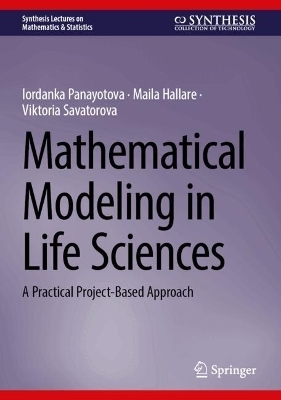
Mathematical Modeling in Life Sciences
Springer International Publishing (Verlag)
978-3-032-17485-7 (ISBN)
- Noch nicht erschienen - erscheint am 16.06.2026
- Versandkostenfrei
- Auch auf Rechnung
- Artikel merken
This textbook offers an introduction to the mathematical modeling of complex living systems. The authors guide undergraduate students in modeling ecological and biomedical problems using differential equations, dynamical systems, and data-driven methods. The modeling process including assumption formulation, model construction, numerical simulation, sensitivity analysis, prediction, and biological interpretation is presented step by step. Through hands-on projects and case studies, students learn to apply mathematical techniques and numerical simulations to study glucose insulin regulation in diabetes, tumor immune interactions in cancer therapy, and multi-species dynamics in Chesapeake Bay ecosystem. Together, these projects link mathematical theory to meaningful practice, helping students develop technical skills while fostering an appreciation of mathematics as a powerful tool for discovery and decision-making. Accompanied by student exercises and supported by MATLAB® code, the book also provides instruction on fitting models to real data and performing parameter sensitivity analysis. The book is well-suited for upper-undergraduate coursework or independent study and serves as a valuable resource for those aspiring to be researchers and practitioners in the life sciences.
Iordanka Panayotova, Ph.D., is an Associate Professor of Mathematics at Christopher Newport University (CNU), where she has been teaching mathematical modeling for many years, integrating project-based and data-driven modeling into a wide range of undergraduate courses. She holds a Ph.D. in Applied Mathematics from the University of Wisconsin Milwaukee (2005) and a Ph.D. in Computational Mathematics from the National Academy of Sciences of Belarus (2000). With a track record of over 30 peer-reviewed publications, Dr. Panayotova s recent work focuses on mathematical modeling for life sciences, including data-driven climate ecosystem modeling that informs conservation and fisheries management decisions in Chesapeake Bay. Her mentoring and research activities have been supported in part by the NSF CURM (Center for Undergraduate Research in Mathematics) program and the Innovation Hub at CNU. Having supervised numerous undergraduate research projects, she received the 2020 CNU Class of 2013 Alumni Mentorship Award and the 2023 CNU Faculty Award for Excellence in Interdisciplinarity. Dr. Panayotova currently serves as co Editor-in-Chief of the CODEE Journal, an online peer-reviewed journal focused on the teaching and learning of differential equations.
Maila Hallare, Ph.D., is an Associate Professor of Mathematics at the United States Air Force Academy. She received her doctorate in Mathematics from the University of Kansas and works in differential equations, dynamical systems, and mathematical modeling. Her teaching and research show how mathematical ideas help explain scientific, engineering, and military problems. She uses theoretical results to establish and understand the behavior of mathematical models. Dr. Hallare has supervised many undergraduate research projects in applied mathematics and enjoys mentoring new faculty in course design, publishing, and developing research projects. She served as Editor-in-Chief of the CODEE Journal from 2022 to 2025 and continues to support national efforts in differential equations education. She believes that mathematical modeling helps make ODEs and dynamical systems relevant and relatable in the classroom, and she values interdisciplinary collaboration with colleagues who share an interest in theoretical models.
Viktoria Savatorova, Ph.D., is an Associate Professor in the Department of Mathematics at Central Connecticut State University where she teaches a range of math courses and integrates modeling projects into her curriculum. She received her Ph.D. in Applied Mathematics and Physics from Moscow Engineering Physics Institute (1996) and Doctor of Science (habilitation) degree from the Russian Ministry of Science and Education (2011). Her research interests encompass mathematical modeling for applications in engineering and life sciences, multiscale methods, differential equations, and dynamical systems. Dr.Savatorova has over 40 peer-reviewed publications, with recent work focusing on mathematical modeling for life sciences, including diabetes onset, blood glucose management, and data-informed modeling of climate change impacts on fish species in Long Island Sound. Her participation in the 2023-2024 MAA Preparation for Industrial Careers in Mathematics (PIC Math) Program has reinforced her commitment to interdisciplinary research and engaging students in real-world projects, aligning with her goal to enhance students' practical experience and preparation for mathematically intensive careers. Dr. Savatorova currently serves as co Editor-in-Chief of the CODEE Journal.
Introduction.- Predator-Prey Interactions in the Chesapeake Bay Fishes.- Modeling the Effect of Invasion in the Chesapeake Bay Ecosystem.- Parameter Sensitivity Analysis in ODE-based Models: Application to Fish Population Dynamics.- Modeling Climate Change Impact on Fish Populations in Chesapeake Bay.- Virotherapy as a Cancer Treatment.- Modeling Immune Response in Melanoma.- Modeling and Self-management of Diabetes.- Modeling Diabetes Onset through Bifurcation and Parameter Sensitivity Analysis.- Optimal Control in Diabetes Management.
| Erscheint lt. Verlag | 16.6.2026 |
|---|---|
| Reihe/Serie | Synthesis Lectures on Mathematics & Statistics |
| Zusatzinfo | X, 140 p. 30 illus. in color. |
| Verlagsort | Cham |
| Sprache | englisch |
| Maße | 168 x 240 mm |
| Themenwelt | Mathematik / Informatik ► Mathematik |
| Schlagworte | Biological Systems • Data-driven Dynamical Systems • Equilibria • Mathematical Modeling • parameter sensitivity analysis • Sensitivity Analysis • stability |
| ISBN-10 | 3-032-17485-6 / 3032174856 |
| ISBN-13 | 978-3-032-17485-7 / 9783032174857 |
| Zustand | Neuware |
| Informationen gemäß Produktsicherheitsverordnung (GPSR) | |
| Haben Sie eine Frage zum Produkt? |
aus dem Bereich