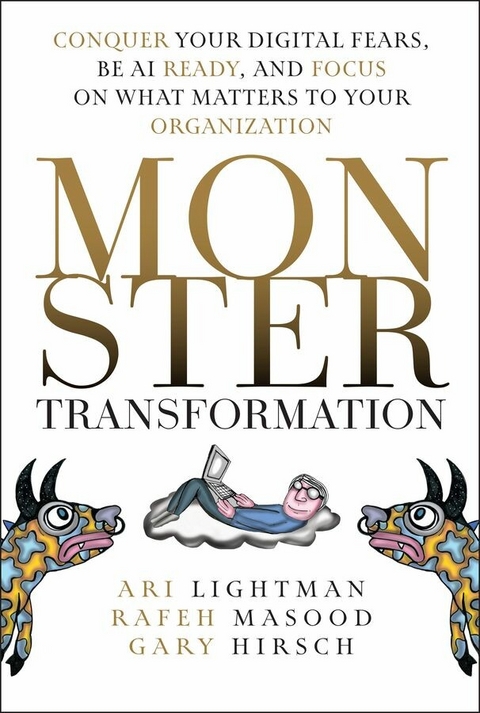
Monster Transformation (eBook)
352 Seiten
Wiley (Verlag)
9781394313723 (ISBN)
A hands-on approach to preparing your company for AI-powered digital transformation
In Monster Transformation: Conquer Your Digital Fears, Be AI Ready, and Focus on What Matters to Your Organization, a team of veteran digital leaders delivers an expert framework to digital transformation that focuses on the competencies your employees will need to have-and develop-to enable your organization to function in a world defined by generative artificial intelligence. Monster Transformation blends actionable insights, real-world case studies, and immediately recognizable organizational behaviors that can either move forward or derail transformation in the age of AI.
Whether you are leading, a part of, supporting or interested in organizational transformation, this book challenges conventional thought on dealing with transformation, provides insights on how and why barriers to effective change arise and pragmatic mechanisms to address challenges, diminish barriers and leverage employees. You'll also find:
- Examples of transformation blockers and obstacles, as well as the steps you need to take to eliminate and overcome them
- Real-world insights from interviews with transformation leaders across industries and organizational layers
- 10 incisive case studies from well-known brands including Ferrari, Instacart, Patagonia, Brooks Running, and Calm, hands-on scenarios, chapter exercises, and actionable takeaways you can apply immediately at your own organization
Perfect for managers, executives, and other business leaders, Monster Transformation offers a practical approach for implementing the world's newest, most exciting technologies in your company. With a foreword by Shellye Archambeau, bestselling author of Unapologetically Ambitious, Monster Transformation is a no-BS humanistic take on how organizations can adapt and thrive in a chaotic and turbulent environment.
ARI LIGHTMAN is an internationally recognized expert in digital transformation and technology disruption and a Professor of Digital Media and Marketing at Carnegie Mellon University's Heinz College of Information Systems and Public Policy.
RAFEH MASOOD is the Chief Growth and Digital Officer at Royal Caribbean Group where he oversees digital, AI, data analytics, travel commerce platforms, and brand awareness efforts across the company's family of brands.
GARY HIRSCH is the book's artist and illustrator. He is also a speaker, facilitator, and the co-founder of On Your Feet (oyf.com), a pioneer in the field of applied improvisation and an experiential consultant for numerous Fortune 500 companies.
Introduction
“Most organizations don’t want to change—they say they do, but when confronted with the cost of real transformation, they fall back on excuses disguised as legitimate reasons.”
— Anil Aggarwal, founder of Money2020 and Shoptalk
Change, as the saying goes, is inevitable. As trite as this may sound, the truth is that the imperative for businesses to transform is increasing while the willingness to put in effective and effort is only decreasing. All organizations are going through a fire drill of re-organizing themselves, adapting to shifting expectations and trying to become more innovative, resilient, and agile. They are continually bombarded by new technology vendors and service providers that promise efficiencies, collaboration, compliance, discovery, or the ability to generate new revenues from data, markets, products, or services.
Artificial intelligence (AI) is just the latest example of a technology that forces organizations into the age-old transformation question – how do we do it successfully? Can consultants help us get up to speed to become AI proficient and enabled and at what cost? What should we address first that might throw up roadblocks, causing delays, false starts, and failed implementations? Some organizations are reaching an existential point – although they might not even know it – where they must evolve or risk becoming stagnant, inefficient, irrelevant, or, even worse, extinct.
Like the technologies that preceded AI (the cloud, metaverse, blockchain, to name a few), AI dominates the conversation around transformation. However, unlike previous technological shifts, AI is considered a game-changer transforming how we work, live, and interact with technology. For organizations, AI impacts many of the decisions companies make and drives change in an unprecedented way. Organizations, particularly legacy ones, faced with this new AI-driven landscape, must come to terms with what transformation means for them and rethink, well, just about everything.
And yet, transformation is not something an organization can fix by simply buying an AI-enabled application, attending a webinar or certification course (“Transform your Business Using AI in Just Three Days”), or hiring a new C-level executive. True transformation involves rolling up your sleeves, getting to work, and addressing many of the challenges and issues that were put off for whatever reason. Many executives have been sold on the idea that there is a perfect playbook or guaranteed path to transformation success. Strategic advisors arrive with frameworks. Vendors pitch silver-bullet solutions. And yet challenges still persist. Why? Because real change is hard. It requires continuous assessment, tactical maneuvering, self-awareness, and a willingness to face uncomfortable truths about our organizations and ourselves.
Another Book on Transformation?
This book began from a place of shared woe, lament, and exasperation. Through our work with hundreds of organizations, we have seen the same patterns emerge: unrealized expectations, stalled initiatives, and a growing gap between transformation ambitions and reality. The three authors of this book have designed and taught classes and workshops and consulted for and put in place programs to understand digital and organizational transformation, disruption, and innovation. Students, participants, clients, and employees have then made strides associated with transformative thinking, only to go back to work and encounter roadblocks and hurdles leading to more frustration. The results? Market share erodes. Innovation slows. Employee engagement plummets. What starts with the promise of transformative change becomes a bottleneck of stalled efforts with the associated impacts rippling out in waves, from customer dissatisfaction and poor bottom lines to employee displacement and cultural disruption.
Just how pervasive is this sense of frustration? During a recent executive education class, we asked participants to describe their digital transformation efforts in one word or emoji. The overwhelming response? The poop emoji. This was not just gallows humor – it was a literal expression of the difficulties that permeate many of these efforts.
Why? Because transformation demands active participation and clear expectations. It requires people to change how they think, work, and lead, navigating a maze of technology, people, and processes, all while trying to keep the organization running. And now, with generative AI emerging as the Ozempic of the corporate world, helping organizations shed inefficiencies like pounds on the scale, the divide is growing even starker. Some organizations transform speedily, while others fall behind without the right tools, processes, people, and approaches. Those organizations with well-designed AI systems are accelerating their transformation at unprecedented rates, while others risk becoming the eight-track of today’s digital world.
A Fork in the Road
Many legacy companies find themselves in what can only be described as a midlife crisis. They have the wisdom of experience and the weight of success, but they are watching younger, more agile companies make technological leaps. Sure, they want the nimbleness of a startup but are still weighed down by the anchor of established processes and archaic systems. They might have attended seminars, used frameworks, and even attended some of our workshops, and yet their transformation efforts often remain isolated to specific activities (AI chatbots, anyone?) or relegated to certain divisions like customer service or fulfillment, creating more rifts and divisions than any actual benefits.
In our research into why organizations struggle with transformation, we discovered something powerful: when we openly share and identify our transformation fears – when we name the monsters that stand in our way – we take the first step toward overcoming them. Here’s what we’ve recognized about transformation challenges: every organization is experiencing them to some extent. Naming and understanding why they exist is the first step, but to tame them we need to understand them within each organization’s unique context. It’s not just about identifying generic obstacles. Each organization’s history, culture, current state, and simultaneous internal and external pressures create their own unique transformation landscape. It is like trying to navigate a complex journey without a map customized to your specific situation. It’s just a fact. There is no “one-size-fits-all” solution. Understanding this reality is the first step toward making progress.
Some Want It, Most Resist It, All Face It
That is exactly where this book began. Picture this: an operator (a battle-scarred digital transformation veteran), an academic (a Carnegie Mellon professor), and an artist ( and pioneer of applied improvisation) walk into a bar. No, this is not the setup for a joke. It’s how we started our journey to decipher why transformations so often go sideways or even reverse course. Between rounds and rounds of debates, we realized something fundamental: the first step to solving any problem is defining it. When you understand how the issue came about and how it impedes your efforts, you gain power over it. When you name your fears, they become challenges to overcome rather than invisible forces holding you back.
This is not just bar talk. Through our work founding, developing, and teaching several executive education programs, we have had a front-row seat to the transformation circus. We were fortunate to speak with professionals, industry analysts, futurists, practitioners, academics, and consultants across multiple industries (n = 105). Others, we surveyed to get their thoughts on hurdles to successful transformation (n = 50). We gathered data, insights, and listened to battle stories. What emerged was a pattern of recurring monsters – each unique, each frightening, and each absolutely defeatable once you acknowledge and understand what you are up against. We also heard encouraging stories of folks who are going up against these monsters and winning slowly but surely. They made us think of people we have worked with who have unique skills (competencies) that are important to consider in slaying transformation monsters. So, we developed a list of these competencies – Monster Slayers – that we believe are foundational for reducing barriers and having the best chance at transformational success.
The good news is you don’t need to go out and hire a bunch of new people; they already exist within your organization. The bad news is that because of a number of factors like organizational inertia, they have not been able to practice and share their Monster Slaying talents. This is what we will be conveying throughout this book – understanding the critical need to identify, activate, and engage these slayers to have the greatest chance of success.
Here is what else we learned along our journey: transformation is not about checking boxes or implementing technology. It is about creating value and building competencies. Full stop. You cannot create change when you are paralyzed by unnamed monsters. You cannot build competencies without understanding how they emerge from different skill sets while simultaneously suppressing them. True transformational competency involves: acknowledging the barriers that hamper success; bringing an attitude of openness and honesty;...
| Erscheint lt. Verlag | 9.12.2025 |
|---|---|
| Sprache | englisch |
| Themenwelt | Mathematik / Informatik ► Mathematik |
| ISBN-13 | 9781394313723 / 9781394313723 |
| Informationen gemäß Produktsicherheitsverordnung (GPSR) | |
| Haben Sie eine Frage zum Produkt? |
 EPUB (Adobe DRM)
Größe: 30,2 MB
Kopierschutz: Adobe-DRM
Adobe-DRM ist ein Kopierschutz, der das eBook vor Mißbrauch schützen soll. Dabei wird das eBook bereits beim Download auf Ihre persönliche Adobe-ID autorisiert. Lesen können Sie das eBook dann nur auf den Geräten, welche ebenfalls auf Ihre Adobe-ID registriert sind.
Details zum Adobe-DRM
Dateiformat: EPUB (Electronic Publication)
EPUB ist ein offener Standard für eBooks und eignet sich besonders zur Darstellung von Belletristik und Sachbüchern. Der Fließtext wird dynamisch an die Display- und Schriftgröße angepasst. Auch für mobile Lesegeräte ist EPUB daher gut geeignet.
Systemvoraussetzungen:
PC/Mac: Mit einem PC oder Mac können Sie dieses eBook lesen. Sie benötigen eine
eReader: Dieses eBook kann mit (fast) allen eBook-Readern gelesen werden. Mit dem amazon-Kindle ist es aber nicht kompatibel.
Smartphone/Tablet: Egal ob Apple oder Android, dieses eBook können Sie lesen. Sie benötigen eine
Geräteliste und zusätzliche Hinweise
Buying eBooks from abroad
For tax law reasons we can sell eBooks just within Germany and Switzerland. Regrettably we cannot fulfill eBook-orders from other countries.
aus dem Bereich