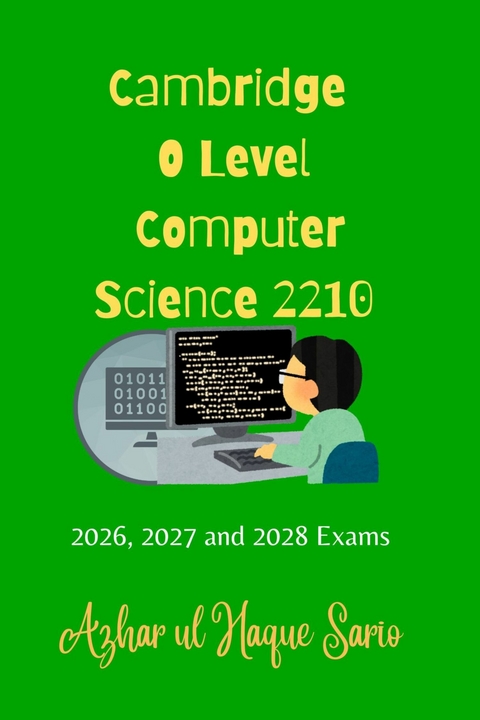
Cambridge O Level Computer Science 2210 (eBook)
172 Seiten
Azhar Sario Hungary (Verlag)
9783384774750 (ISBN)
Unlock the silent language of the machines that run your world.
This book is a comprehensive guide to Cambridge O Level Computer Science for the 2026, 2027, and 2028 exams. You will explore the entire computer system. The text begins with data representation. You will learn why computers strictly use 1s and 0s. It explains binary as a language of light switches. You will master hexadecimal conversion using the 'Nibble' trick. The book details data transmission. You will understand how files are chopped into packets. It explains error detection methods like checksums. You will study hardware architecture. The text describes the CPU as a microscopic metropolis. It explains the Von Neumann architecture and the stored program concept. You will learn about input and output devices. It details how sensors act as a digital nervous system. The book covers software systems. It distinguishes between the machine's servants and the user's tools. It explains the role of the operating system as a conductor. You will study the internet and its uses. It differentiates the physical infrastructure from the web. It explains blockchain as a shared, glass ledger. You will explore automated technologies. It details the loop of sensors, microprocessors, and actuators. You will learn algorithm design. It covers decomposition and abstraction. You will practice programming. It explains variables, loops, and arrays. It details databases. You will learn to use SQL for data retrieval. You will master Boolean logic. It explains logic gates like the 'Strict Guardian' AND gate.
This book provides a unique value that other textbooks fail to offer. It rejects dry, academic jargon. It uses a conversational, human tone to explain complex silicon concepts. It relies on vivid analogies to make facts stick. It compares the CPU to a city mayor. It describes the hard drive as the percussion section of an orchestra. It views software not just as code, but as the digital soul of the machine. The author brings authentic, lived experience to every chapter. You will find insights from real-world fieldwork, such as analyzing server farms and industrial robotics. It connects abstract math to physical reality. It explains the 'why' behind the technology. It treats the reader as an architect, not just a user. It transforms the study of logic into a field guide for the modern world. It is designed to bridge the gap between human thought and machine action.
Disclaimer: This book is an independent publication by Azhar ul Haque Sario. It is not affiliated with, endorsed by, or connected to Cambridge Assessment International Education. Any reference to Cambridge syllabus codes or names is strictly for descriptive purposes under nominative fair use.
Automated and emerging technologies
The Ghost in the Gear: An Odyssey into Automation, Robotics, and the Artificial Mind
Introduction: The Invisible Pulse
I recently stood in the center of a massive fulfillment warehouse. It was midnight. The space was the size of ten football fields. It was eerily quiet. There were no shouting foremen. There was no clatter of dropped boxes. There was only a low, electric hum.
Across the polished concrete floor, hundreds of orange discs—robots—glided in a silent ballet. They lifted pallets weighing nearly a ton. They spun. They moved in perfect synchronization. They missed each other by inches.
I realized then that I was standing inside a living organism. It was not made of flesh and bone. It was made of silicon, copper, and code.
We walk through a world that is constantly watching us. It measures us. It adjusts to us. When you approach a sliding door, it opens. When you walk into a dark room, the lights flicker on. When you type a search query, the answer appears before you finish the sentence.
This is not magic. It is engineering. It is a silent symphony played by three distinct sections: Automated Systems, Robotics, and Artificial Intelligence.
To understand our modern world, we must dismantle it. We must look behind the curtain. We must understand the loop.
Part 1: The Automated Loop (Syllabus 6.1)
1.1 The Anatomy of the Machine
I want you to visualize a reflex.
Think about touching a hot stove. Your skin feels the heat. Your nerves send a signal to your brain. Your brain shouts "Danger!" Your muscle pulls your hand away.
This happens in a fraction of a second.
In the world of industrial design, we replicate this biology. We call it an Automated System. Through my investigations into control engineering, I have found that every automated system—from the nuclear reactor in France to the toaster in your kitchen—relies on a "Holy Trinity" of components.
They are:
Sensors (The Nerves)
Microprocessors (The Brain)
Actuators (The Muscles)
Let us dissect them one by one.
The Sensor: The Translator of Reality
A computer is deaf, blind, and numb. It exists in a digital void. It only knows electricity. It knows "On" or "Off." It knows 1 or 0.
The physical world, however, is not binary. The world is "analogue." The wind does not just blow "on" or "off." It blows at 10 mph, then 12.5 mph, then gusts to 20 mph. Temperature fluctuates constantly.
The Sensor is the bridge. It is an input device. Its job is to read a physical property of the environment and convert it into an electrical signal.
I recall field testing a weather station on a cliff edge. We used specific instruments to "feel" the storm.
The Thermistor: This measures temperature. As it gets hotter, the electrical resistance inside the sensor changes. The computer reads this change as heat.
The Light Dependent Resistor (LDR): This measures light. In streetlights, this sensor watches the sunset. When the resistance drops, it knows night has fallen.
The Proximity Sensor: You have seen this on the back bumper of a modern car. It shoots out a silent sound wave or an electromagnetic field. If that wave hits a wall and bounces back, the sensor knows something is there.
The Moisture Sensor: Used in smart farming. Two metal prongs sit in the dirt. If the dirt is wet, electricity flows easily between the prongs. If the dirt is dry, the electricity stops.
The Great Translation: ADC There is a catch. The sensor usually produces an analogue signal (a wave). The computer needs a digital signal (steps).
Therefore, between the sensor and the brain, there is almost always a chip called an Analogue-to-Digital Converter (ADC). It takes the smooth wave of reality and chops it into numbers the computer can read.
The Microprocessor: The Decision Maker
Once the data is digital, it travels to the Microprocessor. This is the Central Processing Unit (CPU).
If you look at a circuit board, this is the black square chip with many metal legs. It is the "brain."
But do not mistake it for a human brain. A microprocessor does not "know" what a greenhouse is. It does not "know" what a wall is. It only knows math. It follows an algorithm.
I have watched engineers program these chips. The logic is stark and unforgiving. It usually follows a simple three-step rhythm:
READ: It looks at the number coming from the sensor.
COMPARE: It checks that number against a "stored value" or "threshold" in its memory.
DECIDE: If the number breaks the rule, it sends a command.
The Logic of Control: Imagine a smart fan.
Stored Value: 25∘C (The Limit).
Sensor Reading: 28∘C.
Comparison: 28>25.
Result: True.
Action: Send signal to output.
The Actuator: The Muscle
The microprocessor is weak. It operates on tiny voltages (usually 5 volts or 3.3 volts). It cannot push a door open. It cannot heat a room. It is just a thinker.
It needs an Actuator.
An actuator is an output device. It converts the electrical signal from the brain into physical movement or energy. It changes the world.
The Motor: It spins. It drives wheels on a robot or spins the drum of a washing machine.
The Solenoid: A magnetic coil that pushes a metal rod. It is used in automatic door locks. Click. The door is open.
The Relay: This is a switch. The weak computer signal turns on the Relay, and the Relay turns on the massive high-voltage power for a heater.
The LED: A light. It gives visual feedback to a human.
The Endless Cycle
This is not a straight line. It is a loop.
Input: The sensor feels the room gets cold.
Process: The chip sees the temperature is too low.
Output: The actuator turns on the heater.
Feedback: The sensor feels the room getting warmer.
Process: The chip sees the temperature is now okay.
Output: The actuator turns the heater off.
This is called a Feedback Loop. It is the heartbeat of automation.
1.2 Deep Dive: Automation in the Wild
To truly understand this, we must leave the classroom. We must look at how these systems function in the chaos of the real world. I have curated several scenarios based on industrial observation.
Scenario A: The Smart Greenhouse (Precision Agriculture)
Farming used to be about intuition. A farmer would look at the sky, smell the air, and guess if it would rain. Today, farming is a data science.
I visited an orchid nursery that was fully automated. Orchids are fragile. They need exact humidity.
The Sensor: Hygrometers (humidity sensors) were buried in the moss. They took a reading every 10 seconds.
The Process: The microprocessor compared the reading to a target of 60% humidity.
The Actuator: If the humidity dropped to 59%, solenoid valves opened. High-pressure misting nozzles sprayed a fine fog over the flowers.
The Advantage: The plants never experienced stress. They grew 20% faster. Water was not wasted. The farmer could sleep at night, knowing the system was watching.
The Disadvantage: Complexity breeds fragility. One week, a spider spun a web over a sensor. The sensor read the web as "moisture." It thought the air was wet. It stopped watering. A whole row of orchids dried out and died because the computer lacked the "common sense" to see the spider web.
Scenario B: The Autonomous Train (Transport)
I traveled recently on a driverless metro line. I stood at the very front window. There was no driver cabin. Just the track rushing towards me.
The Sensor: Infrared beams watched the doors. Pressure pads watched the tracks. Accelerometers watched the speed.
The Process: The computer calculated the distance to the next station down to the millimeter.
The Actuator: Hydraulic brakes clamped down. Electric motors whirred.
The Logic: The system is built on "Fail-Safe" logic. If a sensor fails, the train stops. It does not guess. If the infrared beam on the door is broken (someone's foot is in the way), the motor cannot start. The circuit is physically open.
The Advantage: Safety and schedule. Humans get tired. Humans get distracted...
| Erscheint lt. Verlag | 10.12.2025 |
|---|---|
| Sprache | englisch |
| Themenwelt | Mathematik / Informatik ► Informatik |
| ISBN-13 | 9783384774750 / 9783384774750 |
| Informationen gemäß Produktsicherheitsverordnung (GPSR) | |
| Haben Sie eine Frage zum Produkt? |
 EPUB (Adobe DRM)
Größe: 281 KB
Kopierschutz: Adobe-DRM
Adobe-DRM ist ein Kopierschutz, der das eBook vor Mißbrauch schützen soll. Dabei wird das eBook bereits beim Download auf Ihre persönliche Adobe-ID autorisiert. Lesen können Sie das eBook dann nur auf den Geräten, welche ebenfalls auf Ihre Adobe-ID registriert sind.
Details zum Adobe-DRM
Dateiformat: EPUB (Electronic Publication)
EPUB ist ein offener Standard für eBooks und eignet sich besonders zur Darstellung von Belletristik und Sachbüchern. Der Fließtext wird dynamisch an die Display- und Schriftgröße angepasst. Auch für mobile Lesegeräte ist EPUB daher gut geeignet.
Systemvoraussetzungen:
PC/Mac: Mit einem PC oder Mac können Sie dieses eBook lesen. Sie benötigen eine
eReader: Dieses eBook kann mit (fast) allen eBook-Readern gelesen werden. Mit dem amazon-Kindle ist es aber nicht kompatibel.
Smartphone/Tablet: Egal ob Apple oder Android, dieses eBook können Sie lesen. Sie benötigen eine
Geräteliste und zusätzliche Hinweise
Buying eBooks from abroad
For tax law reasons we can sell eBooks just within Germany and Switzerland. Regrettably we cannot fulfill eBook-orders from other countries.
aus dem Bereich