


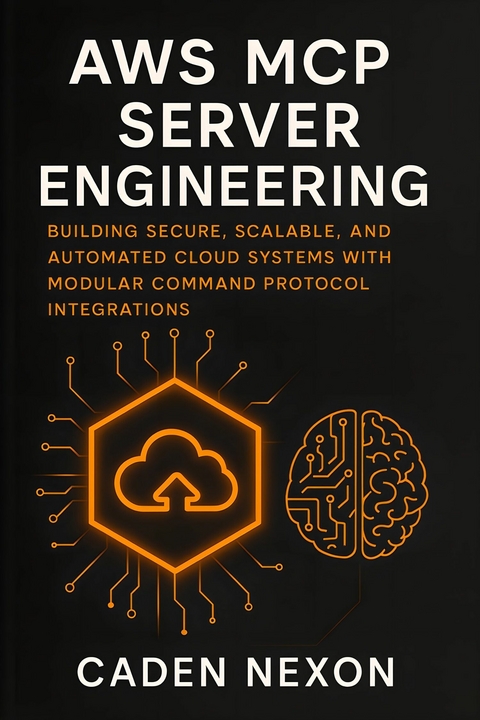
AWS MCP Server Engineering (eBook)
233 Seiten
Publishdrive (Verlag)
9780001119536 (ISBN)
AWS MCP Server Engineering is the definitive guide for architects, DevOps engineers, and cloud professionals who want to build the next generation of secure, automated, and modular cloud systems using the Modular Command Protocol (MCP) ecosystem.
This book demystifies how MCP servers, clients, and tools integrate seamlessly with AWS to create intelligent, event-driven, and highly maintainable infrastructure. Through clear explanations, best practices, and real-world architectural patterns, you'll learn how to design cloud systems that are scalable, predictable, and deeply automated-without unnecessary complexity.
Inside, you'll discover how to:
Architect AWS-based MCP server ecosystems for high reliability and performance
Implement secure, role-based, and policy-driven cloud automation
Build modular workflows using Lambda, Step Functions, SQS, SNS, API Gateway, and more
Leverage Infrastructure as Code (IaC) with Terraform and AWS CDK to automate everything
Integrate MCP with monitoring, logging, and alerting frameworks for complete observability
Design cloud systems using modern patterns such as event-driven automation, microservices-based command modules, and distributed orchestration
Apply production-ready security, compliance, and cost-optimization techniques
Develop real-world automation pipelines and MCP extensions for CI/CD, governance, and cloud operations
Whether you're modernizing existing systems or building automated cloud environments from scratch, this book equips you with the knowledge and hands-on frameworks to deliver secure, scalable, and future-ready cloud platforms on AWS.
If you want to master MCP-driven cloud automation and engineer cloud systems that truly run themselves, this is the guide you need.
Implementing a Minimal MCP Server with AWS SDK
The theoretical foundation now transitions to practical implementation. The following example constructs a minimal MCP server using Python 3.11, FastAPI for HTTP handling, Pydantic for schema validation, and boto3 for AWS interactions. This server exposes a single capability group (storage) with two tools: list_buckets and upload_object. The implementation demonstrates manifest generation, schema validation, IAM-based authentication, and S3 integration.
python
1 import uuid
2 import hashlib
3 import json
4 from datetime import datetime, timedelta
5 from typing import Any, Dict, List, Optional
6
7 import boto3
8 from botocore.exceptions import ClientError, BotoCoreError
9 from fastapi import FastAPI, Request, Response, HTTPException, Depends
10 from fastapi.security import HTTPBearer, HTTPAuthorizationCredentials
11 from pydantic import BaseModel, Field, validator
12 from jose import JWTError, jwt
13 import uvicorn
14
15 # AWS clients and configuration
16 s3_client = boto3.client("s3")
17 sts_client = boto3.client("sts")
18
19 # MCP server configuration
20 SERVER_ID = "aws-mcp-demo-01"
21 MANIFEST_VERSION = "1.0.0"
22 JWT_SECRET = "development-secret-change-in-production"
23 JWT_ALGORITHM = "HS256"
24 TOKEN_EXPIRY_MINUTES = 15
25
26 app = FastAPI(title="AWS MCP Demo Server", version=MANIFEST_VERSION)
27 security = HTTPBearer()
28
29
30 class ToolParameter(BaseModel):
31 name: str = Field(..., description="Parameter name")
32 type: str = Field(..., description="JSON type: string, number, boolean, object, array")
33 description: str = Field(..., description="Human readable description")
34 required: bool = Field(True, description="Whether parameter is required")
35 default: Optional[Any] = Field(None, description="Default value if omitted")
36
37 @validator("type")
38 def validate_type(cls, v):
39 valid_types = {"string", "number", "boolean", "object", "array", "integer"}
40 if v not in valid_types:
41 raise ValueError(f"Invalid type: {v}")
42 return v
43
44
45 class ToolSchema(BaseModel):
46 tool_id: str = Field(..., description="Unique namespaced tool identifier")
47 display_name: str = Field(..., description="Human readable name")
48 description: str = Field(..., description="Detailed tool description")
49 parameters: List[ToolParameter] = Field(default_factory=list)
50 output_schema: Dict[str, Any] = Field(default_factory=dict)
51 idempotent: bool = Field(False, description="Supports idempotency keys")
52 streaming: bool = Field(False, description="Supports streaming responses")
53
54
55 class CapabilityGroup(BaseModel):
56 group_id: str = Field(..., description="Unique capability group identifier")
57 display_name: str = Field(..., description="Human readable group name")
58 description: str = Field(..., description="Group purpose and scope")
59 tool_ids: List[str] = Field(default_factory=list)
60
61
62 class MCPManifest(BaseModel):
63 server_id: str
64 version: str
65 timestamp: datetime
66 capabilities: List[CapabilityGroup]
67 tools: List[ToolSchema]
68
69
70 # In-memory storage for demo (use DynamoDB in production)
71 active_subscriptions: Dict[str, Dict] = {}
72 idempotency_store: Dict[str, Dict] = {}
73
74
75 def generate_manifest() -> MCPManifest:
76 return MCPManifest(
77 server_id=SERVER_ID,
78 version=MANIFEST_VERSION,
79 timestamp=datetime.utcnow(),
80 capabilities=[
81 CapabilityGroup(
82 group_id="storage",
83 ...
| Erscheint lt. Verlag | 5.12.2025 |
|---|---|
| Sprache | englisch |
| Themenwelt | Mathematik / Informatik ► Informatik ► Programmiersprachen / -werkzeuge |
| ISBN-13 | 9780001119536 / 9780001119536 |
| Informationen gemäß Produktsicherheitsverordnung (GPSR) | |
| Haben Sie eine Frage zum Produkt? |
 EPUB (Adobe DRM)
Größe: 945 KB
Kopierschutz: Adobe-DRM
Adobe-DRM ist ein Kopierschutz, der das eBook vor Mißbrauch schützen soll. Dabei wird das eBook bereits beim Download auf Ihre persönliche Adobe-ID autorisiert. Lesen können Sie das eBook dann nur auf den Geräten, welche ebenfalls auf Ihre Adobe-ID registriert sind.
Details zum Adobe-DRM
Dateiformat: EPUB (Electronic Publication)
EPUB ist ein offener Standard für eBooks und eignet sich besonders zur Darstellung von Belletristik und Sachbüchern. Der Fließtext wird dynamisch an die Display- und Schriftgröße angepasst. Auch für mobile Lesegeräte ist EPUB daher gut geeignet.
Systemvoraussetzungen:
PC/Mac: Mit einem PC oder Mac können Sie dieses eBook lesen. Sie benötigen eine
eReader: Dieses eBook kann mit (fast) allen eBook-Readern gelesen werden. Mit dem amazon-Kindle ist es aber nicht kompatibel.
Smartphone/Tablet: Egal ob Apple oder Android, dieses eBook können Sie lesen. Sie benötigen eine
Geräteliste und zusätzliche Hinweise
Buying eBooks from abroad
For tax law reasons we can sell eBooks just within Germany and Switzerland. Regrettably we cannot fulfill eBook-orders from other countries.
aus dem Bereich


