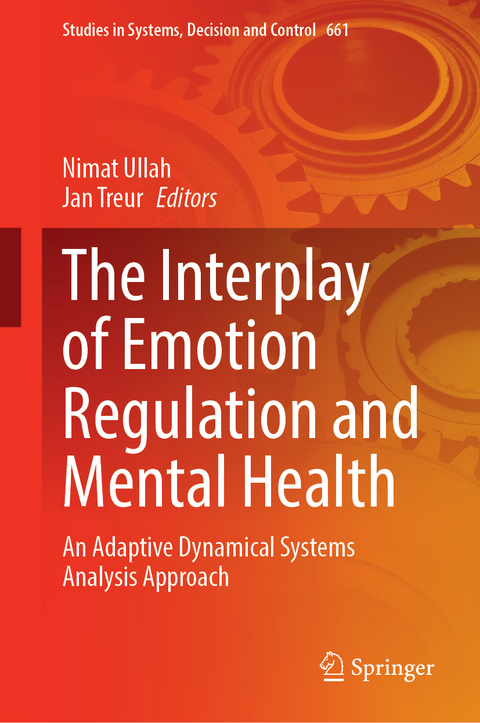
The Interplay of Emotion Regulation and Mental Health
Springer International Publishing (Verlag)
978-3-032-16543-5 (ISBN)
- Noch nicht erschienen - erscheint am 30.03.2026
- Versandkostenfrei
- Auch auf Rechnung
- Artikel merken
For many disorders, proper emotion regulation is a crucial protective factor. Therefore, this volume provides an in-depth exploration of emotion regulation through the lens of computational modeling and analysis. Emotion regulation is a critical psychological process that enables individuals to manage their emotional responses in diverse situations. This book examines how flexibility in emotion regulation strategies such as suppression, cognitive reappraisal, and attention modulation supports mental well-being by allowing individuals to adapt their emotional responses according to context. Drawing from recent advances in psychology and neurobiology, the book presents a series of models that highlight the role of contextual sensitivity and the influence of factors such as age, gender, and personality traits on regulatory preferences. One of the themes of this book is the contextual nature of emotion regulation, where flexibility enables instant contextual shifts between different strategies based on situational demands. Several models simulate scenarios in which specific emotions, such as anger or anxiety, are context-sensitive according to the individual s goals and context. Simulation results reveal how certain emotions may strongly depend on achieving personal or external goals, underscoring the dynamic nature of emotion regulation. In addition, another important theme is adaptivity of emotion regulation. This does not concern instant contextual changes but longer-term changes in response to experiences over time. Learning processes to strengthen emotion regulation over time may be very important to reduce negative health effects induced by reduced emotion capabilities. These forms of adaptivity are also extensively addressed in this book. In addition to general mechanisms of emotion regulation, this book also addresses specialized applications for various psychological and behavioral conditions. These include computational models for conditions like anxiety, autism spectrum disorders, social media addiction, burnout, and eating disorders.
1.An Adaptive Dynamical Systems Analysis Approach to the Dynamics of Emotion and its Regulation to Support Mental Health.- 2.Flexibility in Emotion Regulation Strategies.- 3.Decision-Making in Choosing Regulation Strategies while Downregulating Negative Emotions.- 4.Goal Driven Choices of Emotion Regulation Strategies.- 5.Age and Gender Differences in Choice of Emotion Regulation Strategies.- 6.Simultaneous Employment of Multiple Emotion Regulation Strategies.- 7.Computational Analysis of the Interplay between Food Desires and Negative Emotions.- 8.An Adaptive Agent Based Model for Learning Regulation of a Highly Sensitive Person's Response.- 9.A Neurologically Inspired Computational Model for Autism Spectrum Disorders.- 10.Genito-Pelvic Pain/Penetration Disorder: An Adaptive Computational Fear-Avoidance Model.- 11.Internal Processes of a Person with a borderline personality disorder: A Computational Analysis.- 12.Modelling Desensitization Due to Overstimulation through Second-Order Network Adaptation.- 13.An Adaptive Cognitive Agent Model for Desire Regulation Under Stress.- 14.Causal Relationships between Cannabis, Anxiety and Sleep: Computational Analysis of the Adaptivity.- 15.Towards an Integrated Model of Caffeine-Induced Stress Dynamics.- 16.Second-Order Adaptation in Emotion Regulation and Social Media Use.- 17.Adaptive Dynamics of Emotion Regulation: Modeling Age and Gender Dependent Variability Over Time.- 18.Reward-Driven Emotion Regulation Across the Lifespan: Insights from a Fourth-Order Adaptive Network Model.- 19.From Stress to Burnout: A Multi-Order Adaptive Simulation of Psychological Decline.- 20.A Temporal-Causal Model of Burnout Dynamics and the Regulatory Role of Physical Exercise.- 21.An Adaptive Network Model for Burnout and the Regulatory Role of Dreaming.- 22.Dynamic Modeling of Burnout and Sleep Interaction through a Temporal-Causal Approach.- 23.An Adaptive Network Model of Employee Burnout and Personality: The role of the Big Five Traits.- 24.A Multilevel Network Model of Emotion Regulation Strategy Dynamics via Metaplasticity.- 25.A Cognitive Model of Mindfulness-Based Stress Reduction: The Role of Yoga Practice.- 26.Modeling Probiotic Influences on ASD Symptoms Through a Second-Order Adaptive Network Model.- 27.Modeling Therapeutic Interventions for Cognitive Control Using Adaptive Causal Networks.- 28.Modeling Stress Coping Through Mutual Support Networks.- 29.An Adaptive Network Model of Therapy Effects in Anorexia Nervosa.- 30.Future Prospects for Healthier Emotion Regulation: Computational Analysis from an Adaptive Dynamical System Perspective Modelled by Multi-Adaptive Networks.- 31.Discussion.
| Erscheint lt. Verlag | 30.3.2026 |
|---|---|
| Reihe/Serie | Studies in Systems, Decision and Control |
| Zusatzinfo | Approx. 500 p. |
| Verlagsort | Cham |
| Sprache | englisch |
| Maße | 155 x 235 mm |
| Themenwelt | Informatik ► Theorie / Studium ► Künstliche Intelligenz / Robotik |
| Medizin / Pharmazie ► Physiotherapie / Ergotherapie ► Orthopädie | |
| Technik ► Elektrotechnik / Energietechnik | |
| Schlagworte | Computational Modelling • Dynamical Systems • Emotion Regulation • Mental Health Treatment • Mental processes |
| ISBN-10 | 3-032-16543-1 / 3032165431 |
| ISBN-13 | 978-3-032-16543-5 / 9783032165435 |
| Zustand | Neuware |
| Informationen gemäß Produktsicherheitsverordnung (GPSR) | |
| Haben Sie eine Frage zum Produkt? |
aus dem Bereich