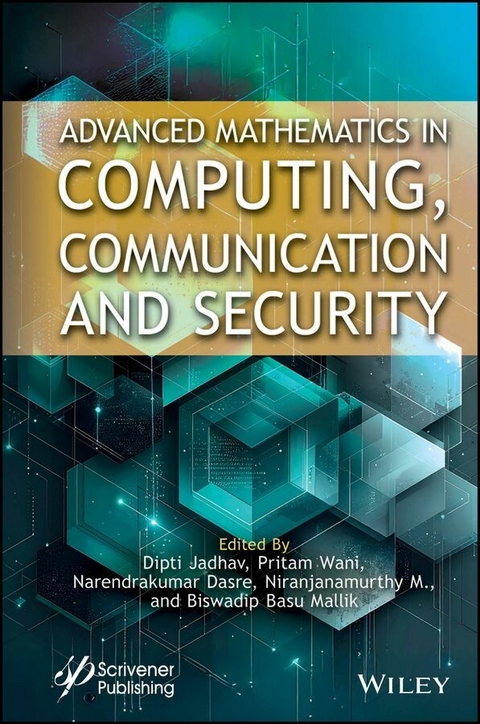
Advanced Mathematics in Computing, Communication and Security (eBook)
797 Seiten
Wiley-Scrivener (Verlag)
978-1-394-30728-9 (ISBN)
Explore the cutting edge of scientific computing with this volume, which provides a comprehensive look at the interdependency between mathematics and computer science.
Within the evolving landscape of computer science, mathematics is increasingly playing a pivotal role. Disciplines like linear algebra, statistics, calculus, and discrete mathematics serve as the cornerstone for comprehension and innovation within various computer science domains. This book underscores the deep-seated interdependency between the realms of mathematics and scientific computing, exploring how each discipline mutually reinforces and advances the other. With its rich theoretical framework and analytical rigor, mathematics provides the bedrock upon which many computational concepts and methodologies are built. In turn, computer science offers a practical avenue for applying mathematical abstractions to tackle real-world problems efficiently and effectively. Cutting-edge technologies, such as scientific computing, deep learning, and computer vision, require not only a mastery of foundational mathematics, but a diverse interdisciplinary approach. This book sheds light on the burgeoning frontiers of computer science, bringing together researchers with expertise across multiple industries, making it an essential resource for beginners and experienced practitioners alike.
Dipti Jadhav, PhD is an Associate Professor in the Department of Information Technology in the Ramrao Adik Institute of Technology at D.Y. Patil University with more than 18 years of research and teaching experience. She has edited one book, authored more than 30 research papers in international journals and conferences, and holds one Australian and one German patent. Her research focuses on image processing, computer vision, pattern recognition, software engineering, machine learning, and artificial intelligence.
Pritam Wani, PhD is a Professor at the Ramrao Adik Institute of Technology. Nerul, India. She has published papers in national and international journals.
Narendrakumar Dasre, PhD is an Associate Professor of Applied Mathematics at the Ramrao Adik Institute of Technology with more than 21 years of teaching experience. He has authored and reviewed 14 national and international books and published 11 research papers in national and international journals. His areas of interest include image processing, topology, number theory, and applied mathematics.
Niranjanamurthy M., PhD is an Assistant Professor in the Department of Artificial Intelligence and Machine Learning at the BMS Institute of Technology and Management with more than 14 years of experience. He has published more than 25 books and more than 95 articles in various national and international conferences and journals. He has also filed 30 patents, six of which have been granted. His areas of interest include data science, machine learning, e-commerce and m-commerce, software testing and engineering, and cloud computing.
Biswadip Basu Mallik, PhD is an Associate Professor of Mathematics in the Department of Basic Sciences and Humanities at the Institute of Engineering and Management with more than 22 years of research and teaching experience. He has published several research papers and book chapters in various scientific journals, authored five books, edited an additional 13, and published five Indian patents. His research focuses on computational fluid dynamics, mathematical modeling, machine learning, and optimization.
Explore the cutting edge of scientific computing with this volume, which provides a comprehensive look at the interdependency between mathematics and computer science. Within the evolving landscape of computer science, mathematics is increasingly playing a pivotal role. Disciplines like linear algebra, statistics, calculus, and discrete mathematics serve as the cornerstone for comprehension and innovation within various computer science domains. This book underscores the deep-seated interdependency between the realms of mathematics and scientific computing, exploring how each discipline mutually reinforces and advances the other. With its rich theoretical framework and analytical rigor, mathematics provides the bedrock upon which many computational concepts and methodologies are built. In turn, computer science offers a practical avenue for applying mathematical abstractions to tackle real-world problems efficiently and effectively. Cutting-edge technologies, such as scientific computing, deep learning, and computer vision, require not only a mastery of foundational mathematics, but a diverse interdisciplinary approach. This book sheds light on the burgeoning frontiers of computer science, bringing together researchers with expertise across multiple industries, making it an essential resource for beginners and experienced practitioners alike.
1
Comparative Analysis of Secure Multi-Party Techniques in the Cloud
Janak Dhokrat1*, Namita Pulgam2, Tabassum Maktum3 and Vanita Mane1
1Department of Computer Engineering, Ramrao Adik Institute of Technology, D.Y. Patil Deemed to be University, Navi Mumbai, Maharashtra, India
2Department of Computer Science and Engineering, Ramrao Adik Institute of Technology, D.Y. Patil Deemed to be University, Navi Mumbai, Maharashtra, India
3Department of Computer Engineering, Anjuman Islam’s Kalsekar Technical Campus, Navi Mumbai, Maharashtra, India
Abstract
Data collaboration is the cooperative sharing and analysis of data among individuals or organizations to achieve common goals. Data collaboration is crucial for better decision making, innovation, cost reduction, and addressing complex issues. It also fosters transparency, trust, and global impact but requires careful management of data privacy and security. Generally, data collaboration gathers information from various sources, involving domain experts. Hence, data collaboration involves many challenges such as privacy, security, quality, and legal compliance. Addressing trust, ethics, technical compatibility, bias, and ownership is also vital in data collaboration. Outdated infrastructure can hinder its success. Hence, there is a need to understand and learn techniques which can be used in data collaboration to handle privacy concerns.
Secure Multi Party Collaboration (SMPC) techniques can be used as evolutionary solution for the challenge of balancing data privacy with the need for collective analysis. In current times, where keeping data safe when working together is super important, SMPC enables this for several parties to work on computations together while ensuring everyone’s privacy. It is core principle of SMPC to facilitate a collaborative computational environment where entities can jointly derive insights from their combined datasets without disclosing the specifics of their individual data points. Unlike traditional methods that require data sharing, SMPC employs cryptographic protocols to facilitate secure computations while keeping the underlying data confidential. An analysis is performed between many techniques like Yao’s Garbled Circuits, Shamir Secret Sharing, Homomorphic Encryption, Multi Party Computation (MPC) Protocols, Fully Homomorphic Encryption, and Zero-Knowledge Proofs. Hence, the detailed and comparative analysis of SMPC techniques is presented in this chapter.
The analysis is performed by considering various parameters: privacy preservation, complexity, key management, trade-offs and so on. This analysis helps to understand the techniques’ pros and cons and can help for the selection of appropriate techniques for SMPC.
Keywords: Secure multi-party computation, cloud collaboration, cryptographic methodologies, homomorphic encryption, zero-knowledge proofs
1.1 Introduction
In the domain of collaborative data analysis, a revolutionary method called Secure Multi-Party Computation (SMPC) has become increasingly important. This approach responds to the issue–how to maintain data confidentiality and facilitate group analysis for resolving a concern in today’s environment. The idea is that different parties can contribute their data for computations, yet they do not share this data with others. By the use of strategies like these, it creates an environment where organizational information can be integrated and analyzed to feed desired information without posing a threat to individuals’ information.
In traditional data-sharing practices, data is shared directly with the third party because that the data becomes vulnerable to misuse, theft, and unauthorized access. Once data is shared, there is almost no control over how it will be used; hence, it has high chances of being used unconscionably. These practices were not always very secure regarding user privacy. The traditional processes fail to address data owner’s need for control and do not supply enough transparency to meet entities such as General Data Protection Regulation (GDPR) or Health Insurance Portability and Accountability Act (HIPAA). The privacy risks involved in sharing the detailed information are considerably eliminated through SMPC since it allows teams to collaborate while keeping the details concealed. Some of the traditional data sharing practices are explained further.
1.1.1 Traditional Data Sharing Practices
Direct Data Sharing: Information is shared through the direct exchange of raw data so all teams have access to all the data. This method was much prone to risk, since the information was exposed to other people with the tendency of compromising the data.
Trusted Third Party: Firms provides data to a single party or organization to do the computations and to respectively reveal the results. Although it centralized data analysis, it was highly dangerous if that central trusted party leaked or was untrustworthy.
Data Anonymization: They endeavored to minimize identification of identity when exchanging the information by eliminating personal facts. For that reason, most reports had relatively simple anonymization methods, and therefore, it was possible to reverse these procedures and obtain identifiable data that minimized privacy.
Partial Data Sharing: Shareholders incurred lesser amounts of risks by sharing only sections of group data. While this approach did offer some form of protection it was limiting in terms of the amount of analysis that could be carried out.
Secure Data Rooms: Firms met in very secretive settings to perform an analysis of information gathered with each other. Although this method provided a much-needed security especially to the projects, proprietary information it had its drawbacks particularly in the context of a large project or where the team members were located in remote regions.
All these old ways either put privacy at risk or limited access what people could do with the data. Thus, SMPC is beneficial for organizations that need to work together and exchange data but at the same time do not want to compromise on the given resource’s security. Analyzing the possible drawbacks of SMPC, one can conclude that SMPC is a revolutionary solution which allows only the teams to work together without other people viewing in the details of the information. Techniques like Yao’s Garbled Circuits, Shamir’s Secret Sharing, Homomorphic Encryption, MPC Protocols, Fully Homomorphic Encryption, Zero-Knowledge Proofs techniques are studied and analyzed for the comparison. It is applied for security in the multiparty computation through the cryptographic techniques. It permits many users to make a calculation which depends on their input while no party gets to learn about the input of the others. Key mechanisms through which SMPC ensures data security includes:
Homomorphic Encryption: Used to carry out calculations on encrypted data while providing the result and not the data itself.
Shamir’s Secret Sharing: Divides data in portions; the parties possessing the portions can merge them to create the whole data.
Yao’s Garbled Circuits: This is an encryption technique that allows two participants to achieve a function on some data without knowing the data of the other participant.
Zero-Knowledge Proofs: Enables one party to satisfy a value without revealing it.
The combination of these methods used in the system ensures the protection of input, accuracy of computations, and no information leakage. The development of SMPC is a big step forward for working together with data giving us a strong system for secure group projects. This also fixes many problems that comes with data sharing. While SMPC offers strong data security, it faces critical issues also. Several critical issues are addressed below to ensure the robustness of secure multi-party collaborations.
1.1.2 Critical Issues in SMPC
- Quantum Threats: With the advent of quantum computing, potential threats to existing cryptographic primitives used in SMPC need to be considered. Developing quantum resistant SMPC protocols is an ongoing area of research.
- Trust Establishment: Establishing trust in a decentralized and collaborative environment presents challenges, especially when parties may be unknown to each other.
- Malicious Participant Handling: Protecting against behavior that could disrupt computations provide false inputs or facilitate unauthorized access is an essential consideration in SMPC protocols.
- Key Management: Robust distribution and management of encryption keys are integral for ensuring the maintenance of system integrity and preventing compromises of security.
- Dynamic and Real-Time Collaborations: Adapting SMPC to scenarios where participants may join or leave during the computation is crucial. Protocols need to be resilient to such changes without compromising security.
- Computational Overhead: SMPC often involves complex cryptographic operations. So, trade off should be maintained between achieving security goals and maintaining computational efficiency.
The main objective of the chapter is to provide depth of methodologies used for secure multi-party collaboration in the cloud. The remaining chapter is organized as follows: Introduction on the concept of secure multi-party collaboration in the cloud is provided in Section 1.1. Section 1.2 provides a summary of...
| Erscheint lt. Verlag | 2.12.2025 |
|---|---|
| Sprache | englisch |
| Themenwelt | Mathematik / Informatik ► Mathematik |
| Schlagworte | Analysis • Artificial Intelligence • Blockchain • Calculus • cryptography • Data Science • Discrete Mathematics • Image Processing • linear algebra • machine learning • Optimization • security • Signal Processing • Statistics • Video Processing |
| ISBN-10 | 1-394-30728-4 / 1394307284 |
| ISBN-13 | 978-1-394-30728-9 / 9781394307289 |
| Informationen gemäß Produktsicherheitsverordnung (GPSR) | |
| Haben Sie eine Frage zum Produkt? |
 EPUB (Adobe DRM)
Kopierschutz: Adobe-DRM
Adobe-DRM ist ein Kopierschutz, der das eBook vor Mißbrauch schützen soll. Dabei wird das eBook bereits beim Download auf Ihre persönliche Adobe-ID autorisiert. Lesen können Sie das eBook dann nur auf den Geräten, welche ebenfalls auf Ihre Adobe-ID registriert sind.
Details zum Adobe-DRM
Dateiformat: EPUB (Electronic Publication)
EPUB ist ein offener Standard für eBooks und eignet sich besonders zur Darstellung von Belletristik und Sachbüchern. Der Fließtext wird dynamisch an die Display- und Schriftgröße angepasst. Auch für mobile Lesegeräte ist EPUB daher gut geeignet.
Systemvoraussetzungen:
PC/Mac: Mit einem PC oder Mac können Sie dieses eBook lesen. Sie benötigen eine
eReader: Dieses eBook kann mit (fast) allen eBook-Readern gelesen werden. Mit dem amazon-Kindle ist es aber nicht kompatibel.
Smartphone/Tablet: Egal ob Apple oder Android, dieses eBook können Sie lesen. Sie benötigen eine
Geräteliste und zusätzliche Hinweise
Buying eBooks from abroad
For tax law reasons we can sell eBooks just within Germany and Switzerland. Regrettably we cannot fulfill eBook-orders from other countries.
aus dem Bereich