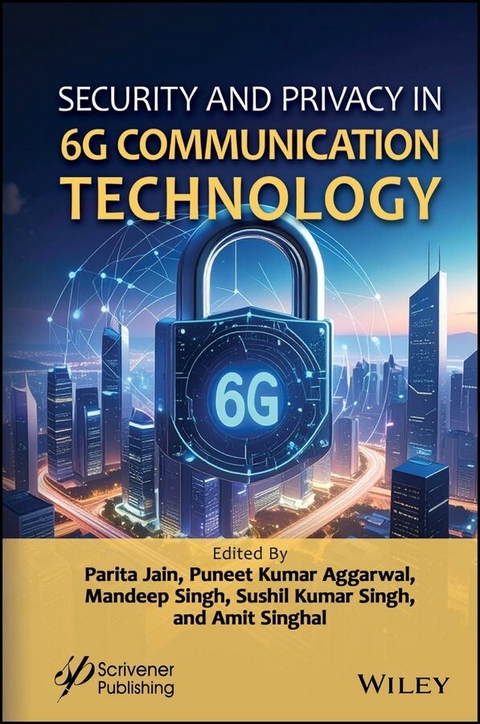
Security and Privacy in 6G Communication Technology (eBook)
526 Seiten
Wiley-Scrivener (Verlag)
978-1-394-31101-9 (ISBN)
Future-proof your knowledge and expertise in telecommunications with this essential guide, which provides a comprehensive analysis of the critical security and privacy challenges in the transition to 6G communication.
The advancement from 5G to 6G communication represents a quantum leap in wireless technology, promising unprecedented speeds, ultra-low latency, and ubiquitous connectivity. As the industry embarks on this journey, it encounters a host of technical challenges, particularly in ensuring the security and privacy of data transmitted across these networks. The interconnected nature of 6G systems, combined with the proliferation of Internet of Things devices and the sheer volume of data exchanged, creates a fertile ground for cyber threats and privacy breaches.
This book delves into these intricate technical challenges, offering a comprehensive analysis of the security and privacy implications of 6G communication. We explore the vulnerabilities inherent in 6G networks, ranging from potential weaknesses in network protocols to the risk of unauthorized access to sensitive data. Through detailed examination and real-world examples, we provide insights into cutting-edge security measures and privacy-preserving techniques tailored specifically to the unique characteristics of 6G systems. By addressing these challenges head-on, we aim to empower engineers, researchers, and policymakers with the knowledge and tools necessary to build resilient and secure 6G networks that safeguard user privacy and data integrity in an increasingly interconnected world. By dissecting the complexities of 6G architecture and protocols, the book equips readers with a nuanced understanding of the unique security and privacy considerations that must be addressed in the design and implementation of these transformative systems.
Parita Jain, PhD is an Assistant Professor of Research and Assistant Dean of Academics in the Department of Computer Science and Engineering at the KIET Group of Institutions. She has authored numerous research papers published in reputable national and international conferences and journals, covering diverse topics such as agile software development, machine learning, and quality assurance in software engineering. She brings a wealth of expertise in areas such as software engineering, artificial intelligence, machine learning, and data science, fostering an environment conducive to learning, growth, and innovation.
Puneet Kumar Aggarwal, PhD is an Associate Professor at ABES Engineering College with more than a decade of experience. His research interests and scholarly contributions, showcased through numerous publications in prestigious conferences and journals, demonstrate his commitment to advancing the field of IT. His career is marked by his dedication to quality education, with extensive research contributions in cybersecurity, machine learning, and mobile applications.
Mandeep Singh is a dedicated professional with more than eight years of experience in academia. With more than 25 publications to his credit, including 15 academic papers and ten book chapters, he has established himself as a prolific researcher. His contributions span various domains, including AI, machine learning, blockchain, and Internet of Things.
Sushil Kumar Singh, PhD is an Associate Professor in the Department of Computer Engineering at Marwadi University with more than 12 years of experience teaching in the field of computer science. He has published four books and many high-quality papers in international journals and conferences. His research interests include blockchain, artificial intelligence, big data, Internet of Things, smart city security, and cyber-physical systems.
Amit Singhal is a professor and head of the Department of Computer Science and Engineering at Raj Kumar Goel Institute of Technology, Ghaziabad. With over 22 years of academic experience, his research focuses on computer networks, cybersecurity, AI, blockchain, big data, and IoT. He has published multiple books and has authored numerous research papers in high-impact journals and international conferences. His contributions extend to patents on IoT-driven intelligent monitoring systems and cloud-based public transport monitoring. He also serves as an editor and reviewer for leading journals.
1
A Comprehensive Study of Security and Privacy Issues of 6G Wireless Communications Networks
Pawan Kumar1*, Mandeep Singh2, JaiShree Jain1, Anu Chaudhary1 and Shashank Sahu1
1Department of CSE, Ajay Kumar Garg Engineering College, Ghaziabad, Uttar Pradesh, India
2School of Computer Science Engineering and Technology, Bennett University, Greater Noida, Uttar Pradesh, India
Abstract
Due to the rapid growth of smart Internet-of-Things devices or internet-based applications and high-speed networks, the fifth-generation (5G) communications network will roll out from twhe market in future, and the sixth-generation (6G) communications network will completely replace the 5G networks with their advanced features. The 6G network is faster and more reliable than 5G networks in terms of their advanced features like high data speed (1 terabit per second), low latency time, capability to handle large networks, advanced security features for data transmission, and minimized energy consumption. Security and privacy of networks is the primary concern of any communication network. The book chapter aims to present a comprehensive study of the future evolution of 6G network with their key features, applications, challenges, security issues, and requirements to establish 6G wireless communications. Research more focuses on the study of the security and critical privacy issues associated with 6G technologies. Overall, this paper provides useful information for industries and academic researchers and discusses the potential for opening up new research directions related to the security of 6G networks.
Keywords: 6G security, privacy, communication, security threats, physical layer security, AI/ML security
1.1 Introduction
The growth rate of mobile volume data has increased rapidly in the last recent years due to increasing large number of mobile users, internet subscribers, connective devices, M2M (machine-to-machine) connections, etc. It is also expected that the volume of data will increase with a high growth rate in the coming years. According to a statistics report of the International Telecommunication Union, it is expected that mobile traffic data will reach up to 607 and 5,016 exabytes per month at the end of the year 2025 and 2030, respectively. Furthermore, it is also expected that 70% of the world population access mobile internet services by 2025, and, if we are talking about the Asia Pacific Region, then it will reach up to 13.5 billion devices. Nowadays, wireless broadband has become a very emerging and demanded technology in the field of communication, and its applications are used in various areas such as transportation, healthcare systems, infrastructure development, home internet, and military applications, performing better results. Although presently most industries and academics are using 5G wireless technology for commercial purposes for data transmission, 5G technology has several drawbacks. A very big challenge for telecommunication industries with 5G communication is the handling of massive internet traffic data in terms of reliability of data and latency time, providing better efficient energy and intelligence, and managing the security and privacy aspect of data. Managing of increasing data growth rate with low latency time is a big challenge for the existing 5G data communication systems. For example, the delay of air interface in haptic internet-based telemedicine is 1 ms in 5G networks, but it requires a delay of less than 0.1 milliseconds (ms). For better management of all the above issues, there is a need for a new advanced communication technology that overcomes the all these issues [1, 2]. A new advanced 6G communication technology was introduced that not only overcomes the problems of 5G but also provides a high-speed wireless communications network along with ultra-high reliability and low latency time. The 6G network was introduced by China Global and Huawei Technologies in November 2021 and launched a satellite for 6G communications, but it is estimated to be used publicly worldwide by the end of the year 2030. This chapter is divided into five subsections. The first section contains a detailed description ofthe introduction part. The second section explains the historic evolution of all communication generations starting from1G networks to present 5G networks along with their key features. The third section focuses on the complete study of 6G communication networks with their applications, benefits, and drawbacks and about the challenges in establishing 6G networks. The fourth section of the book chapter consists of the information about the all security metrics or measures that are in all communication generations, and it also focuses on four important key security features that need to be focused on for tomorrow’s 6G networks. The last section of the book chapter concludes with the conclusion of the chapter.
1.1.1 History of Wireless Communication
In the last few years, remarkable advancements have been made in the field of mobile communication in term of communication and information transfer. In the early days, mobile phones were limited in size, and their data speed was very less as compared to today’s high-speed smartphones. Mobile networks are processing huge improvementswith time in the field of telecommunication through different journeys starting from 1G (first-generation wireless network) to 6G (sixth-generation wireless network). The capability areas of wireless communication systems are also expanding with time. Each generation of mobile networks performed a significant milestone in the development of mobile communications [3]. The outline of all five generations of mobile networks along with their features is given in Figure 1.1, and the complete description is discussed below.
1G (First-Generation Mobile Networks): 1G network was based on an analog technology system and was initially introduced by Japan in 1979 and, later on, in 1980, used by other countries of the world. The 1G mobile networks used the frequency-division duplexing (FDD) method for radio-frequency transfer between transmitter and receiver. In 1G mobile communication, users can communicate with each other through phone calls only, but the drawback of this approach is that it is not applicable to receiving or sending text messages to other users. The distance coverage area of 1G technology was also very small, even though a large numbers of cell towers were required for signal transfer, and that was the reason why a large number of signal tower were installed around the country for signal transfer. 1G mobile network communication has no facility for roaming support among different operators, users can only transfer signals within a specified range of tower. The quality of sound was also not good, it provides less security and privacy, and information was easily hacked due to low encryption techniques. Data transfer speed of 6G communication was very less and varies in range of up to 2.4 kbps only [4, 5].
Figure 1.1 Generation evolution of communication networks from 1G to 6G.
2G (Second-Generation Mobile Networks): 2G mobile communication networks was used digital cellular networks for data transfer among mobile users and were launched in the year 1991 in Finland. It was operated on GSM (Global System for Mobile Communication) methodology and operates on frequency bands of ranges varying from 900 MHz to1800 MHz. A 2G generation network provides a high data rate speed and large coverage area as compared to a 1G network. It also supported both voice and SMS communication for data transfer and transfer data with a data speed of 64 kbps.
3G (Third-Generation Mobile Networks): 3G communication networks provided high data transfer speed as compared to 1G and 2G communication networks with data speed of 144 Kbps to 2Mbps. 3G communication networks were well suitable for audio, video, and web-based applications. Three types of mobile access techniques (code division, wide band division, and wide band code division multiple access) were used for communication in 3G technology.
4G (Fourth-Generation Networks): 4G network was launched in 2009, and it provided large bandwidth, high security, and fast internet access service as compared to 3G technology and other previous generation technology. 4G is 10 times faster than in speed as compared to 3G technology with consist of 100 Mbps data transfer speed. 4G technology, based on Long-Term Evolution (LTE) technique, that enables voice calls, mobile data, and text messages on a 4G mobile phone.
5G (Fifth-Generation Network): 5G is the latest iteration of cellular technology and the successor of 4G. It providesfaster downloading and uploading data speed as compared to 4G and 3G. It establishes the more reliable and efficient connection among mobile users. 4G network i s also capable to connect a number of devices at the sametime with the network. Downloading speed of 4G lies in between range of 10 and 20 Gbps, and it is 100 times faster in speed as compared to 4G network [6, 7].
1.1.2 Overview of 6G Networks
Even though 5G technology has not been implemented fully throughout the world, limitations of 5G networks motivate researchers, to begin new advanced research in the field of communication-related to 6G networks. In this regard, the first 6G world’s summit was organized in Finland in March 2019, and top communication expertsof the world drafted together a first 6G network white paper. From this summit, the 6G network was unofficially born, and several countries of the world...
| Erscheint lt. Verlag | 27.11.2025 |
|---|---|
| Sprache | englisch |
| Themenwelt | Mathematik / Informatik ► Informatik |
| Technik ► Elektrotechnik / Energietechnik | |
| Schlagworte | 6G Communication • Advanced Communication Technologies • Cybersecurity in Telecommunications • data privacy • Emerging communication technologies • Future communication systems • network encryption • Network Security • Next-Generation Networks • Privacy Challenges in Advanced Networks • privacy-preserving techniques • Privacy Protection in 6G • Secure Data Transmission • Secure Networking Protocols • Wireless Communication Security |
| ISBN-10 | 1-394-31101-X / 139431101X |
| ISBN-13 | 978-1-394-31101-9 / 9781394311019 |
| Informationen gemäß Produktsicherheitsverordnung (GPSR) | |
| Haben Sie eine Frage zum Produkt? |
 EPUB (Adobe DRM)
Kopierschutz: Adobe-DRM
Adobe-DRM ist ein Kopierschutz, der das eBook vor Mißbrauch schützen soll. Dabei wird das eBook bereits beim Download auf Ihre persönliche Adobe-ID autorisiert. Lesen können Sie das eBook dann nur auf den Geräten, welche ebenfalls auf Ihre Adobe-ID registriert sind.
Details zum Adobe-DRM
Dateiformat: EPUB (Electronic Publication)
EPUB ist ein offener Standard für eBooks und eignet sich besonders zur Darstellung von Belletristik und Sachbüchern. Der Fließtext wird dynamisch an die Display- und Schriftgröße angepasst. Auch für mobile Lesegeräte ist EPUB daher gut geeignet.
Systemvoraussetzungen:
PC/Mac: Mit einem PC oder Mac können Sie dieses eBook lesen. Sie benötigen eine
eReader: Dieses eBook kann mit (fast) allen eBook-Readern gelesen werden. Mit dem amazon-Kindle ist es aber nicht kompatibel.
Smartphone/Tablet: Egal ob Apple oder Android, dieses eBook können Sie lesen. Sie benötigen eine
Geräteliste und zusätzliche Hinweise
Buying eBooks from abroad
For tax law reasons we can sell eBooks just within Germany and Switzerland. Regrettably we cannot fulfill eBook-orders from other countries.
aus dem Bereich