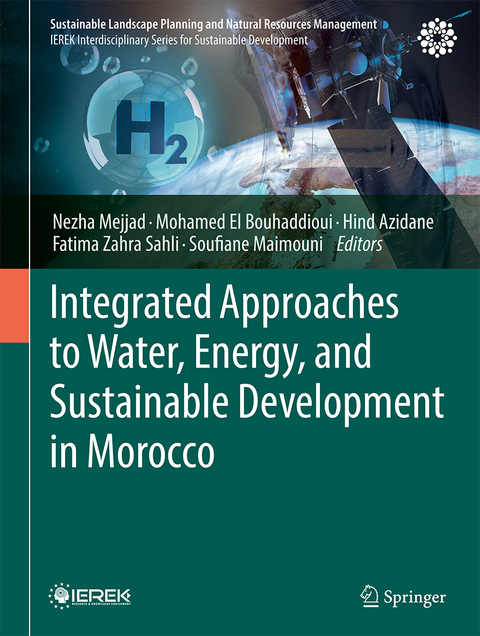
Integrated Approaches to Water, Energy, and Sustainable Development in Morocco
Springer International Publishing (Verlag)
978-3-032-16240-3 (ISBN)
- Noch nicht erschienen - erscheint am 24.03.2026
- Versandkostenfrei
- Auch auf Rechnung
- Artikel merken
This book provides a comprehensive analysis of the interconnection between water resources, agriculture, and other industrial sectors, along with an exploration of the importance of new alternatives for natural resource conservation and protection, such as waste valorization and its conversion into eco-friendly products, and renewable energy as a solution to climate change. At the same time, it highlights the necessity of civic engagement in tackling these challenges. It is structured into four main sections that address critical challenges and solutions in the field. The first section focuses on water resources and ecosystems, from coastlines to inland valleys, where the first section investigates how natural factors and human activities affect water quality, availability, and sustainability. Through various case studies, the book highlights the complex relationship between water quality and coastal environments. The second section analyses the conversion of environmental challenges into ecological solutions through resource and waste valorization. This section outlines a clear vision for valorizing Morocco s natural resources (such as phosphate and oil shale) to address agricultural, industrial, and environmental challenges within a sustainable growth framework. The third section investigates the relationship between urban development and land use changes using GIS and remote sensing methods, which are influencing agricultural lands. This part explores the roles of societal behavior and ecological engagement in shaping the path toward sustainability in Morocco. This section presents integrated insights into the importance of civic engagement, social behavior, and dynamics in promoting inclusive and sustainable environmental governance. The fourth section emphasizes hydrogen as an emerging sector and a cornerstone of Morocco's sustainable energy transition, as well as its growing role in global decarbonization efforts. This part of the book emphasizes the role that green hydrogen may play as a clean energy source in mitigating climate and supporting long-term societal, economic, and environmental sustainability. At the same time, it underscores the importance of strategic planning, technological innovation, and international collaboration in positioning Morocco as a key actor in the global green hydrogen transition. This book serves as a valuable resource for researchers, policymakers, and practitioners seeking innovative solutions to sustainable water resource management, waste valorization, and enhanced energy security amid growing environmental challenges.
Dr. Nezha MEJJAD holds a Ph.D. in Geochemistry and Environment from Hassan II University of Casablanca, Morocco (2018, awarded Very Honorable with Committee Praise ). She is a Research Scientist in Marine Geochemistry and Environmental Sustainability at the National Centre for Nuclear Energy, Science and Technology (CNESTEN), Rabat, Morocco. Dr. Mejjad s research focuses on the environmental impacts of human activities on marine and coastal ecosystems, with emphasis on blue carbon sequestration and storage, microplastic and heavy metal pollution, and the use of nuclear and isotopic techniques for marine environmental monitoring. She has more than 10 years of experience in marine environmental studies, including geochemical characterization of sediments, pollution source identification, and reconstruction of historical environmental changes using radiometric dating and isotopic tracers. She has participated in several international collaborations on microplastic contamination, sediment pollution history, and carbon cycling in seagrass and lagoonal ecosystems. Her scientific output includes over 40 peer-reviewed articles, 10 book chapters, and three edited books published or in press with major international publishers. Dr. Mejjad also serves on the editorial boards of several international journals published by prestigious publishers, including Nature and Springer, and contributes to advancing research on marine pollution, blue carbon, and environmental sustainability. Her ongoing work provides critical insights into carbon dynamics and pollution trends in Moroccan coastal systems, supporting climate change mitigation, environmental protection, and the sustainable management of aquatic ecosystems.
I. Water Resources and Ecosystems.- 1. Sun And Beach Tourism: What Pressures Are On Water Resources? A PESTLE and SWOT Analysis.- 2. Identification of Groundwater Potential Zones (GWPZ) Using Geospatial Techniques and AHP Method: a Case Study of the Coastal Basin of ESSAOUIRA, Morocco.- 3. Dynamic of traditional and Modern Irrigation Methods within the Floodplain of the Middle Sebou Valley, Downstream of Fez (Morocco).- 4. Mineralogical and Chemical Composition Changes in Oualidia Lagoon Sediments over the Last 40 Years.- 5. Studies on Temporary Aquatic Habitats in Eastern Morocco: Ecological and Health Importance of Culicidae (Diptera: Nematocera).- II. Pollution, Materials, and Waste Valorization.- 6. Removal of 133Ba from aqueous solutions by adsorption onto oil shale and determination of the main phase responsible for its fixation.- 7. Phosphate Glass Fibers Based on Natural Phosphate and Oil Shale as Environmentally Friendly Fertilizers with Enhanced Strength.- 8. Food and Agro Waste Valorization for construction applications: A Comprehensive Review.- III. Urban Development, Land Use, And Citizen Engagement.- 9. Using Gis to identify land use cover change measure urban sprawl based on agricultural land: A case study of Ait Amira in central-western Morocco.- 10. Ecological Engagement in Morocco: Balancing Sustainable Development with Dynamic Citizen Behavior.- 11. Exploring the Implications of a Whole-of-Society Approach on Pro-environmental Behavior Among Mobile Communities During the COVID-19 Pandemic.- IV. Urban Development, Land Use, And Citizen Engagement.- 12. Impact of Electrolysis Operating Range on the Sustainability and Profitability of a Wind-Powered Green Hydrogen Plant: A Case Study in Southern Morocco.- 13. Green Hydrogen Strategies in France and Morocco: A Comparative Techno-Economic and Geopolitical Assessment Towards 2050.- V. Synthesis.- 14. Integrated Approaches to Water, Energy, and Sustainable Development in Morocco: A synthesis.
| Erscheint lt. Verlag | 24.3.2026 |
|---|---|
| Reihe/Serie | Sustainable Landscape Planning and Natural Resources Management |
| Zusatzinfo | IV, 243 p. 89 illus., 76 illus. in color. |
| Verlagsort | Cham |
| Sprache | englisch |
| Maße | 210 x 279 mm |
| Themenwelt | Informatik ► Theorie / Studium ► Künstliche Intelligenz / Robotik |
| Naturwissenschaften ► Geowissenschaften ► Geografie / Kartografie | |
| Naturwissenschaften ► Geowissenschaften ► Hydrologie / Ozeanografie | |
| Schlagworte | Adsorption • Analytic Hierarchy Process (AHP) • Artificial Intelligence (AI) • Deep learning • Eco-Driving Approach • Estuarine Dredged Sediments • field survey • food waste valorization • geographic information systems • Geospatial techniques • Land use cover change • oil shale • Sustainable Development Goals (SDGs) • Watering Methods • Water Management |
| ISBN-10 | 3-032-16240-8 / 3032162408 |
| ISBN-13 | 978-3-032-16240-3 / 9783032162403 |
| Zustand | Neuware |
| Informationen gemäß Produktsicherheitsverordnung (GPSR) | |
| Haben Sie eine Frage zum Produkt? |
aus dem Bereich