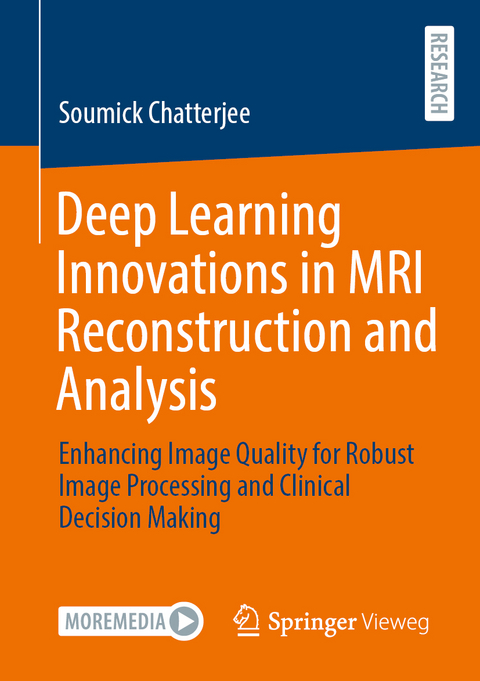
Deep Learning Innovations in MRI Reconstruction and Analysis
Springer Fachmedien Wiesbaden GmbH (Verlag)
978-3-658-50740-4 (ISBN)
- Noch nicht erschienen - erscheint am 19.02.2026
- Versandkostenfrei
- Auch auf Rechnung
- Artikel merken
High-resolution magnetic resonance imaging (MRI) is clinically vital but inherently slow. Accelerating acquisition via undersampling introduces artefacts, whereas long scans risk motion blur; traditional solutions, such as compressed sensing, often fail under such heavy corruption. Consequently, this thesis investigates deep learning methods to correct these artefacts. It develops pipelines for the reconstruction of undersampled (Cartesian and radial) and motion-corrupted data, and for super-resolution, whilst exploring the integration of prior knowledge and complex-valued convolutions. Beyond visual diagnostics, the thesis examines the impact of reconstruction on automated image processing. It proposes and evaluates pipelines for classification, segmentation (supervised and weakly/semi-supervised), anomaly detection, and registration. Validated on brain tumour and vessel tasks, the study demonstrates that the proposed deep learning-based reconstruction effectively supports both clinical inspection and robust automated decision-making systems.
Dr Soumick Chatterjee is a postdoctoral researcher at Human Technopole in Milan, Italy. He is also a lecturer in AI for medical imaging at Otto von Guericke University Magdeburg, Germany, where he completed his PhD. His primary area of research focuses on machine learning, specifically deep learning, and its applications in medical imaging and genetics.
1. Introduction.- I Fundamentals.- 2. Magnetic Resonance Imaging.- 3. Image Processing.- 4. Neural Networks.- II Current Techniques.- 5. Undersampled MRI Reconstruction.- 6.Motion Correction.- 7. Automatic MR Image Processing Pipelines.- III Advancing the Field of Undersampled Reconstruction.- 8. Artefact Reduction in the Image Space.- 9. Undersampled Reconstruction as Super Resolution.- 10. Working in the Hybrid Space.- IV Undersampled Reconstruction as a Generalised Component of an MRI Processing Pipeline.- 11. Spatiospatial Models: Brain Tumour Classification.- 12. GP-models: Brain Tumour Classification.- 13. StRegA: Anomaly Detection.- 14. DS6: Vessel Segmentation.- 15. MICDIR: Image Registration.- V.Tackling the Motion.- 16. Retrospective Motion Correction.- VI Conclusion and Outlook.- 17. Concluding Remarks.- 18. Directions for Future Research.
| Erscheint lt. Verlag | 4.5.2026 |
|---|---|
| Zusatzinfo | Approx. 395 p. Textbook for German language market. |
| Verlagsort | Wiesbaden |
| Sprache | englisch |
| Maße | 148 x 210 mm |
| Themenwelt | Mathematik / Informatik ► Informatik ► Datenbanken |
| Technik | |
| Schlagworte | Anomaly Detection • artefacts • Cartesian MRI • classification • Deep learning • machine learning • Motion • MRI • Radial MRI • reconstruction • Segmentation • supervised learning • Unsupervised Learning • Weakly-supervised Learning |
| ISBN-10 | 3-658-50740-3 / 3658507403 |
| ISBN-13 | 978-3-658-50740-4 / 9783658507404 |
| Zustand | Neuware |
| Informationen gemäß Produktsicherheitsverordnung (GPSR) | |
| Haben Sie eine Frage zum Produkt? |
aus dem Bereich