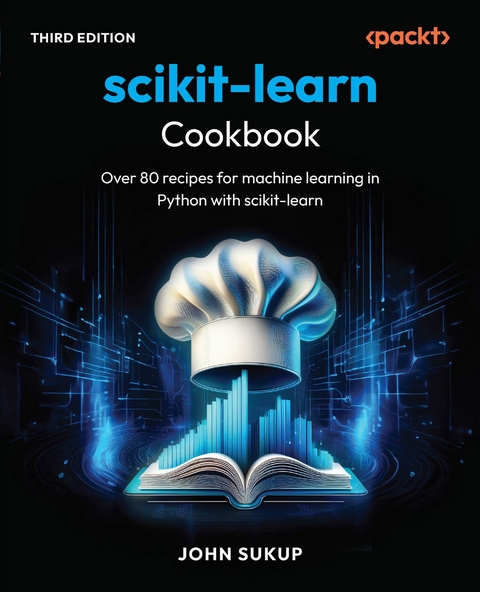
scikit-learn Cookbook (eBook)
388 Seiten
Packt Publishing (Verlag)
978-1-83664-444-6 (ISBN)
Trusted by data scientists, ML engineers, and software developers alike, scikit-learn offers a versatile, user-friendly framework for implementing a wide range of ML algorithms, enabling the efficient development and deployment of predictive models in real-world applications. This third edition of scikit-learn Cookbook will help you master ML with real-world examples and scikit-learn 1.5 features.
This updated edition takes you on a journey from understanding the fundamentals of ML and data preprocessing, through implementing advanced algorithms and techniques, to deploying and optimizing ML models in production. Along the way, you'll explore practical, step-by-step recipes that cover everything from feature engineering and model selection to hyperparameter tuning and model evaluation, all using scikit-learn.
By the end of this book, you'll have gained the knowledge and skills needed to confidently build, evaluate, and deploy sophisticated ML models using scikit-learn, ready to tackle a wide range of data-driven challenges.
Preface
Although the technology world today is all abuzz about artificial intelligence (AI) and the large language models (LLMs) that power them, machine learning (ML) is still providing value to businesses through predictive modeling and prescriptive analytics. So many systems today are powered by ML on the backend that most people would be surprised to learn how often businesses employ such techniques to refine their marketing strategy, upsell and improve product placement, and customize user experiences, among other applications.
While countless tools and software exist today to enable ML applications, one tool has become the backbone of both hobbyists and enterprises alike: scikit-learn. It’s hard to believe that scikit-learn v0.1 debuted over 15 years ago in January 2010, yet even after all that time and all the changes and advancements in ML and AI, it still holds its place as one of the foremost Python libraries for both AI/ML.
scikit-learn is a powerful, open source ML library for Python that provides simple and efficient tools for data mining and data analysis, built on top of NumPy, SciPy, and Matplotlib. It offers a versatile, user-friendly framework for implementing a wide range of ML algorithms, enabling efficient development and deployment of predictive models in real-world applications.
This book is devoted to scikit-learn v1.5. It takes you on a journey from understanding the fundamentals of ML and data preprocessing, through implementing advanced algorithms and techniques, to deploying and optimizing ML models in production. Along the way, you will explore practical, step-by-step recipes that cover everything from feature engineering and model selection to hyperparameter tuning and model evaluation, all using scikit-learn 1.5.
Finally, every chapter contains examples designed to give you an opportunity to apply the chapter’s learning through coding exercises.
Who this book is for
This book is for data scientists and ML professionals looking to deepen their understanding of advanced ML techniques. Additionally, software engineers and developers who want to implement sophisticated ML models in their applications can benefit equally.
What this book covers
Chapter 1, Common Conventions and API Elements of scikit-learn, covers the standard conventions and core API elements of scikit-learn, including the design principles behind estimators, transformers, and pipelines, as well as common methods such as fit(), predict(), and transform().
Chapter 2, Pre-Model Workflow and Data Preprocessing, covers preprocessing tools and techniques, including enhanced data transformers and feature engineering methods.
Chapter 3, Dimensionality Reduction Techniques, includes updated approaches for dimensionality reduction with new algorithms and improvements in scikit-learn.
Chapter 4, Building Models with Distance Metrics and Nearest Neighbors, includes updates on the latest developments in distance metric-based models.
Chapter 5, Linear Models and Regularization, covers the linear models and regularization techniques that are now available.
Chapter 6, Advanced Logistic Regression and Extensions, explores the latest advancements in logistic regression and its extensions.
Chapter 7, Support Vector Machines and Kernel Methods, covers features and optimizations in SVMs and kernel methods.
Chapter 8, Tree-Based Algorithms and Ensemble Methods, includes the latest improvements and new ensemble techniques.
Chapter 9, Text Processing and Multiclass Classification, covers new text vectorization methods and multiclass classification strategies.
Chapter 10, Clustering Techniques, explores unsupervised learning techniques for finding naturally occurring groupings of similar data points.
Chapter 11, Novelty and Outlier Detection, covers techniques for finding inlier and outlier data points in training datasets.
Chapter 12, Cross-Validation and Model Evaluation Techniques, covers cross-validation strategies, scoring methods, and model evaluation tools.
Chapter 13, Deploying scikit-learn Models in Production, includes tools and best practices for deploying scikit-learn models in production environments, with a focus on scalability and maintainability.
To get the most out of this book
This book is designed to provide basic examples of the most important features of scikit-learn v1.5. In order to maximize the effectiveness of your learning, in addition to completing the exercises in each chapter, we encourage you to try your own examples and explore additional function arguments beyond those presented. Additionally, combining your learning from different chapters is an effective way to coalesce your scikit-learning understanding holistically.
| Software/hardware covered in the book | OS requirements |
| scikit-learn v1.5 or greater | Windows, macOS X, and Linux (any) |
| Git >=2.46.x |
| Python >=3.9.x |
Each chapter reminds you of the GitHub repository where example code is stored and how to install it locally.
Installing Python libraries in virtual environments with requirements.txt
Installing Python packages from a requirements.txt file is a common practice for managing project dependencies. Here’s a step-by-step guide:
- Navigate to your project directory.
- Open your Terminal or Command Prompt and navigate to the root directory of your Python project, where the requirements.txt file is located: cd /path/to/your/project
- Using a virtual environment isolates your project’s dependencies from other Python projects on your system, preventing conflicts. Next, create the virtual environment: python -m venv venv_name
(Replace venv_name with your desired name for the virtual environment, e.g., venv or scikitlearncookbook.)
- Activate the virtual environment:
- On macOS/Linux, use the following: source venv_name/bin/activate
- On Windows, use this:venv_name/Scripts/activate
Installing the packages
With your virtual environment activated (if you created one), use pip to install the packages listed in requirements.txt:
pip install -r requirements.txtIf you are not using a virtual environment or need to specify a particular Python executable, you might use pip3 instead of pip.
Verifying installation (optional)
You can verify that the packages are installed by running the following:
pip listThis command will list all the installed packages in your current environment, including those from requirements.txt.
When you are finished working on the project, you can deactivate the virtual environment:
deactivateIf you are using the digital version of this book, we advise you to type the code yourself or access the code via the GitHub repository (link available in the next section). Doing so will help you avoid any potential errors related to the copying and pasting of code.
Download the example code files
The code bundle for the book is hosted on GitHub at https://github.com/PacktPublishing/scikit-learn-Cookbook-Third-Edition.
We also have other code bundles from our rich catalog of books and videos available at https://github.com/PacktPublishing. Check them out!
Conventions used
There are a number of text conventions used throughout this book.
CodeInText: Indicates code words in text, database table names, folder names, filenames, file...
| Erscheint lt. Verlag | 19.12.2025 |
|---|---|
| Sprache | englisch |
| Themenwelt | Mathematik / Informatik ► Informatik |
| ISBN-10 | 1-83664-444-2 / 1836644442 |
| ISBN-13 | 978-1-83664-444-6 / 9781836644446 |
| Informationen gemäß Produktsicherheitsverordnung (GPSR) | |
| Haben Sie eine Frage zum Produkt? |
 EPUB (Ohne DRM)
Digital Rights Management: ohne DRM
Dieses eBook enthält kein DRM oder Kopierschutz. Eine Weitergabe an Dritte ist jedoch rechtlich nicht zulässig, weil Sie beim Kauf nur die Rechte an der persönlichen Nutzung erwerben.
Dateiformat: EPUB (Electronic Publication)
EPUB ist ein offener Standard für eBooks und eignet sich besonders zur Darstellung von Belletristik und Sachbüchern. Der Fließtext wird dynamisch an die Display- und Schriftgröße angepasst. Auch für mobile Lesegeräte ist EPUB daher gut geeignet.
Systemvoraussetzungen:
PC/Mac: Mit einem PC oder Mac können Sie dieses eBook lesen. Sie benötigen dafür die kostenlose Software Adobe Digital Editions.
eReader: Dieses eBook kann mit (fast) allen eBook-Readern gelesen werden. Mit dem amazon-Kindle ist es aber nicht kompatibel.
Smartphone/Tablet: Egal ob Apple oder Android, dieses eBook können Sie lesen. Sie benötigen dafür eine kostenlose App.
Geräteliste und zusätzliche Hinweise
Buying eBooks from abroad
For tax law reasons we can sell eBooks just within Germany and Switzerland. Regrettably we cannot fulfill eBook-orders from other countries.
aus dem Bereich