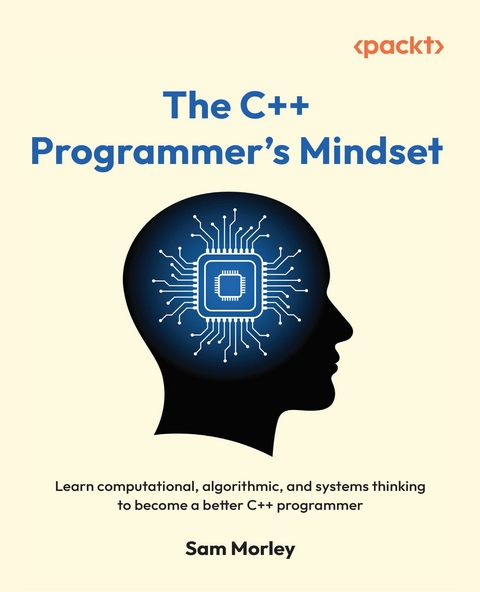
The C++ Programmer's Mindset (eBook)
398 Seiten
Packt Publishing (Verlag)
978-1-83588-843-8 (ISBN)
Solve complex problems in C++ by learning how to think like a computer scientist. This book introduces computational thinking-a framework for solving problems using decomposition, abstraction, and pattern recognition-and shows you how to apply it using modern C++ features. You'll learn how to break down challenges, choose the right abstractions, and build solutions that are both maintainable and efficient.
Through small examples and a large case study, this book guides you from foundational concepts to high-performance applications. You'll explore reusable templates, algorithms, modularity, and even parallel computing and GPU acceleration. With each chapter, you'll not only expand your C++ skillset, but also refine the way you approach and solve real-world problems.
Written by a seasoned research engineer and C++ developer, this book combines practical insight with academic rigor. Whether you're designing algorithms or profiling production code, this book helps you deliver elegant, effective solutions with confidence.
1
Thinking Computationally
Solving problems is a central part of being a programmer, as well as a useful skill for everyday life. The methodology is broadly the same wherever you look: identify smaller, more tractable challenges; realize these as instances of a general class of problem; solve the intermediate challenges; and put everything together as a sequence of simple steps to solve the larger problem. In computer science, we call this computational thinking.
This chapter serves as an introduction to the basic components of computational thinking at a high level. The objectives are to lay the foundation for more detailed analysis and in-depth examples later in the book. The first part of the chapter introduces the four components of computational thinking (decomposition, abstraction, pattern recognition, and algorithm design). The second half of the chapter deals with C++ specifically and identifies some aspects of the C++ language and standard library that can not only help implement efficient solutions, but also help you think about the problems themselves.
It is important to remember that the four components of computational thinking are not a step-by-step guide to solving problems. Learning how and when these different components come together to deliver a solution relies on a good knowledge of the tools and methodologies available to you as the solver, and on your past experience. This chapter will help you get started with building the necessary foundations of the theory and set the stage for building out some basic examples to get you started with tackling larger and more complex problems later.
Solving problems is an iterative process. There will be many failed attempts and false starts. This is a necessary part of the process. The last part of the chapter deals with good software practices that will enable you to iterate quickly and easily on your designs and arrive at a correct and usable solution more quickly.
In this chapter, we’re going to cover the following main topics:
- The components of computational thinking
- Decomposing problems
- Building abstractions and recognizing common patterns
- Understanding algorithms
- Using modern C++ and good practice
Free Benefits with Your BookYour purchase includes a free PDF copy of this book along with other exclusive benefits. Check the Free Benefits with Your Book section in the Preface to unlock them instantly and maximize your learning experience. |
Technical requirements
In this chapter, we discuss the theory and methodology of computational thinking. As such, this chapter doesn’t include much code. However, some of the later sections do have some samples of C++ code, and, as with the rest of this book, some familiarity with C++ is expected. Since the latter sections describe good practice for working with code, the Chapter-01 folder in the GitHub repository for this book (https://github.com/PacktPublishing/The-CPP-Programmers-Mindset) includes these samples of code along with unit tests. These tests do not contribute to the content of the chapter.
The components of computational thinking
Solving problems is an iterative process. There are many things to consider at each step. As some challenges are overcome, others will emerge. Computational thinking provides the framework for deciding what step to take next. As with all iterative processes, there will be steps that don’t work out because the solutions you arrive at are unsatisfactory or simply don’t work, but this is all part of the process.
Before we continue, we need to discuss what we mean by a “problem.” For the purposes of this book, a problem is a specific task with well-defined constraints and parameters. The actual nature of the task can be relatively simple or highly complex, as long as it is specific. The constraints can also be broad in nature: they can be managerial (time constraints, deadlines), technical (performance), or domain-specific (physical limitations). The parameters describe the data and other information that is provided in order to solve the task.
The four components of computational thinking are as follows:
- Decomposition
- Abstraction
- Pattern recognition
- Algorithm design
Each step in the problem-solving process will involve one or more of these components, but they are not, in themselves, the steps that one must follow. For instance, some steps will fall into a class of well-known problems with “off-the-shelf” solutions that can be implemented with ease. Other steps will be complex and require decomposition into many smaller problems. Moreover, these components cannot be considered in isolation. One cannot decompose a problem without understanding the essential constituents of the problem or recognizing standard patterns among the noise of contextual information that may or may not be relevant. You must consider all the components at once.
It is sometimes easy to miss the bigger picture when you are solving small and nuanced problems – especially how your solution will interface with the larger system. This could be the larger piece of software in which your solution will live, or the way clients interact with your software. These issues are also part of the problem that you would need to solve, using the components of computational thinking to guide you.
As you gain experience, the number of patterns and standard problems that you recognize will grow, and the speed at which you arrive at useful abstractions will increase. In the beginning, these aspects will be the most troublesome. In the remainder of this book, we will look at common techniques and some standard problems that will allow you to get started with problem-solving. Unfortunately, we cannot simply give you a complete catalogue of patterns and abstractions: if all problems were already solved, there would be no need for a framework for solving problems.
Solving problems is not only an iterative process, but also a dynamic process. Some choices will have implications for the rest of the process and possibly even for previous steps. For example, selecting a programming language, such as C++, will have a dramatic effect on the way you go about designing algorithms, selecting abstractions, the standard patterns available, and the way you further decompose problems. For example, if one solves a problem in Python, one might try to lean on the numerous high-performance libraries, which may or may not provide the exact functionality required. However, in C++, you have more freedom to implement your own high-performance primitive operations.
There will be times when you have to undo several steps of the process, especially while you’re still building experience. The important thing here is to understand that this is a necessary step in the learning process. You must endeavor to understand why that particular line of investigation failed and how to incorporate this knowledge into the next iteration. Don’t be afraid to go back to the beginning (time allowing) and start again. Sometimes this is the only way to make progress.
In the remainder of this chapter, we look in more detail at the four components of computational thinking. For now, we will only discuss the components in general. We will revisit these components in far more detail in later chapters, when we look at real examples and how to apply these concepts using C++.
General advice
Solving problems can be hard, especially when you’re fairly new to a particular domain, language, tool, or working environment. Here is some general advice on how to make this easier and more enjoyable.
- Keep a journal of patterns, abstractions, and other information that you can refer back to when new problems appear. As you get more experience, you will internalize many of these, but there will always be some that you forget about that you might need to call on in the future.
- Seek out small problems to hone your skills. Websites such as LeetCode (https://leetcode.com/) have huge libraries of small problems that are designed to teach specific patterns and techniques. This can help, especially at the beginning when you don’t have your own catalogue to draw upon. The greater the variety of problems that you see, the more you have to draw upon when you’re looking for patterns and abstractions when solving entirely new problems; the problems don’t need to be identical, just similar enough to provide inspiration.
- Talk to colleagues and friends about problems, where this is appropriate. Sometimes the act of explaining a problem can help make it clearer for you and will sometimes help you to solve the problem directly. If you can find a more senior or experienced colleague who is willing to help, then they can share their own expertise with you, which can sometimes help you arrive at solutions more quickly. If no colleagues or friends are available, even talking the problem through with your rubber duck can help – and they are always willing to listen.
A far too mathematical example
Before we go into detail about the components of computational thinking, we should first look at an example where many of these ideas manifest. The example...
| Erscheint lt. Verlag | 27.11.2025 |
|---|---|
| Sprache | englisch |
| Themenwelt | Informatik ► Programmiersprachen / -werkzeuge ► C / C++ |
| ISBN-10 | 1-83588-843-7 / 1835888437 |
| ISBN-13 | 978-1-83588-843-8 / 9781835888438 |
| Informationen gemäß Produktsicherheitsverordnung (GPSR) | |
| Haben Sie eine Frage zum Produkt? |
 EPUB (Ohne DRM)
Digital Rights Management: ohne DRM
Dieses eBook enthält kein DRM oder Kopierschutz. Eine Weitergabe an Dritte ist jedoch rechtlich nicht zulässig, weil Sie beim Kauf nur die Rechte an der persönlichen Nutzung erwerben.
Dateiformat: EPUB (Electronic Publication)
EPUB ist ein offener Standard für eBooks und eignet sich besonders zur Darstellung von Belletristik und Sachbüchern. Der Fließtext wird dynamisch an die Display- und Schriftgröße angepasst. Auch für mobile Lesegeräte ist EPUB daher gut geeignet.
Systemvoraussetzungen:
PC/Mac: Mit einem PC oder Mac können Sie dieses eBook lesen. Sie benötigen dafür die kostenlose Software Adobe Digital Editions.
eReader: Dieses eBook kann mit (fast) allen eBook-Readern gelesen werden. Mit dem amazon-Kindle ist es aber nicht kompatibel.
Smartphone/Tablet: Egal ob Apple oder Android, dieses eBook können Sie lesen. Sie benötigen dafür eine kostenlose App.
Geräteliste und zusätzliche Hinweise
Buying eBooks from abroad
For tax law reasons we can sell eBooks just within Germany and Switzerland. Regrettably we cannot fulfill eBook-orders from other countries.
aus dem Bereich