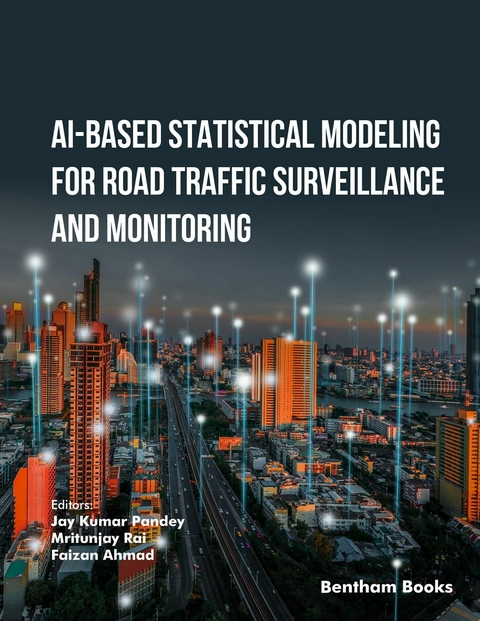
AI-Based Statistical Modeling for Road Traffic Surveillance and Monitoring (eBook)
300 Seiten
Bentham Science Publishers (Verlag)
979-8-89881-111-2 (ISBN)
Positioned at the intersection of intelligent transportation systems (ITS), computer vision, and machine learning, this book presents a comprehensive examination of how artificial intelligence and statistical techniques are reshaping traffic monitoring, management, and urban mobility in the era of smart cities. The book begins with the core principles of AI and traffic systems, introducing statistical modeling, data acquisition, and image processing for traffic analysis. Midway, it transitions into deep learning-powered applications such as object detection, vehicle tracking, congestion forecasting, and real-time incident recognition. Later sections address legal, regulatory, and ethical frameworks, while concluding chapters highlight IoT-enabled models and future trajectories in AI-powered traffic management. Key Features: Introduces principles of AI, machine learning, and statistical modeling for traffic systems Demonstrates applications of deep learning in congestion prediction, incident detection, and vehicle tracking Examines AI-driven traffic optimization, urban mobility solutions, and self-driving technologies Evaluates security, data privacy, and legal considerations in AI-based traffic surveillance Integrates AI with IoT frameworks for real-time monitoring in smart city infrastructure Highlights future directions and policy implications for sustainable and ethical traffic management.
Introduction to Artificial Intelligence in Traffic Systems
Ritwik Raj Saxena1, *
Abstract
Traffic management is a pressing challenge in modern societies. The population of humans is increasing at a substantial pace, and along with that, the expanse of urban areas and the number of vehicles are increasing as well. This makes it increasingly more complicated to monitor and manage all transport modalities at the same time, while maintaining low tenable costs. Also, with an expanding number of automobiles, vehicular congestion, a growing number of choke points, and increased instances of on-road disruption collectively become rapidly burgeoning traffic management problems, especially in urban areas. These issues pose an exceedingly complex challenge for metropolitan communities, leading to financial losses, delays in the delivery of emergency services to people, environmental pollution, and a reduced quality of life. Artificial Intelligence (AI) has stood out as a potent instrument for resolving such questions. It can augment traffic flow, accentuate transportation effectiveness, and raise the reassurance levels of passengers, commuters, as well as pedestrians. This chapter attempts to elucidate a myriad of applications of AI in the province of transportation management. It examines its potential to revolutionize urban transportation.
Existing research on AI-based traffic management systems, utilizing techniques such as fuzzy logic, reinforcement learning, deep neural networks, and evolutionary algorithms, demonstrates the potential of AI to transform the traffic landscape. This chapter endeavors to review the topics where AI and traffic management intersect. It comprises areas like AI-powered traffic signal control systems, automatic distance and velocity recognition (for instance, in autonomous vehicles, hereafter AVs), smart parking systems, and Intelligent Traffic Management Systems (ITMS), which use data captured in real-time to keep track of traffic conditions, and traffic-related law enforcement and surveillance using AI.
AI applications in traffic management cover a wide range of spheres. The spheres comprise, inter alia, streamlining traffic signal timings, predicting traffic bottlenecks in specific areas, detecting potential accidents and road hazards, managing incidents accurately, advancing public transportation systems, developing innovative driver assistance systems, and minimizing environmental impact through simplified routes and reduced emissions.
The benefits of AI in traffic management are also diverse. They comprise improved management of traffic data, sounder route decision automation, easier and speedier identification and resolution of vehicular issues through monitoring the condition of individual vehicles, decreased traffic snarls and mishaps, superior resource utilization, alleviated stress of traffic management manpower, greater on-road safety, and better emergency response time.
The chapter acknowledges the challenges associated with the implementation of AI-activated transportation management systems, such as the acquisition of reliable data, concerns associated with data privacy, computational costs, and cybersecurity threats like adversarial attacks. It highlights the need for high-quality, real-time data to train and maintain AI models. There are additional challenges which are related to the integration of AI with existing traffic management infrastructure. Redressing these challenges would ensure that the public trust in such systems is maintained. Further, the existence of ethical considerations around bias in AI algorithms, particularly Natural Language Processing (NLP) models, including gender insensitivity of AI models, creates another potential hurdle.
AI has the potential to engender a quantum shift in traffic management by bringing about smarter and more resilient transportation systems. This chapter underlines the need to overcome existing challenges in the operation of AI-regulated traffic management systems, which will ensure their seamless performance. This will serve to perfect the on-road experience of people and bring advancement in their quality of life. The future of AI in traffic management is supported by potential applications in the field, like AI-maneuvered traffic forecasting, real-time traffic updates, and personalized travel assistance. Future AI-driven traffic management systems are projected to be more comprehensive in their applications. They will also be more powerful, holistic, ethical, inclusive, environmentally sustainable, robust, maintainable, and easily operable. Crucially, these systems are expected to be economically feasible, optimizing both time and resource utilization.
* Corresponding author Ritwik Raj Saxena: Department of Computer Science, University of Minnesota, Duluth Campus, Duluth, Minnesota, USA; E-mail: saxen130@d.umn.edu
Introduction, Background, and Motivation
The flourishing field of AI has penetrated various domains, and the field of traffic systems and transportation is no exception. Metropolitan areas are grappling with exceeding complexity in traffic management. In this backdrop, the implementation of intelligent systems materializes as a promising solution. Advanced algorithms and modern methods of data analytics have been used to power intelligent systems. These systems hold the potential to revolutionize how we navigate roads and streamline the flow of vehicles. This chapter delves intothe intersection of AI and traffic management. It endeavors to explore the transformative applications and potential benefits of this technology [1-7].
Definition of AI in Traffic Management
AI in traffic management refers to the application and strategic deployment of AI and associated technologies to adjust, augment, and enrich the flow, safety, economy, efficiency, and ecological sustainability of traffic and to automate transportation systems. AI algorithms are built to analyze and process huge quantities of data that are obtained from a large variety of sources, including sensors, cameras, and historical traffic patterns, to make intelligent decisions and automate traffic management tasks [8]. AI, especially machine learning algorithms, is poised to learn from this data and improve the performance of traffic systems. The algorithms help AI-grounded traffic systems to dynamically adapt to changing traffic conditions over a large duration as well as in real-time. These systems also allow for proactive traffic management by being able to forecast future traffic trends based on past data and current observations, which are carried out using advanced sensors or whose insights are fed to the models by humans.
A significant component of AI in traffic management systems is their utility in developing strategies to minimize traffic crowding, especially since the accumulation of traffic is a significant transportation problem in the current era that plagues the roads and arteries not only of major urban centers but also of smaller towns. AI-powered systems prioritize the passage of, inter alia, ambulances, police vehicles, and fire engines for timely and effectual delivery of essential services and emergency response. This is carried out by dynamic adjustment of traffic signals and rerouting traffic based on real-time updates on road conditions [9]. One of the earliest applications of AI in traffic management was automated traffic signal control. Incident management and parking guidance are other manifestations of automation within AI in traffic management.
Adjusting traffic signal timings based on real-time traffic conditions is an example of AI in traffic management. This process is usually powered by advanced sensors and fuzzy systems but can also involve neural networks [10]. It helps maintain a smooth traffic flow. Furthermore, being fed with real-time data on accidents, road closures, and other incidents, AI systems can be used to implement appropriate responses concomitantly. AI-centered systems are leveraged to provide drivers with real-time route recommendations to help them avoid areas with vehicular huddling, thereby minimizing travel time [11]. These systems use real-time data on parking availability to direct drivers to available parking spaces. This is termed AI-based parking management [12].
Perhaps the most well-known application of automation and AI in traffic management and transportation systems is self-driving cars. The integration of AI into self-driving cars enables them to navigate roads safely and efficiently. These vehicles, equipped with sophisticated AI algorithms, are capable of navigating complex road environments without human intervention. The integration of advanced sensors, such as LiDAR and high-definition cameras, in self-driving vehicles enables such vehicles to perceive their surroundings efficiently, make driving-associated decisions in real-time, and execute the required maneuvers with precision and efficiency...
| Erscheint lt. Verlag | 28.10.2025 |
|---|---|
| Sprache | englisch |
| Themenwelt | Mathematik / Informatik ► Informatik |
| ISBN-13 | 979-8-89881-111-2 / 9798898811112 |
| Informationen gemäß Produktsicherheitsverordnung (GPSR) | |
| Haben Sie eine Frage zum Produkt? |
 EPUB (Ohne DRM)
Digital Rights Management: ohne DRM
Dieses eBook enthält kein DRM oder Kopierschutz. Eine Weitergabe an Dritte ist jedoch rechtlich nicht zulässig, weil Sie beim Kauf nur die Rechte an der persönlichen Nutzung erwerben.
Dateiformat: EPUB (Electronic Publication)
EPUB ist ein offener Standard für eBooks und eignet sich besonders zur Darstellung von Belletristik und Sachbüchern. Der Fließtext wird dynamisch an die Display- und Schriftgröße angepasst. Auch für mobile Lesegeräte ist EPUB daher gut geeignet.
Systemvoraussetzungen:
PC/Mac: Mit einem PC oder Mac können Sie dieses eBook lesen. Sie benötigen dafür die kostenlose Software Adobe Digital Editions.
eReader: Dieses eBook kann mit (fast) allen eBook-Readern gelesen werden. Mit dem amazon-Kindle ist es aber nicht kompatibel.
Smartphone/Tablet: Egal ob Apple oder Android, dieses eBook können Sie lesen. Sie benötigen dafür eine kostenlose App.
Geräteliste und zusätzliche Hinweise
Buying eBooks from abroad
For tax law reasons we can sell eBooks just within Germany and Switzerland. Regrettably we cannot fulfill eBook-orders from other countries.
aus dem Bereich