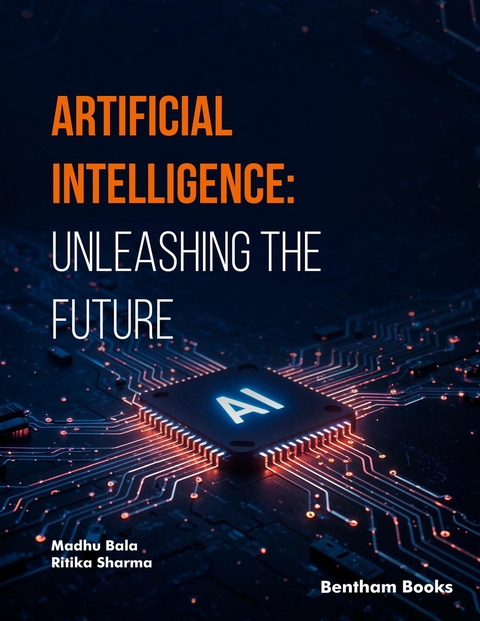
Artificial Intelligence: Unleashing the Future (eBook)
168 Seiten
Bentham Science Publishers (Verlag)
979-8-89881-051-1 (ISBN)

Artificial Intelligence: Unleashing the Future builds a robust conceptual framework on artificial intelligence and machine learning before diving into practical applications. Beginning with a historical overview and foundational techniques in machine learning and deep learning the book's chapters explore the deployment of AI in agriculture through smart irrigation, plant disease detection, and robotic farming; in cybersecurity via intelligent threat detection and defense tools; in healthcare through diagnostic AI, robotic surgery, and telemedicine; and in education by enabling personalized learning and adaptive technologies. Ethical, regulatory, and privacy concerns are also thoughtfully addressed, ensuring readers grasp both the opportunities and the complexities of AI integration. Key Features • Trace AI's evolution and emerging architectures • Apply machine learning across real-world sectors • Explore sector-specific case studies and implementations • Understand ethical, legal, and data privacy issues • Gain insights into future trends in AI deployment
The Rise of Artificial Intelligence
Madhu Bala, Ritika Sharma
Abstract
The human brain is one of the most important organs that help us think, learn new things, and remember what we have seen. With the advancements in technologies, artificial intelligence (AI) came into the picture which is nothing but the simulation of the human brain. The current chapter will throw light on the evolution, technologies, and transformative changes of AI in various sectors. Beginning with the historical background, it traces the journey of AI from its early stages to the advanced machine learning and deep learning models in the present. This knowledge is important for those who are seeking relevant skills and stay updated in a competitive environment. It is believed that a more well-informed person can engage himself in meaningful discussions, contributing to the democratic shaping of its future. Knowing the history of AI is important to have a clear understanding that where it is now and where it may go in the future.
1. Introduction
1.1. Historical Background
The human brain consists of 86 billion neurons interconnected by trillions of synapses. This network enables the human brain to perform and process vast amounts of tasks. It is an extremely powerful organ that has finite speed, memory, and ability to work 24x7 without any fatigue. However, these cognitive functions have certain limitations like limited working memory and susceptibility to mental health conditions. Due to this, AI is required to augment human intelligence and address these challenges. It involves the development of various algorithms and software that enable computer systems to perform tasks like problem-solving, experience-based learning, pattern recognition, etc that would require human intelligence. In the current scenario, AI has made significant changes in various fields [1, 2]. AI systems are useful tools in a variety of applications, from self-driving cars and virtual assistants [3] to healthcare diagnostics [4] and financial analysis, because they are built to analyse data, adapt to new information, and
complete tasks autonomously. The relationship between AI and the human brain is a fascinating subject that bridges the gap between neuroscience, computer science, and cognitive psychology. By exploring how AI mimics the human brain or neural processes, it would be easier to know the potentials of human and artificial intelligence.
Artificial intelligence is a much older technology than anyone would imagine. AI started to evolve in the early 1900s when different scientists began to ask questions like: can an artificial brain be created? The history of AI can be explained in various phases (shown in Fig. 1) which is a very interesting story to know how AI evolved from its birth to till date.
Fig. (1))Evolution of artificial intelligence.
1.1.1. Groundwork of AI (1943-50)
In 1950, Alan Turing, an English mathematician, and computer scientist gave the concept of the “Turing test”, which formed the basis for AI. John McCarthy, known as the father of AI held a workshop in 1955 at Dartmouth where he introduced the word “Artificial Intelligence” for the very first time, and from then, this word came into popular usage by the people.
1.1.2. Maturation and Birth of AI (1950-56)
AI matured during the years 1957-1979. Arthur Samuel introduced the term machine learning in 1952 during his speech that how machines can play chess better than humans whereas in 1955 Simon and Allen Newell developed the first AI-based program that was designed for the proofs of mathematical theorems. In a conference, John McCarthy introduced AI as an academic coin and also developed LISP as the first programming language for AI research in 1958.
1.1.3. Golden Age of AI (1957-79)
In 1966, a chatbot was developed that was able to converse with humans. The American Association of Artificial Intelligence (AAAI) was also founded in 1979. In the era of 1980s, the concept of deep learning came into the picture. The first neural network named ‘Neocognitron’ was developed by Kunihiko Fukushima in 1979. This network was designed using multiple pooling and convolutional layers to recognize visual patterns.
1.1.4. AI Winter (1979-1980)
The term AI winter was also introduced during these years. It refers to the tough time period when there was a decrease in funding for research and interest in the publicity of AI was also decreased. These years are also termed the ‘first AI Winter’. In 1980, AI wastrained again with the introduction of expert systems and deep learning techniques. LISP machines were getting into use commercially and a significant downturn was observed.
1.1.5. The Emergence Phase (1980-1993)
In 1985, the Bayesian network was introduced by Judea Pearls for causal analysis of statistical methods. Further, in 1989, Yan LeCun demonstrated backpropagation at Bells Lab. It was the first practical demonstration where a convolutional neural network was combined with backpropagation to read the handwritten characters. Due to high costs and not getting efficient results, the government and other investors stopped giving funds to the researchers. The time period between 1987 to 1993 was the second AI winter.
1.1.6. Intelligent Agents Phase (1993-till Present)
A significant forward leap was found in 1993 especially in the development of intelligent computer programs. AI professionals started using AI to perform specific tasks and some of the noteworthy tasks are mentioned below:
- 1990: IBM introduced ‘Deep Blue’, a computer, as an expert system to play chess under regular time control. In 1997, it won a chess game against a reigning world champion where world chess champion GARY Kasparov was defeated by Deep Blue.
- 2002: AI in the form of Roomba, which was a vacuum cleaner entered our homes.
- 2006: AI gained entry into the business world and companies like Facebook, and Twitter started using AI.
- 2009: A research paper based on the implementation of GPUs for the training of neural networks was published by Rajat Raina et al.
- 2012: “Google Now” an Android app was launched by Google to provide information to users as a prediction.
- 2018: With two expert debaters, the IBM “Project Debater” engaged in difficult debates and did very well. Meanwhile, Google introduced a new program called 'duplex', a virtual assistant which was capable of taking appointments on calls.
- 2020: A beta test on GPT-3 was performed. It was an advanced model based on deep learning techniques that could write code, poetry, and any other kind of writing task.
- 2021: Dall-E was created by OpenAI to generate captions for images depending on users' requirements.
- 2022: Key models like OpenAI’s GPT-3.5, Google’s PaLM, and DeepMind’s Gopher came into the picture. GPT 3.5 is a large model with billions of parameters that became prominent in terms of conversational AI.
- 2023: Multimodal capabilities and accessibility both are increased with the introduction of GPT-4 allowing text and image processing. Meta’s LLaMA and Google’s Gemini are other examples used for content generation, education, research, and industry-oriented solutions as well.
By the end of 2025, GPT-5 is also anticipated whereas Google is planning to launch its advanced Gemini multimodal with enhanced integration, comprehensive handling of documents, and ethical safeguards.
1.2. Key AI Technologies
The AI environment consists of many technologies as shown in Fig. (2) that enable the machines to learn and act like human beings. With the passage of time, these technologies are bringing tremendous changes in different fields making human life more easier and comfortable. It is a good fit for applications that involve identifying patterns and relationships in the data given as an input.
Fig. (2))Some key AI technologies.
For example, it can detect cancer in the human body with more accuracy and at a faster rate just by analysing the input images. In the manufacturing field, automatic robots [5] are established so well that hazardous tasks are performed by these robots thereby reducing the...
| Erscheint lt. Verlag | 20.10.2025 |
|---|---|
| Sprache | englisch |
| Themenwelt | Informatik ► Theorie / Studium ► Künstliche Intelligenz / Robotik |
| ISBN-13 | 979-8-89881-051-1 / 9798898810511 |
| Informationen gemäß Produktsicherheitsverordnung (GPSR) | |
| Haben Sie eine Frage zum Produkt? |
 EPUB (Ohne DRM)
Digital Rights Management: ohne DRM
Dieses eBook enthält kein DRM oder Kopierschutz. Eine Weitergabe an Dritte ist jedoch rechtlich nicht zulässig, weil Sie beim Kauf nur die Rechte an der persönlichen Nutzung erwerben.
Dateiformat: EPUB (Electronic Publication)
EPUB ist ein offener Standard für eBooks und eignet sich besonders zur Darstellung von Belletristik und Sachbüchern. Der Fließtext wird dynamisch an die Display- und Schriftgröße angepasst. Auch für mobile Lesegeräte ist EPUB daher gut geeignet.
Systemvoraussetzungen:
PC/Mac: Mit einem PC oder Mac können Sie dieses eBook lesen. Sie benötigen dafür die kostenlose Software Adobe Digital Editions.
eReader: Dieses eBook kann mit (fast) allen eBook-Readern gelesen werden. Mit dem amazon-Kindle ist es aber nicht kompatibel.
Smartphone/Tablet: Egal ob Apple oder Android, dieses eBook können Sie lesen. Sie benötigen dafür eine kostenlose App.
Geräteliste und zusätzliche Hinweise
Buying eBooks from abroad
For tax law reasons we can sell eBooks just within Germany and Switzerland. Regrettably we cannot fulfill eBook-orders from other countries.
aus dem Bereich