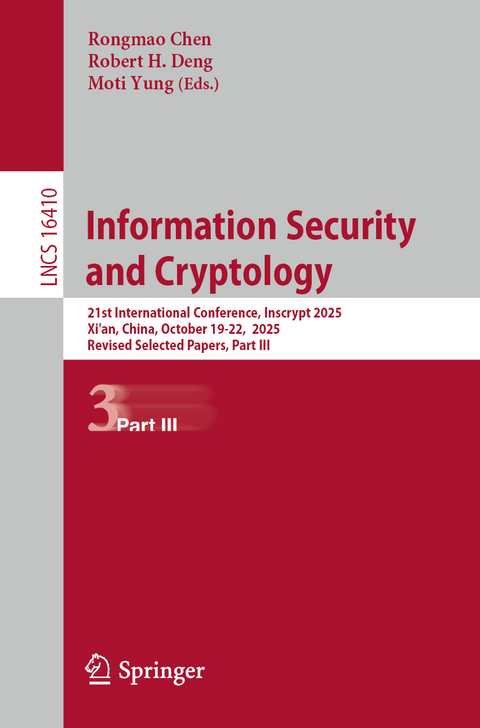
Information Security and Cryptology
Springer Verlag, Singapore
978-981-95-6208-4 (ISBN)
- Titel nicht im Sortiment
- Artikel merken
The 79 full papers presented in these proceedings were carefully reviewed and selected from 315 submissions. The papers were organized in the following topical sections:
Part I : Post-Quantum Cryptography; Functional Encryption; Cryptanalysis and Implementations I; Cryptanalysis and Implementations II.
Part II : Secure Multi-party Computation; Anomaly Detection Methodologies & Models; Network Security & Traffic Analysis.
Part III : Privacy Preserving/Enhancing Technologies; AI and Security I; AI and Security II.
.- Privacy Preserving/Enhancing Technologies.
.- Homomorphic MaxPooling via Bootstrapping for Privacy-Preserving Neural Networks.
.- PrivGGM: Private Data Synthesis Using Multivariate Gaussian Generative Models and Fuzzy Rough Sets.
.- A Framework for Efficient Enhanced Privacy ID from Group Actions.
.- Publicly Verifiable Private Information Retrieval Protocols Based on Function Secret Sharing.
.- FH-TEE: Single Enclave for all Applications.
.- Comparing and Improving Perturbation Mechanisms under Local Differential Privacy.
.- Anonymous Attribute-based Multi-keyword Searchable Encryption scheme for Medical Data Sharing using Blockchain.
.- Invisible Data Capsule: Bridging On-Chain and Off-Chain Data Collaboration.
.- AI and Security I.
.- DNNKeyLock: Securing Deep Neural Network Intellectual Property with Steganography and Token Authentication.
.- HBS Algorithmic Database Construction: A Chain-of-Thought-Driven Approach.
.- EGNNFingers: Explainability-Driven Fingerprinting Framework for GNN Ownership Verification.
.- Vertical Federated Convolutional Framework Based on Function Secret Sharing.
.- Transferable Dormant Backdoor : Covertly Embedding Transferable Backdoor via Knowledge Distillation in Pre-trained Models.
.- Detecting Stealthy Backdoor Attacks in Federated Learning via Wavelet Analysis on Dynamic Dimensions.
.- Backdoor Attacks for Geographic Information Science with Principal Component Analysis and Singular Value Decomposition.
.- AI and Security II.
.- SeqFuzz : Efficient Kernel Directed Fuzzing via Effective Component Inference.
.- LLM-DAS: An LLM-Powered Deobfuscation System for ARM Binary Code.
.- Dynamic Generation Method of SELinux Policy Based on Knowledge Graph.
.- CANalyze-AI: Semantic Zero-Day Detection and Rule Synthesis via LoRA-Fine-Tuned LLM for CAN Security.
.- FuzzyHawk: Unveiling Ransomware Behavior Patterns via Graph-Based Fuzzy Matching.
.- SC-HNM:Filtering False Negatives for Network Service Embeddings.
.- Min-Entropy Estimation for Physical Layer Key Generation: An Empirical Study.
.- Dual Modal Featuring Scheme for Learning Based Android Malware Prevention.
| Erscheint lt. Verlag | 4.2.2026 |
|---|---|
| Reihe/Serie | Lecture Notes in Computer Science |
| Zusatzinfo | XX, 474 p. |
| Verlagsort | Singapore |
| Sprache | englisch |
| Maße | 155 x 235 mm |
| Themenwelt | Informatik ► Grafik / Design ► Digitale Bildverarbeitung |
| Informatik ► Netzwerke ► Sicherheit / Firewall | |
| Informatik ► Theorie / Studium ► Kryptologie | |
| Schlagworte | Adversarial Attack • Anomaly Detection • Blockchain • Cryptanalysis • Deep learning • differential privacy • Encrypted Traffic Inspection • federated learning • functional encryption • homomorphic encryption • Large language model • lattice • privacy preserving • Private Set Intersection • secure multi-party computation • Zero-knowledge |
| ISBN-10 | 981-95-6208-2 / 9819562082 |
| ISBN-13 | 978-981-95-6208-4 / 9789819562084 |
| Zustand | Neuware |
| Informationen gemäß Produktsicherheitsverordnung (GPSR) | |
| Haben Sie eine Frage zum Produkt? |
aus dem Bereich