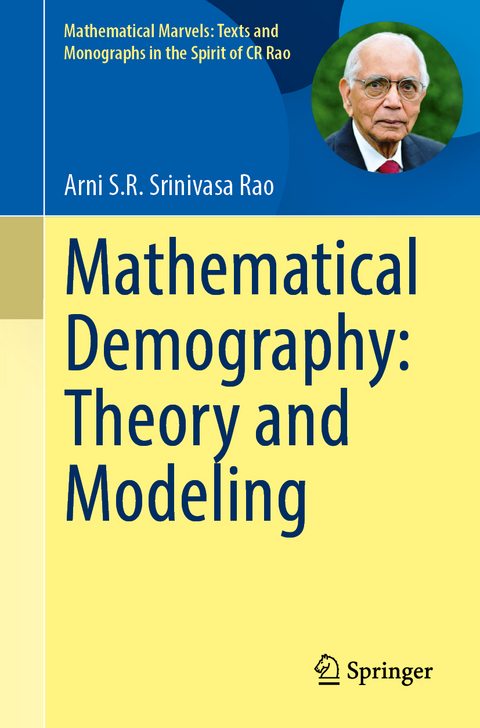
Mathematical Demography: Theory and Modeling
Springer Verlag, Singapore
978-981-95-6128-5 (ISBN)
- Titel nicht im Sortiment
- Artikel merken
This textbook offers a comprehensive understanding of theoretical and formal mathematical demography and human population dynamics. Presented in an engaging, clear and concise manner, it aims to outline traditional material and recent advancements in the field, specifically tailored for both beginners and professionals. Separate chapters discuss classical as well as recent developments in stable and stationary populations, such as Euler Lotka population equations, and life tables. Partial differential equations models of single population dynamics, McKendrick von Foerster models of population growth and Okubo s diffusion models are derived. Population ecology models like the Lotka Volterra two-population framework, Kermack McKendrick three-population models, and their stability analysis foundations are succinctly explained. Recent advancements in stationary population theories and newer population stability principles developed are included. The book also includes two chapters on stochastic process models in demography. The content of the book is not only accessible and relevant to students and researchers in mathematical demography but also to those working in actuarial science, ecology, statistics and mathematical modeling.
Arni S.R. Srinivasa Rao is a Professor at the Medical College of Georgia, Augusta University, and Director of the Laboratory for Theory and Mathematical Modeling, housed within the Division of Infectious Diseases at the Medical College of Georgia, Augusta, U.S.A. Previously, he conducted research and taught at the Mathematical Institute, University of Oxford (2003, 2005–2007), the Indian Statistical Institute, Kolkata (1998–2002, 2006–2012), the Indian Institute of Science (2002–2004), and the University of Guelph (2004–2006). Until 2012, he held a permanent faculty position at the Indian Statistical Institute, Kolkata, India. He works in artificial intelligence, pure and applied mathematics, probability, and their applications in medicine. He has received the Heiwa–Nakajima Award (Japan) and the Fast Track Young Scientists Fellowship in Mathematical Sciences (DST, New Delhi, India). Rao proved major theorems in stationary population models, including Rao’s Partition Theorem and the Rao–Carey Theorem. His mathematical modeling assisted in national policies for controlling the spread of diseases. He introduced a new class of network models for studying avian pathogen biology on grid graphs, known as “chicken walk models”. He also developed the world’s first AI model for COVID-19 identification using mobile phone apps and introduced concepts such as “Exact Deep Learning Machines” and “Multilevel Contours” within bundles of complex number planes. Rao has edited 12 volumes of the Handbook of Statistics series in collaboration with the legendary statistician Dr. C.R. Rao. He currently serves on the editorial boards of several prestigious journals and book series, including: Series Editor (2019–): Handbook of Statistics, Elsevier Editor-in-Chief (2024–): Mathematical Marvels: Texts and Monographs in the Spirit of C.R. Rao, Springer Guest Editor (2023–2024): Complex Analysis and Operator Theory, Springer Guest Editor (2025): Sankhya A and Sankhya B, Springer Editorial Board (2015–): Journal of the Indian Society for Probability and Statistics, Springer Guest Editor (2022): Journal of Mathematical Analysis and Applications (JMAA), Elsevier Editorial Board (2023–): Demography, Duke University Press
Euler-Lotka Population Integral Equations.- PDE Models in Population Dynamics.- Life Table.- Classical and Newer Measures of Population Stability.- Mathematics of Stationary Populations.- Markov Process Models in Demography.- Branching Process.- Multiple Decrement Table.
| Erscheint lt. Verlag | 11.6.2026 |
|---|---|
| Reihe/Serie | Mathematical Marvels: Texts and Monographs in the Spirit of CR Rao |
| Zusatzinfo | 16 Illustrations, black and white |
| Verlagsort | Singapore |
| Sprache | englisch |
| Maße | 155 x 235 mm |
| Themenwelt | Mathematik / Informatik ► Mathematik ► Angewandte Mathematik |
| Schlagworte | Branching Process • Euler-Lotka's equations • Kermack-McKendrick equations • Life Table • Lotka-Volterra Equations • Markov process • Mathematical Demography • Mathematical Modeling • McKendrick von Foerster equations • multiple decrement table • Partial differential equations • population dynamics • population integral equation • population stability • Rao's partition theorems • stationary population • stochastic and deterministic models |
| ISBN-10 | 981-95-6128-0 / 9819561280 |
| ISBN-13 | 978-981-95-6128-5 / 9789819561285 |
| Zustand | Neuware |
| Informationen gemäß Produktsicherheitsverordnung (GPSR) | |
| Haben Sie eine Frage zum Produkt? |
aus dem Bereich