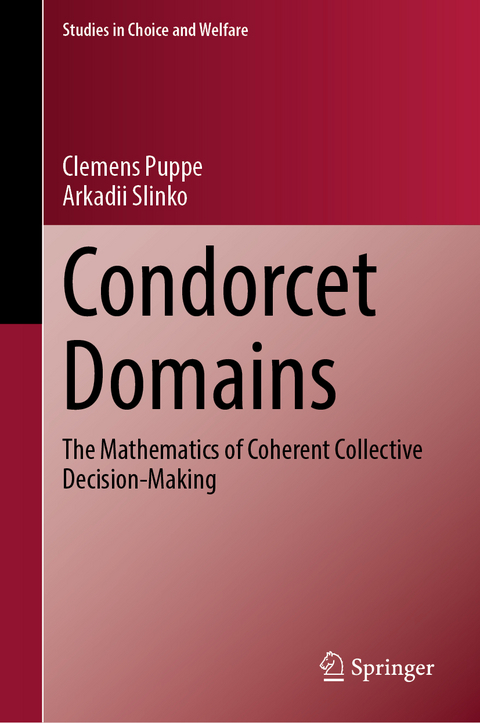
Condorcet Domains
Springer International Publishing (Verlag)
978-3-032-15115-5 (ISBN)
- Noch nicht erschienen - erscheint am 31.03.2026
- Versandkostenfrei
- Auch auf Rechnung
- Artikel merken
This book offers a comprehensive account of Condorcet domains structured sets of preference orders in which the pairwise majority relation remains transitive for any odd-numbered group of voters. These domains form the foundation for normatively robust voting procedures and enable strong possibility results in incentive-compatible mechanism design.
Well-known examples include single-peaked, single-crossing, and group-separable domains. The study of Condorcet domains bridges multiple disciplines, including economics, political science, mathematics, and computer science, and has seen significant theoretical advances in recent years.
This monograph systematically presents these developments, covering both foundational concepts and cutting-edge results. It will be of interest to economists, mathematicians, and scholars in related fields seeking a deep understanding of preference aggregation and its structural underpinnings.
This interdisciplinary book by Clemens Puppe and Arkadii Slinko offers a canonical reference on the mathematical foundations of Condorcet domains. It shows how discrete convexity, median graphs, and permutation lattices play a central role in understanding coherent collective decision-making, and applies the insights to voting systems and incentive compatibility.
Prof. Hervé Moulin, Adam Smith Business School, University of Glasgow, United Kingdom
Clemens Puppe is Professor of Economic Theory at the Karlsruhe Institute of Technology (KIT), where he also serves as co-director of the Institute of Economics. He studied Mathematics and Philosophy at Heidelberg University and the Free University of Berlin, and earned his Ph.D. from the University of Karlsruhe with a thesis on individual decision-making under uncertainty. His research focuses on microeconomic theory, particularly decision theory and social choice theory, with contributions to the measurement of freedom, diversity theory, judgment aggregation, and strategy-proof voting rules.
Prof. Puppe has held academic positions at the University of Vienna, the University of Bonn, and visiting appointments at institutions including Harvard University, the University of Auckland, and Oxford University. He is co-editor of the Handbook of Rational and Social Choice and served as managing editor of Social Choice and Welfare from 2012 to 2024.
Arkadii M. Slinko is currently Professor of Mathematics at the University of Auckland, New Zealand. Before taking this position in 1993 he was a Senior Research Fellow of the interdisciplinary Institute of Systems Analysis of Russian Academy of Sciences in Moscow. He has published extensively in a wide range of journals in mathematics, computer science, economics, and politics. His current research focuses on the mathematics of social choice, game theory, and secret sharing.
Basic concepts and results.- Single-peaked domains and generalisations.- Single-crossing domains.- Peak-pit Condorcet domains.- Domains defined by alternating schemes.- Compositions and decompositions of Condorcet domains.- Symmetric Condorcet domains.- Constructions of large Condorcet domains.- Dittrich s classification of maximal Condorcet domains on four alternatives.- Arrovian aggregation and strategy-proof social choice.- Condorcet domains of weak and partial orders.
| Erscheint lt. Verlag | 31.3.2026 |
|---|---|
| Reihe/Serie | Studies in Choice and Welfare |
| Zusatzinfo | Approx. 230 p. |
| Verlagsort | Cham |
| Sprache | englisch |
| Maße | 155 x 235 mm |
| Themenwelt | Mathematik / Informatik ► Mathematik ► Angewandte Mathematik |
| Wirtschaft ► Volkswirtschaftslehre | |
| Schlagworte | Arrovian preference aggregation • combinatorics • Condorcet domains • Maximal Domains • Mechanism Design • Median graphs • Permutohedron • Single-Crossing Domains • Single-peakedness • Social Choice Theory • Strategy-proof social choice • Transitive majority relation |
| ISBN-10 | 3-032-15115-5 / 3032151155 |
| ISBN-13 | 978-3-032-15115-5 / 9783032151155 |
| Zustand | Neuware |
| Informationen gemäß Produktsicherheitsverordnung (GPSR) | |
| Haben Sie eine Frage zum Produkt? |
aus dem Bereich