


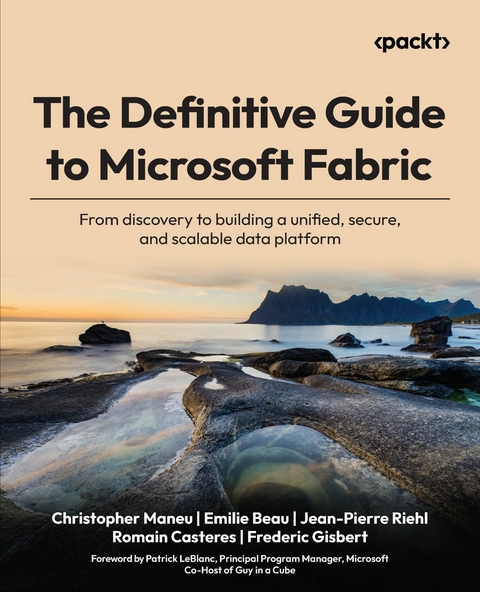
The Definitive Guide to Microsoft Fabric (eBook)
754 Seiten
Packt Publishing (Verlag)
978-1-80669-878-3 (ISBN)
Microsoft Fabric is reshaping how organizations manage, analyze, and act on data by unifying ingestion, storage, transformation, analytics, AI, and visualization in a single platform.
The Definitive Guide to Microsoft Fabric takes you from your very first workspace to building a secure, scalable, and future-proof analytics environment. You'll learn how to unify data in OneLake, design data meshes, transform and model data, implement real-time analytics, and integrate AI capabilities. The book also covers advanced topics, such as governance, security, cost optimization, and team collaboration using DevOps and DataOps principles. Drawing on the real-world expertise of five seasoned professionals who have built and advised on platforms for startups, SMEs, and Europe's largest enterprises, this book blends strategic insight with practical guidance.
By the end of this book, you'll have gained the knowledge and skills to design, deploy, and operate a Microsoft Fabric platform that delivers sustainable business value.
Preface
Computing advances in cycles, trends, and sometimes true revolutions. Some, such as the recent rise of generative AI, are immediately visible. Others are more discreet but just as profound. Such is the case with data.
From the first spreadsheets that popularized the personal computer to DNA analysis with Excel—which had to be specially modified for this use case—data has played a central role in our digital history. Today, data powers not only AI but also our daily decisions, whether it’s finding an affordable gas station or helping organizations capture sources of plastic pollution before they reach our oceans.
Microsoft Fabric positions itself as a true revolution in this field. It is the first unified data platform, covering all stages from storage to sharing in office tools. For data teams—from data engineers to business analysts—it is finally a single space to collaborate, manipulate data with various tools and languages, and present results almost anywhere. This book guides you through discovering Microsoft Fabric, its uses, and its implementation within a team, whatever your role may be.
Divided into several parts, it first guides you step by step through getting started with the service and achieving a tangible first result. The first part, covering Chapters 1 to 5, is dedicated to learning the basics of Microsoft Fabric. You will learn how to set up your environment, import and transform data, and create your first complete report. The goal is to enable you to produce a concrete result quickly while familiarizing yourself with the platform’s fundamental concepts.
The second part of the book, covering Chapters 6 to 16, is intended to deepen each stage of the data life cycle. You will discover how to manage, transform, and enrich your data in advanced ways. Chapters 12 to 16 will give you the keys to integrating Microsoft Fabric within a team or organization, with a particular focus on best practices for deployment, collaboration, and cost optimization. Thus, you will be able to implement a complete solution tailored to your company’s needs.
Microsoft Fabric evolves every month with dozens of new features. To stay informed about the latest developments, check the Fabric update blog. This book is up to date with the latest FabCon Europe announcements from September 2025, but the product is evolving rapidly, and some options or interfaces may slightly differ from what is presented here.
Fabric is an extremely vast platform. This book is one of the largest published on the topic, and despite this, we have chosen not to cover certain topics, such as developer workloads and data functions, to remain focused on the essentials for data teams.
Happy reading, and enjoy discovering Microsoft Fabric!
Who this book is for
This book is for data engineers, analytics engineers, architects, and data analysts moving into platform design roles. It’s also valuable for technical leaders seeking to unify analytics in their organizations. You’ll need only a basic grasp of databases, SQL, and Python.
What this book covers
Anchor 1, Introduction to Microsoft Fabric, explains what Microsoft Fabric is, its architecture and technological pillars, the different Fabric workloads, AI and partner experiences, and typical use cases for business roles and Power BI users.
Anchor 1, Getting Started with Fabric, covers accessing Microsoft Fabric, navigating the Fabric portal, and organizing workspaces, tenants, and domains to create your first Fabric elements.
Anchor 1, From Lakehouse to First Analysis, traces the evolution of data architectures from warehouses to lakehouses, explains foundational concepts, and shows how to apply these architectures in Fabric to reach an initial analysis.
Anchor 1, Unifying Data in OneLake, presents how to organize and govern data in OneLake, including domain-based structuring, shortcuts, schema management, the medallion approach, and governance strategies.
Anchor 1, Ingesting Data into Fabric, describes the types, modes, and methods of ingestion (batch, streaming, and hybrid), data gateways, Dataflow Gen2, pipelines, and live data integration into warehouses.
Anchor 1, Advanced Data Transformation, explores the role of transformations in the data life cycle, stages (bronze/silver/gold), low-code dataflows, SQL and Spark transformation techniques, notebook preparation, scheduling, and orchestration.
Anchor 1, Organizing Data between Data Warehouse and Data Lake, compares warehouses and lakehouses and reviews OLTP/OLAP history, decision criteria for architectures, hybrid patterns, and how Fabric supports consistent querying and security across them.
Anchor 1, Processing and Analyzing Real-Time Data, introduces real-time principles and Microsoft Fabric RTI, streaming ingestion with eventstreams, KQL and time-series persistence, Data Activator, Copilot for RTI, and integration into semantic models.
Anchor 1, Designing Semantic Models, covers the purpose and best practices for semantic models in Fabric and Power BI, including security, performance, partitioning, translation, automated deployment, and Copilot-assisted development.
Anchor 1, Business Analysis and Reporting, shows how to explore datasets and build interactive reports and dashboards with Power BI, as well as learning about automated reporting (Copilot/automatic reports), paginated reports, and enterprise reporting best practices.
Anchor 1, Using AI in Fabric, explores Fabric’s AI capabilities and tools (SynapseML, Azure OpenAI, and LLM/SLM) and how to deploy data agents and AI functions, vector databases and RAG workflows, and ML endpoints within Fabric.
Anchor 1, Collaborating as a Team, details development and consumption-focused collaboration: DevOps/DataOps practices, Git-based workflows, branching and deployment, sharing datasets and reports, permissions, and organizational apps.
Anchor 1, Architecture, examines architectural patterns for Fabric (mesh, hub-and-spoke, and medallion); tenant, capacity, and workspace design; performance and load testing; platform extension via workloads; and recovery/protection strategies.
Anchor 1, Securing Your Data Platform, presents security and governance for Fabric, secure access across endpoints, continuity and compliance practices, and integration with Microsoft Purview for extended governance.
Anchor 1, Administer Fabric, describes enabling and managing Fabric for an organization, user and license management, admin tools and interfaces (admin console, Azure portal, PowerShell, and APIs), role planning, and capacity/workspace administration.
Anchor 1, Mastering and Optimizing Platform Costs, explains how Fabric resource usage drives costs, monitoring and analyzing compute units (CUs), controlling cluster behavior and storage costs, regional/network implications, and cost-optimization tools and reservations.
To get the most out of this book
- Basic data concepts: Having an understanding of databases, tables, and business intelligence fundamentals will be helpful.
- No programming required: Some knowledge about SQL, Python, or DAX will enhance the understanding of certain chapters but isn’t mandatory.
- Professional Microsoft account: Personal accounts (outlook.com, Gmail) won’t work, and you will need organizational access to log in to the Fabric portal.
- Follow Part 1 sequentially: Chapters 1–5 will serve as the foundation, and we recommend reading these chapters sequentially. You can then explore Part 2 based on your role.
- Practice hands-on: Set up your environment early and follow the code examples on GitHub/fabricbook.net.
- Stay current: Check Microsoft’s blog for the latest features beyond this book’s October 2025 baseline.
Download the example code files
All of the source code examples presented in this book are available on GitHub at https://github.com/PacktPublishing/The-Definitive-Guide-to-Microsoft-Fabric as well as at https://fabricbook.net, so you can easily consult and adapt them to your projects. You will also find links to all the resources we mention throughout the chapters. We also have other code bundles from our rich catalog of books and videos available at https://github.com/PacktPublishing. Check them out!
Download the color images
We also provide a PDF file that has color images of the screenshots/diagrams used in this book. You can download it here: https://packt.link/gbp/9781806698790
Conventions used
There are a number of text conventions used throughout this book.
CodeInText: Indicates code words in text, database table names, folder names, filenames, file extensions, pathnames, dummy URLs, user input, and Twitter/X handles. For example: “Execute the fab command.”
A block of code is set as follows:
-- Saving active customers into a Delta table CREATE...| Erscheint lt. Verlag | 21.11.2025 |
|---|---|
| Vorwort | Patrick LeBlanc |
| Sprache | englisch |
| Themenwelt | Mathematik / Informatik ► Informatik ► Datenbanken |
| Mathematik / Informatik ► Informatik ► Web / Internet | |
| ISBN-10 | 1-80669-878-1 / 1806698781 |
| ISBN-13 | 978-1-80669-878-3 / 9781806698783 |
| Informationen gemäß Produktsicherheitsverordnung (GPSR) | |
| Haben Sie eine Frage zum Produkt? |
 EPUB (Ohne DRM)
Digital Rights Management: ohne DRM
Dieses eBook enthält kein DRM oder Kopierschutz. Eine Weitergabe an Dritte ist jedoch rechtlich nicht zulässig, weil Sie beim Kauf nur die Rechte an der persönlichen Nutzung erwerben.
Dateiformat: EPUB (Electronic Publication)
EPUB ist ein offener Standard für eBooks und eignet sich besonders zur Darstellung von Belletristik und Sachbüchern. Der Fließtext wird dynamisch an die Display- und Schriftgröße angepasst. Auch für mobile Lesegeräte ist EPUB daher gut geeignet.
Systemvoraussetzungen:
PC/Mac: Mit einem PC oder Mac können Sie dieses eBook lesen. Sie benötigen dafür die kostenlose Software Adobe Digital Editions.
eReader: Dieses eBook kann mit (fast) allen eBook-Readern gelesen werden. Mit dem amazon-Kindle ist es aber nicht kompatibel.
Smartphone/Tablet: Egal ob Apple oder Android, dieses eBook können Sie lesen. Sie benötigen dafür eine kostenlose App.
Geräteliste und zusätzliche Hinweise
Buying eBooks from abroad
For tax law reasons we can sell eBooks just within Germany and Switzerland. Regrettably we cannot fulfill eBook-orders from other countries.
aus dem Bereich


