


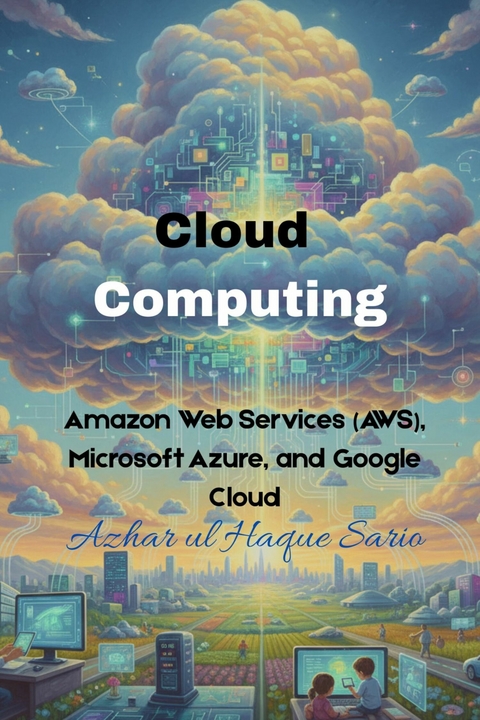
Cloud Computing (eBook)
198 Seiten
Azhar Sario Hungary (Verlag)
978-3-384-75689-3 (ISBN)
Dive into the World of Cloud Computing with This Comprehensive Guide!
This book explores cloud computing basics. It starts with foundational principles. You'll learn about distributed systems. It covers datacenter design and virtualization. The text explains the NIST framework. It details service models like IaaS, PaaS, and SaaS. Deployment options include public, private, and hybrid clouds. Chapters dive into AWS, Azure, and Google Cloud origins. Real-world case studies feature Netflix on AWS. Job skills sections prepare you for roles like cloud architect. It discusses hyperscale datacenters. You'll compare global infrastructures of the big three. The book analyzes hypervisors: Type 1 vs. Type 2. Containerization contrasts with VMs. Multi-cloud strategies are examined. Distributed systems principles include CAP Theorem. Consistency models range from strong to eventual. Consensus algorithms like Paxos and Raft are covered. Communication models discuss RPC and messaging. Core IaaS compute services are detailed. VM instance types and families are compared. Auto-scaling and load balancing are explained. Pricing models focus on cost optimization. Storage services include object, block, and file types. Networking covers VPCs, subnets, and security groups. Databases span relational, NoSQL, and NewSQL. Migration tools are highlighted. Container orchestration with Kubernetes is included. Serverless computing features Lambda, Functions, and Cloud Run. Data analytics tools like EMR, HDInsight, and DataProc are compared. Machine learning platforms such as SageMaker, Azure ML, and Vertex AI are analyzed. Security topics include shared responsibility and IAM. Governance, compliance, and FinOps are addressed. Future trends in cloud tech wrap it up.
What sets this book apart is its blend of academic depth and 2025 real-time applications, something many other guides skim over. Unlike generic overviews that ignore provider nuances, this one offers side-by-side comparisons of AWS, Azure, and GCP services, with hands-on labs and case studies like Capital One's multi-cloud approach. It bridges theory-like CAP Theorem-with practical job training, filling gaps in outdated texts that don't cover emerging trends like AIOps or confidential computing. Readers get competitive edges through skills like workload rightsizing and least-privilege IAM, plus FinOps strategies for cost savings-areas where competitors fall short by being too high-level or vendor-biased.
This author has no affiliation with the brands mentioned and this is independently produced under nominative fair use.
Part 1: Foundational Principles and Core Technologies
The Cloud Computing Paradigm (2025)
1.1 Academic and Historical Context: From Grids to Hyperscale
The concept of cloud computing, which feels so modern, is actually the result of a long and fascinating academic journey. It's the commercial-scale perfection of ideas that have been discussed in computer science departments for over fifty years.
Think of it as an evolutionary ladder. We started with basic client-server models, where one central server delivered information to many "dumb" clients. This was simple, but not powerful. The next major step was distributed computing. This was the academic realization that you could link multiple, independent computers to collaborate on a single, massive task. Imagine a complex scientific problem, like mapping a genome, being broken into a thousand small pieces and solved by a thousand different PCs.
This idea was formalized into grid computing. Grid computing aimed to create a virtual supercomputer by pooling together diverse, scattered (heterogeneous) resources. A university's computer lab, a research facility's servers, and even desktop PCs could all be joined into one logical "grid."
The final, and most critical, piece of the puzzle wasn't technical—it was economic. This was the concept of utility computing. What if computational power could be sold just like electricity? You plug your appliance into the wall, and you get power. You don't know or care which power plant generated it; you just trust that it will be there, and you pay for exactly what you use. Cloud computing, as we know it today, was born when the technical power of grid computing merged with the business model of utility computing.
The "Big Three" cloud providers (AWS, Microsoft Azure, and Google Cloud) are a perfect reflection of this history, as their origins defined their strategies.
Amazon Web Services (AWS) was born from a very real, very painful internal problem: scaling Amazon.com. In the early 2000s, Amazon's e-commerce platform was growing so fast that its internal infrastructure couldn't keep up. They built a massively scalable, API-driven internal service platform to solve their own problem. Then, they had a breakthrough realization: if they needed this, everyone else did too. In 2006, they launched AWS, commercializing their excess capacity. This is why AWS has always felt "bottom-up"—it was built by developers, for developers, with a laser focus on infrastructure (like servers and storage) first.
Microsoft Azure came from a completely different place. Microsoft dominated the enterprise software and developer tool market. Their origin story wasn't about e-commerce; it was about protecting their enterprise kingdom. Azure (originally "Windows Azure") launched in 2010 as a Platform-as-a-Service (PaaS). The goal was to give their millions of existing developers a place to run their .NET applications in the cloud. They only built out their "infrastructure" (IaaS) services later to compete directly with AWS. Their vector for adoption was always top-down: they sold to the CIOs and IT departments who already trusted and ran on Microsoft software.
Google Cloud (GCP) was the last to market, and its origin is perhaps the most advanced. For years, Google had been running planet-scale services like Search, Gmail, and YouTube. To do this, they had to invent technology that was a decade ahead of its time. This included the Borg orchestration system (which became the open-source Kubernetes) and the Spanner global database. GCP was Google's effort to commercialize this incredible internal technology. This gave them a highly advanced, powerful offering, but it also meant they spent years playing catch-up in the market.
The ultimate proof of the utility vision is the Netflix-AWS symbiosis. In 2008, a database corruption event crippled Netflix, which was still shipping DVDs. That crisis forced a radical decision: they would go "all-in" on the public cloud, shutting down their own data centers. Their driver wasn't just cost; it was elasticity and resilience. On AWS, Netflix could deploy thousands of servers in minutes to handle the Friday night streaming rush and then turn them off on Saturday morning. Today, the entire global Netflix service runs on AWS, a testament to the utility model handling unpredictable, massive-scale traffic flawlessly.
1.2 The NIST Framework: Five Essential Characteristics
To have a truly professional discussion about cloud computing, we must use a shared language. For years, the term "cloud" was a vague marketing buzzword. It was applied to everything from a simple web-hosting service to a complex corporate network. The industry desperately needed a formal, rigorous definition.
In 2011, the U.S. National Institute of Standards and Technology (NIST) provided exactly that in its Special Publication 800-145. This document is arguably the most important paper in the history of cloud computing. It's not a product or a vendor's whitepaper; it's a conceptual model that defines the "what," not the "how." It serves as the lingua franca for technologists, business leaders, and legal/compliance analysts.
According to NIST, a service can only be called "cloud computing" if it exhibits five essential characteristics.
On-demand self-service. This is the "I want it now" characteristic. A consumer (like a developer) can get computing resources—like a virtual server or more storage—without any human friction. You don't need to file a support ticket, wait for a procurement officer, or have a technician rack a server. You just open a web portal (like the AWS Management Console or Azure Portal), click a few buttons, and the resource is yours in seconds. This is the characteristic that enables speed and agility.
Broad network access. This means the cloud capabilities are available over the network (the internet) and can be accessed by any standard device—a laptop, a mobile phone, a tablet, or an API. This is the characteristic that enables mobility. It untethers your services from a specific physical location or private network, making them globally accessible.
Resource pooling. This is the engine of the cloud's economic model. The provider's resources (like processing power, memory, and storage) are "pooled" together to serve many different customers at once, a system known as multi-tenancy. You are sharing the same physical hardware with other "tenants," though you are logically and securely isolated from them. This is what creates the massive economies of scale. It's like a giant apartment building—it's far cheaper for 100 people to share one building than for each to build their own private house.
Rapid elasticity. This is the "breathing" characteristic. To the consumer, the cloud appears to have unlimited resources. You can scale your services out (add more servers) to handle a massive spike in traffic, and then scale in (remove those servers) when the traffic dies down. This can often be done automatically. This is the feature that allowed Netflix to conquer global streaming. It's the ultimate defense against both failure (too much traffic) and waste (paying for servers you aren't using).
Measured service. This is the "utility" model in action. You pay for what you use. Cloud systems automatically meter your usage of every service—server time by the second, storage by the gigabyte, data transfer by the petabyte. This usage is monitored, controlled, and reported back to you, usually on a billing dashboard like AWS Cost Explorer. This provides complete transparency and shifts the financial model from large, upfront capital expenses (Capex) to a pay-as-you-go operational expense (Opex).
These five characteristics are not just academic. They form the technical and legal basis for procurement. For example, for the U.S. Federal Government to use a service, the provider (like AWS GovCloud or Azure Government) must be audited and proven to adhere to this NIST definition as part of the FedRAMP authorization process.
1.3 Core Service Models: IaaS, PaaS, SaaS
The NIST framework doesn't just define what a cloud is; it also defines the three primary ways it can be delivered. These three service models—IaaS, PaaS, and SaaS—are all about abstraction. They answer the question: "How much of the technical stack do you want to manage, and how much do you want the provider to manage for you?"
This is most famously explained with the "Pizza as a Service" analogy:
On-Premises (The old way): You make a pizza completely from scratch. You have to buy the oven, buy the ingredients, make the dough, assemble the pizza, and bake it. You are responsible for everything.
Infrastructure-as-a-Service (IaaS): This is like renting a kitchen. The provider gives you the foundational "infrastructure"—the oven, the stovetop, the electricity. But you are still responsible for bringing your own ingredients (data), making the dough (operating system), and assembling/baking the pizza (your application). IaaS offers you the most flexibility and control. Flagship examples include AWS EC2, Azure Virtual Machines, and Google Compute Engine. You choose the OS, the patches, and all the networking, but you don't have to manage the physical data center.
Platform-as-a-Service (PaaS): This is like ordering pizza for delivery. The provider manages...
| Erscheint lt. Verlag | 17.11.2025 |
|---|---|
| Sprache | englisch |
| Themenwelt | Mathematik / Informatik ► Informatik ► Datenbanken |
| Schlagworte | AWS • Cloud Computing • Distributed Systems • Google Cloud • IaaS • Kubernetes • Microsoft Azure |
| ISBN-10 | 3-384-75689-4 / 3384756894 |
| ISBN-13 | 978-3-384-75689-3 / 9783384756893 |
| Informationen gemäß Produktsicherheitsverordnung (GPSR) | |
| Haben Sie eine Frage zum Produkt? |
 EPUB (Ohne DRM)
Digital Rights Management: ohne DRM
Dieses eBook enthält kein DRM oder Kopierschutz. Eine Weitergabe an Dritte ist jedoch rechtlich nicht zulässig, weil Sie beim Kauf nur die Rechte an der persönlichen Nutzung erwerben.
Dateiformat: EPUB (Electronic Publication)
EPUB ist ein offener Standard für eBooks und eignet sich besonders zur Darstellung von Belletristik und Sachbüchern. Der Fließtext wird dynamisch an die Display- und Schriftgröße angepasst. Auch für mobile Lesegeräte ist EPUB daher gut geeignet.
Systemvoraussetzungen:
PC/Mac: Mit einem PC oder Mac können Sie dieses eBook lesen. Sie benötigen dafür die kostenlose Software Adobe Digital Editions.
eReader: Dieses eBook kann mit (fast) allen eBook-Readern gelesen werden. Mit dem amazon-Kindle ist es aber nicht kompatibel.
Smartphone/Tablet: Egal ob Apple oder Android, dieses eBook können Sie lesen. Sie benötigen dafür eine kostenlose App.
Geräteliste und zusätzliche Hinweise
Buying eBooks from abroad
For tax law reasons we can sell eBooks just within Germany and Switzerland. Regrettably we cannot fulfill eBook-orders from other countries.
aus dem Bereich


